Pigment Red 57:1 for Printing Inks: How to Plan a Binder and Dispersion Trial
Published
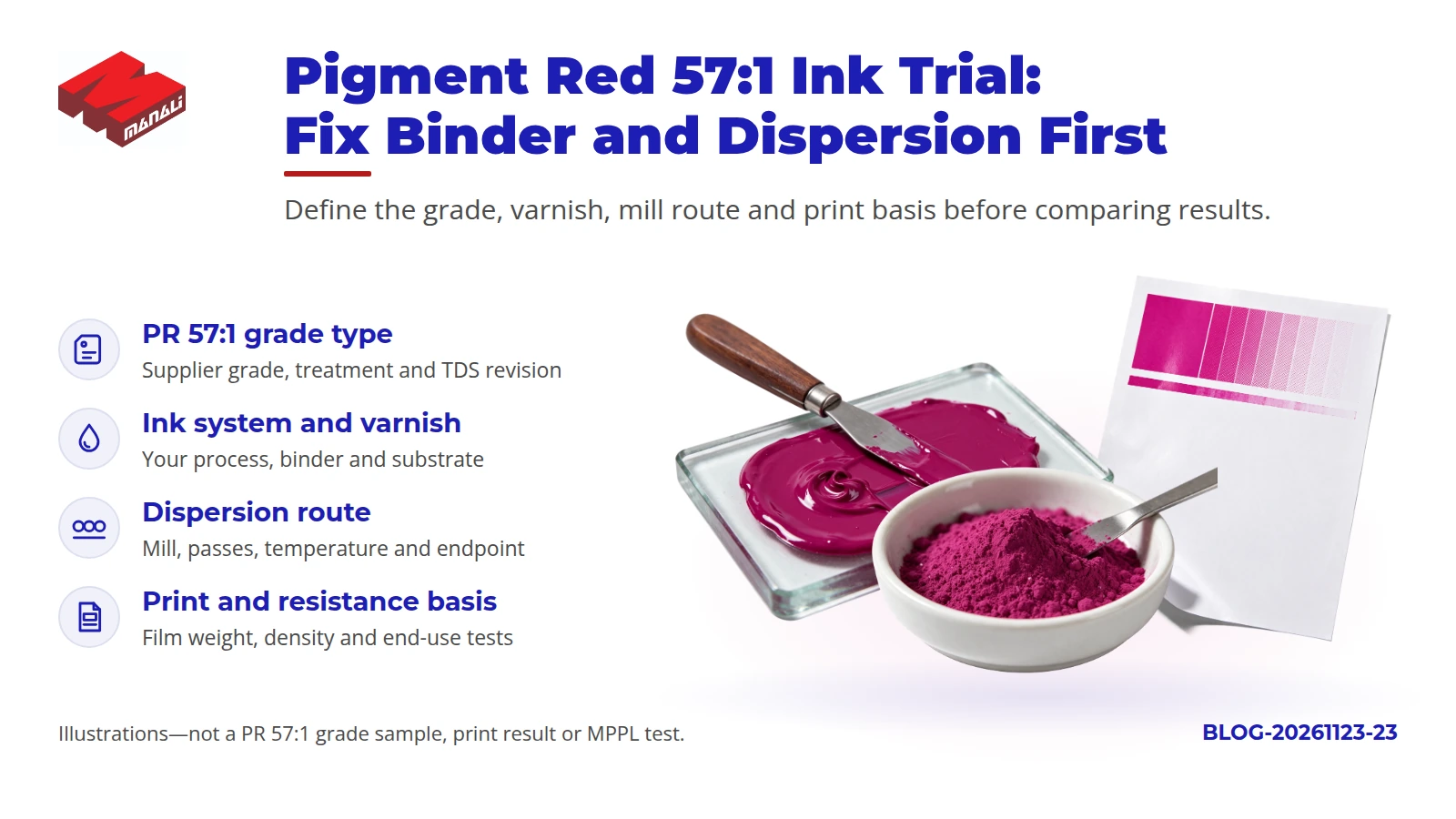
To plan a Pigment Red 57:1 (PR 57:1) ink trial, set the test conditions before you compare any grade. Fix six things in this order:
- The exact grade and its surface treatment.
- The printing process and the varnish or binder.
- The dispersion route and its endpoint.
- The test-print method, and whether you compare at equal film weight or equal density.
- The rheology and water-pickup checks.
- The resistance tests the end use needs, and the acceptance rule.
PR 57:1 is a Colour Index name, not a single product. A result only means something for the grade, the vehicle and the conditions behind it. If every candidate goes through the same varnish, mill and print, a supplier comparison gives you evidence you can act on.
Why “Pigment Red 57:1” alone does not define the trial material
PR 57:1 is the standard magenta in many offset process ink sets. A 2026 crystallography study notes that in Europe, China and many other countries it is preferred over Pigment Red 52:1 for standard magenta because of its better photostability [2]. Because it is so widely used, ink makers compare it often. Because it is so familiar, it is easy to forget how many different commercial grades share the name.
One calcium lake, more than one hydrate phase
PR 57:1 is C.I. Pigment Red 57:1, Colour Index constitution number 15850:1, CAS 5281-04-9. It is a calcium-laked monoazo pigment built on 3-hydroxy-2-naphthoic acid (BONA), with the molecular formula C18H12CaN2O6S [3]. The calcium ion and the sulfonate and carboxylate groups make it a “laked” pigment. That family behaves differently from neutral azo pigments in water, alkali and polar vehicles.
The solid state adds another variable. Crystal-structure work has identified three hydration states:
- a carmine-red trihydrate;
- a magenta monohydrate;
- a dull dark-magenta anhydrate [1].
The 2026 study explains that the monohydrate is the commercially produced phase. The hygroscopic anhydrate converts to the monohydrate when stored in air. The carmine-red trihydrate can form instead if the press cake is not dried enough or if the pigment is stored under very humid conditions [2]. The study also notes that the properties of a print depend on both crystal structure and particle size [2].
So two samples labelled PR 57:1 can differ in shade for reasons that have nothing to do with your ink. They may be different grades, or they may have been stored differently. Rule out both before blaming a shade difference on the varnish or the mill. For a refresher on how Colour Index names work in purchasing, see the Colour Index reference and the guide to pigment Colour Index names and numbers.
Grade types are a supplier’s design choice
Suppliers sell PR 57:1 in grades designed for different ink processes. One manufacturer describes one PR 57:1 grade as high in tinting strength, gloss and transparency, with excellent flow. It recommends that grade for water-based flexo inks and says it is also suitable for offset and nitrocellulose (NC) inks [5]. It describes a second grade as highly transparent, glossy, low in viscosity and solvent resistant. That one is recommended for solvent-based gravure and for polyamide, chlorinated polypropylene, NC, polyurethane and UV inks [6]. The two pages also list different specific surface areas.
Those values belong to that supplier, but the pattern is general: one CI name is engineered into products for different vehicles. Grade codes and type names are not standardised across manufacturers, so “transparent” or “easy dispersing” may not mean the same thing on two lists. The trial request should name:
- the supplier and the grade designation;
- the stated surface treatment and the product form;
- the technical data sheet (TDS) revision the sample was matched to.
Write the ink system down before requesting a sample
Most disagreements about PR 57:1 performance are really disagreements about the ink system. Strength, gloss, flow, water behaviour and resistance are properties of the pigment in a particular vehicle, printed by a particular process on a particular substrate. Change one of those and the ranking of grades can change.
Write a short trial brief before the sample arrives. It should cover:
- the printing process and press type;
- the varnish or binder, the solvent or oil, and the main additives;
- the substrate, and any overprint varnish or lamination;
- the shade standard and the strength target.
That brief becomes the reference every result is attached to. The Pigments for Printing Inks pillar explains how pigment selection differs across ink families. This article stays with one question: how to structure the PR 57:1 binder and dispersion evaluation.
Paste inks: sheet-fed, heat-set and cold-set offset
Offset and letterpress inks are paste inks. They are typically built from:
- rosin-modified phenolic or hydrocarbon resins;
- alkyds and vegetable oils;
- aliphatic or aromatic distillates;
- driers, waxes and other additives.
A patent on rosin-treated monoazo lakes describes an offset vehicle of this kind [4]. Sheet-fed, heat-set web and cold-set news inks set and dry differently, so different properties dominate for each. Offset inks must also work with dampening solution on the press. That makes water behaviour part of the pigment evaluation, and it is one reason a grade that excels in one offset varnish can behave differently in another.
Liquid inks: solvent gravure, flexo and water-based systems
Gravure and flexographic inks are liquid inks. Solvent-based packaging inks often use NC, polyurethane or polyamide binders, and supplier recommendations show that PR 57:1 grades are often aimed at named binder families [6]. Water-based flexo inks typically use acrylic or other water-reducible binders, together with amines, surfactants and defoamers. Each of these changes how the pigment surface is wetted and stabilised.
If the trial covers more than one ink family, treat each family as a separate trial. Where an existing liquid ink already settles, flocculates or loses strength, the article on pigment dispersions in flexographic inks covers how to diagnose those failures.
Choose the varnish or binder you will actually produce with
Laboratories often keep a convenient standard varnish for pigment screening. That is useful for a first ranking. It does not show how a grade behaves in the varnish you actually buy, at the solids, acid value and viscosity your production ink runs at.
Surface treatment and varnish must be judged together
Monoazo lake pigments are often rosin-treated. The patent literature explains why. Forming the lake in the presence of rosin limits crystal growth, which gives a more transparent, cleaner shade. The rosin also reduces aggregation when the pigment dries, so the powder disperses more easily [4]. The same patent records the trade-off. In lithographic offset inks, rosin treatment is considered one of the causes of reduced printability, particularly troubles related to water resistance [4].
That trade-off is the core of a binder and dispersion trial. A heavily treated grade may disperse faster and look more transparent in one varnish, yet interact differently with dampening solution or a more polar binder. A lightly treated grade may need more milling. Neither is better in general. The trial has to show which balance suits your ink.
Keep the comparison inside one vehicle
Prepare every candidate in the same lot of varnish or binder, at the same pigment loading and with the same additives. If a supplier recommends a formula adjustment for its grade, run it as a second, clearly labelled arm of the trial. Do not mix it into the like-for-like comparison. A grade that needs extra dispersant or a different solvent balance to perform has produced a real finding about formulation cost and robustness. Record it.
Fix the dispersion route and the endpoint
Dispersion decides how much of a grade’s colour, gloss and transparency you actually see. An under-dispersed sample can look weaker, dirtier and less transparent than a well-dispersed sample of the same grade.
Premix, mill and work input
For paste inks, record:
- the premix method and time;
- the three-roll or bead mill, and the roll gap or pressure;
- the temperature;
- the number of passes and the order in which components are added.
For liquid inks, record:
- the premix;
- the bead mill, and the media type, size and fill level;
- the mill speed;
- the residence time or passes;
- the mill-base temperature.
Use the same route for every candidate, then count the work needed to reach the agreed endpoint. The rosin-treatment patent compared pigments this way. In a three-roll-mill offset ink, coarse particles disappeared after two passes for one pigment and after three for the comparison pigment [4]. Passes or minutes to endpoint measure processing cost directly, so record them alongside the colour results.
A grind gauge is an endpoint check, not a particle-size test
The NPIRI grindometer is the usual quick check for ink dispersions. ASTM D1316-20 describes it as a way of examining the largest particles in a finished ink dispersion. It does not measure average particle size or particle-size distribution [7]. Use it to confirm that each candidate reached the same endpoint, not to rank grades for strength, transparency or shade.
Agree the endpoint, the gauge and how it is read in writing before milling starts. If a grade cannot reach the endpoint on the agreed route, record that as the result. Do not change the route for that grade alone.
Record temperature and hold time
Milling generates heat, and heat changes vehicle viscosity during processing. Record the mill-base and finished-ink temperatures and the hold time before testing. Then test every candidate after the same rest period. An ink tested straight off the mill and another tested the next day are not a fair pair.
Compare strength and shade on controlled test prints
Hand drawdowns are useful for a first look. A trial decision needs test prints made with a defined method, a defined substrate and a defined film weight.
Use a defined test-print method
ISO 2834-1:2020 sets out how to prepare laboratory test prints of paste inks on paper, board, metal, foil and other substrates. It uses IGT-type and Prüfbau-type printability testers and describes how to work to a reference optical density and a reference ink film thickness [8]. ISO 2834-2:2022 covers liquid flexographic and gravure inks, whether water-based, solvent-based or radiation-curing [9]. Use the part that matches your process, and print every candidate on the same substrate lot.
Equal film weight and equal density answer different questions
These two comparisons answer different questions:
- Equal ink film weight shows how much colour each grade delivers per gram of ink. This is the cost question, because a weaker grade needs more pigment or a heavier film.
- Equal optical density shows how the shades differ once both inks reach the same strength. This covers hue, cleanliness, transparency and gloss at your printing target.
Record which comparison each result comes from. A grade can be stronger at equal film weight and still be dirtier at equal density. A shade difference seen at unequal film weights may simply be a film-weight difference.
State the measurement condition and the reference
ISO 13655:2017 specifies how spectral measurements and colorimetric calculations are made for graphic arts, including offset, flexo, gravure, screen and digital printing [10]. Agree the following before you measure:
- the measurement condition and the backing;
- the illuminant and observer;
- the instrument;
- the colour-difference formula and the tolerance.
Measure against a retained reference: the current production grade or an agreed standard print, stored in the dark. A ΔE value means nothing unless both parties know what it was calculated against.
The process magenta target is colorimetric
For a process magenta, the target is defined by colour, not by pigment. ISO 2846-1:2017 sets colour and transparency characteristics for each ink in an offset process set. It covers sheet-fed, heat-set web and radiation-curing inks, printed on a laboratory printability tester and a defined substrate. It explicitly does not specify pigments [11]. A PR 57:1 grade therefore has to earn conformance in your formulation, and the CI name does not bring it automatically. Include transparency in the comparison, because the magenta must overprint cleanly with cyan and yellow.
Check rheology and, for offset, water pickup
A PR 57:1 grade can change the flow of an ink as much as its colour. Different surface treatments and surface areas interact differently with the vehicle. The difference can show up as a change in tack, viscosity, yield value or flow after standing.
Tack and viscosity under stated conditions
ISO 12634:2017 specifies how to determine the tack of paste inks and vehicles with a rotary tackmeter. It covers inks of low volatility that do not react during the test, on Inkometer/Inkomat-type and TackOscope/TackTester-type instruments [12]. A tack value depends on the instrument, the speed, the temperature and when the reading is taken. Record all four, and compare grades only under the same settings. Measure paste viscosity and yield value by a stated method at a controlled temperature. Measure liquid-ink viscosity by your production method, and repeat it after the agreed storage period.
Water pickup is a lab comparison, not a press prediction
For offset inks, include a water-pickup test. ASTM D4942-20 covers water pickup of lithographic inks and vehicles in a laboratory mixer [13]. Its limits matter:
- Results are comparable only at the same temperature and with the same type and quantity of liquid.
- Laboratory emulsions are coarser than those formed on press, so the results do not by themselves predict printing performance.
- The standard describes the test as useful for supplier–customer acceptance [13].
That suits a PR 57:1 trial. Use the same fountain solution, ratio and temperature for every candidate, and look for differences from the reference ink rather than an absolute pass value. Rosin treatment can contribute to water-resistance troubles in offset inks [4]. So a grade change in a litho ink is not complete until water behaviour has been compared.
Test print resistance against the real end use
Resistance requirements come from the printed product, not from the pigment. ISO 2836:2021 specifies methods for assessing the resistance of prints to liquid and solid agents, solvents, varnishes and acids. It covers all substrates and print processes, including offset, screen, gravure, flexo, inkjet and electrophotography. Food-contact safety is outside its scope [14].
Choose the test agents from the end use:
- the overprint varnish or coating the print will receive;
- the solvent or adhesive used for lamination;
- alkali and soap where the packed product calls for them.
These checks matter for PR 57:1, because laked pigments can respond to alkali, acid and soap differently from neutral pigments, depending on the grade, the treatment and the ink film. For each agent, record both the change in the print and any staining of the contact material. Use the same rating method and the same print density for every candidate. Supplier fastness and resistance ratings are tied to a stated ink type, print strength and method. Treat them as screening information, and test the prints you will actually produce.
Control moisture and storage of powder and ink samples
PR 57:1 hue is linked to its hydrate phase, so moisture and storage belong in the trial plan [1] [2]:
- Keep powder samples closed, and record when each container was opened.
- Store all candidates and the retained reference under the same conditions.
- Do not dry, heat or condition one sample differently from another.
- If an old opened sample prints redder or duller than expected, test a fresh sealed sample before judging the grade.
Store the trial inks closed at a recorded temperature, and test them at the same age. If the plan includes a storage check, set the period and conditions in advance for every candidate.
Request the right documents with the sample
A controlled trial needs a controlled sample. Ask for three documents with every PR 57:1 candidate:
- The technical data sheet (TDS) gives the grade identity, any stated surface treatment and the recommended ink systems. It should also state the ink type, print strength and methods behind any fastness or strength data.
- The safety data sheet (SDS) gives hazard, handling, storage and disposal information.
- A certificate of analysis (COA) or lot-quality record links the sample to an identified production lot.
Ask whether the sample comes from a production lot, and keep a retained portion for later comparison with delivery lots. Ask which regulatory or market statements apply to the exact grade, ink type and destination market, and get them in writing. Do not infer compliance from the CI name or from another supplier’s grade. To see how Manali Pigments approaches documentation, review the Quality & Compliance page.
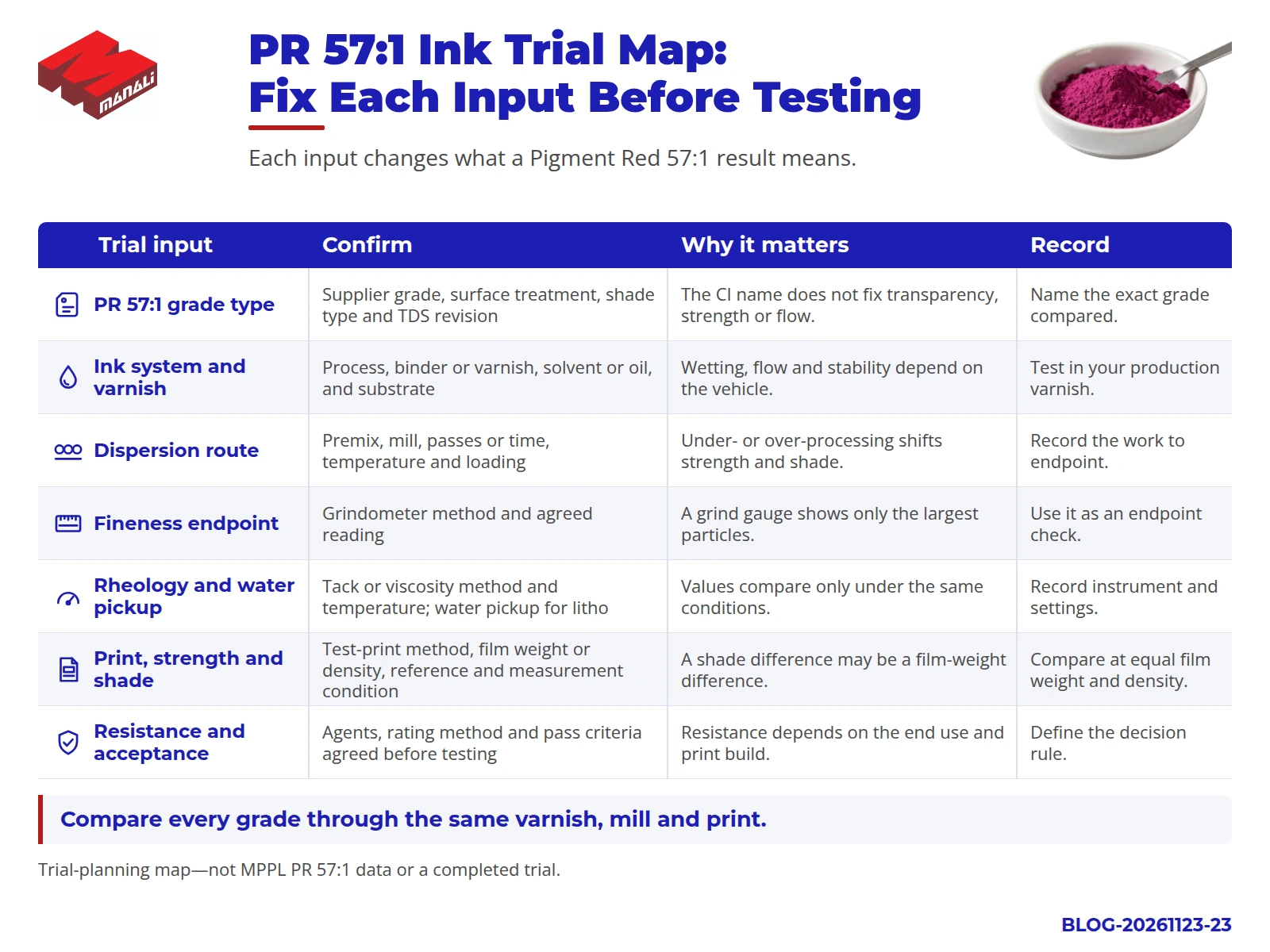
Pigment Red 57:1 ink trial map and decision logic
Use the map below as the trial brief, and complete every row before the first candidate is milled.
| Trial input | Confirm | Why it matters | Record |
|---|---|---|---|
| PR 57:1 grade type | Supplier grade, surface treatment, shade type and TDS revision | The CI name does not fix transparency, strength or flow. | Name the exact grade compared. |
| Ink system and varnish | Process, binder or varnish, solvent or oil, and substrate | Wetting, flow and stability depend on the vehicle. | Test in your production varnish. |
| Dispersion route | Premix, mill, passes or time, temperature and loading | Under- or over-processing shifts strength and shade. | Record the work to endpoint. |
| Fineness endpoint | Grindometer method and agreed reading | A grind gauge shows only the largest particles. | Use it as an endpoint check. |
| Rheology and water pickup | Tack or viscosity method and temperature; water pickup for litho | Values compare only under the same conditions. | Record instrument and settings. |
| Print, strength and shade | Test-print method, film weight or density, reference and measurement condition | A shade difference may be a film-weight difference. | Compare at equal film weight and density. |
| Resistance and acceptance | Agents, rating method and pass criteria agreed before testing | Resistance depends on the end use and print build. | Define the decision rule. |
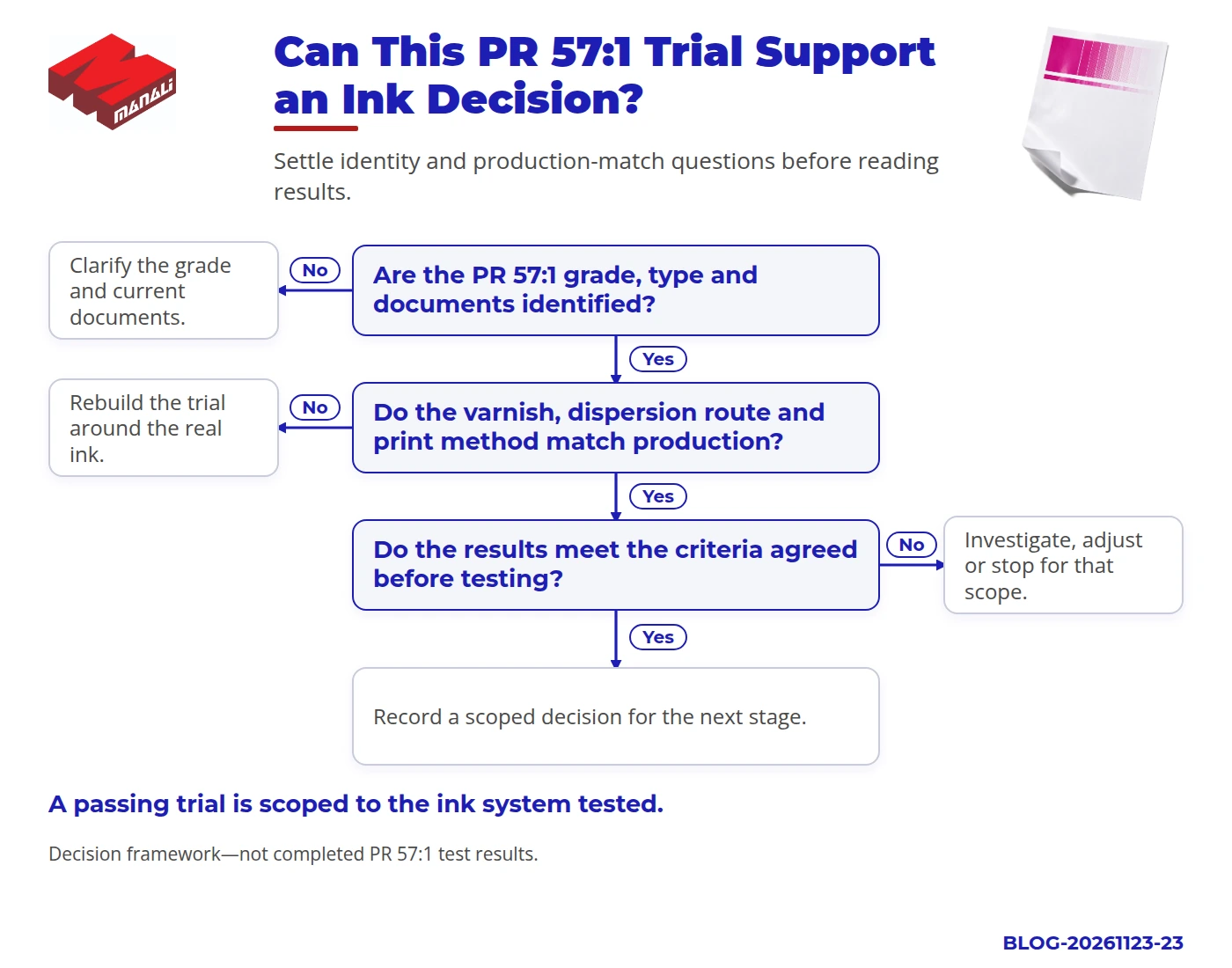
Then use three questions to keep the decision bounded:
- Are the PR 57:1 grade, type and documents identified?
No → Clarify the grade and current documents.
Yes → Proceed to question 2. - Do the varnish, dispersion route and print method match production?
No → Rebuild the trial around the real ink.
Yes → Proceed to question 3. - Do the results meet the criteria agreed before testing?
No → Investigate, adjust or stop for that scope.
Yes → Record a scoped decision for the next stage.
Each question guards against a different mistake:
- The first stops a result being attached to the wrong material.
- The second stops a convenient laboratory varnish or mill route from standing in for your real ink.
- The third tests the evidence against the rule written before testing, not one adjusted to fit the prints.
A No is a finding, not a supplier failure. Once the issue is resolved, return to that question. No route leads to automatic approval.
The final record should contain:
- the grade and lot tested, and the trial brief;
- the work to endpoint;
- strength and shade at equal film weight and at equal density;
- the rheology and water-pickup results;
- the resistance ratings and any deviations;
- the next stage, such as a press trial, a pilot batch or customer approval.
A scoped decision for one offset varnish does not approve the grade for a gravure, flexo or water-based ink.
Related guides apply the same approach to other organic azo pigments. For inks, see Pigment Red 112 for printing inks and Pigment Yellow 13 for printing inks. For coatings, see the Pigment Red 170 coatings guide. The Organic Azo Pigments pillar explains where BONA lakes such as PR 57:1 sit in the wider family.
Frequently asked questions
Is Pigment Red 57:1 one standard product?
No. Pigment Red 57:1 is a Colour Index name for one chemical constitution, C.I. 15850:1, a calcium-laked monoazo pigment. Suppliers sell several grades under that name. These grades can differ in surface treatment, particle size, transparency, strength, flow and recommended ink systems. Record the supplier, grade and TDS revision for every sample you test.
What is the difference between rosin-treated and less-treated PR 57:1 grades?
Rosin treatment during lake formation limits crystal growth and reduces aggregation on drying. This generally gives a more transparent, cleaner and more easily dispersed pigment. In offset inks, rosin treatment can also affect printability and water resistance. Compare grades in your own varnish, and include a water-pickup test for litho inks.
Why can PR 57:1 change shade with moisture or storage?
PR 57:1 exists in hydration states with different hues: a carmine-red trihydrate, a magenta monohydrate and a dull dark-magenta anhydrate. The commercial pigment is the monohydrate. Poor drying or very humid storage can lead to the carmine-red phase. Store all candidates and the reference the same way.
Should strength be compared at equal film weight or equal density?
Use both, because they answer different questions. Equal film weight shows how much colour each grade gives per gram of ink, which drives cost. Equal optical density shows how the shades compare at your printing target. Always record which basis a result comes from.
Does a grindometer reading show that the dispersion is finished?
It shows whether the largest particles are below the agreed endpoint. It does not measure average particle size, distribution, strength or transparency. Use it to confirm that every candidate reached the same endpoint, and record the passes or minutes each needed.
Why test water pickup for offset inks?
Offset inks must work with dampening solution on press, and pigment surface treatment can change that behaviour. A laboratory water-pickup test run under the same temperature and liquid conditions shows whether a new grade behaves differently from the reference ink. On its own, it does not predict press performance.
Does ISO 2846-1 require PR 57:1 for process magenta?
No. ISO 2846-1 specifies colour and transparency characteristics for offset process inks under defined print conditions. It explicitly does not specify pigments. Conformance has to be shown by test prints of your ink.
Can a PR 57:1 grade approved for offset be used in a gravure or flexo ink?
Not without a new trial. Liquid inks use different binders, solvents and dispersion routes, and suppliers often design separate PR 57:1 grades for them. Treat a change of ink family as a new evaluation.
What should I provide when requesting a PR 57:1 sample for an ink trial?
Provide the printing process and the varnish or binder system, the substrate and any overprint varnish or lamination, the shade standard and strength target, and the dispersion route. Add the test-print, measurement and resistance methods, and list the documents you need: the TDS, the SDS and a lot-linked COA.
References
- Bekö, Hammer and Schmidt, “Crystal Structures of the Hydration States of Pigment Red 57:1”, Angewandte Chemie International Edition, 2012. Crystal structures of the trihydrate, monohydrate and anhydrate of PR 57:1 and their powder colours.
- Gramakov, Reibeling, Tapmeyer, Eisenbeil and Piepenbring, “Pigment Red 52 and Pigment Red 52:1: hydration states and five crystal structures from powder data”, Zeitschrift für Kristallographie – Crystalline Materials, 2026. Open-access study covering PR 57:1 hydrate phases, drying and storage effects on hue, and the pigment’s use as standard magenta.
- PubChem compound summary for C.I. Pigment Red 57:1, calcium salt (CID 135423095). Chemical identity record with formula, molecular weight and systematic name.
- US Patent 5,243,031 — Process for the production of monoazo lake pigment coated with water-insoluble rosin. Explains rosin treatment of monoazo lakes and its offset water-resistance trade-off, with an offset vehicle and a three-roll-mill comparison.
- Epsilon Pigments, Lithol Rubine BK-W (Pigment Red 57:1). A supplier PR 57:1 grade recommended for water-based flexo inks, also described as suitable for offset and NC inks. The values belong to that supplier’s grade.
- Epsilon Pigments, Lithol Rubine H4BGL (Pigment Red 57:1). A supplier PR 57:1 grade recommended for solvent-based gravure and other packaging binders. The values belong to that supplier’s grade.
- ASTM D1316-20 — Fineness of Grind of Printing Inks by the NPIRI Grindometer. Official scope: examines the largest particles in a finished ink dispersion, not average size or distribution.
- ISO 2834-1:2020 — Laboratory preparation of test prints — Part 1: Paste inks. Paste-ink test prints made to a reference optical density and a reference ink film thickness.
- ISO 2834-2:2022 — Laboratory preparation of test prints — Part 2: Liquid printing inks. Test prints of liquid flexographic and gravure inks.
- ISO 13655:2017 — Spectral measurement and colorimetric computation for graphic arts images. Measurement and colorimetric calculation procedures for graphic arts.
- ISO 2846-1:2017 — Colour and transparency of printing ink sets for four-colour printing — Part 1: Sheet-fed and heat-set web offset lithographic printing. Process-ink colour and transparency requirements; the standard does not specify pigments.
- ISO 12634:2017 — Determination of tack of paste inks and vehicles by a rotary tackmeter. Tack measurement of paste inks and vehicles, and the instrument geometries covered.
- ASTM D4942-20 — Water Pickup of Lithographic Printing Inks and Vehicles in a Laboratory Mixer. Comparison of litho-ink water pickup under the same temperature and liquid conditions.
- ISO 2836:2021 — Prints and printing inks — Assessment of resistance of prints to various agents. Resistance of prints to liquid and solid agents, solvents, varnishes and acids across print processes.
Explore organic azo pigments for your ink trial
Manali Pigments Private Limited manufactures its pigment categories in-house. Whether a PR 57:1 grade suits your ink still depends on its type, your varnish, your dispersion route and your print conditions. Start with the Organic Azo product information. Then bring your printing process and varnish, dispersion route, strength and shade targets, resistance requirements and document needs into a grade-specific discussion with us.