Pigment Red 170 for Industrial Coatings: What to Confirm Before a Formulation Trial
Published
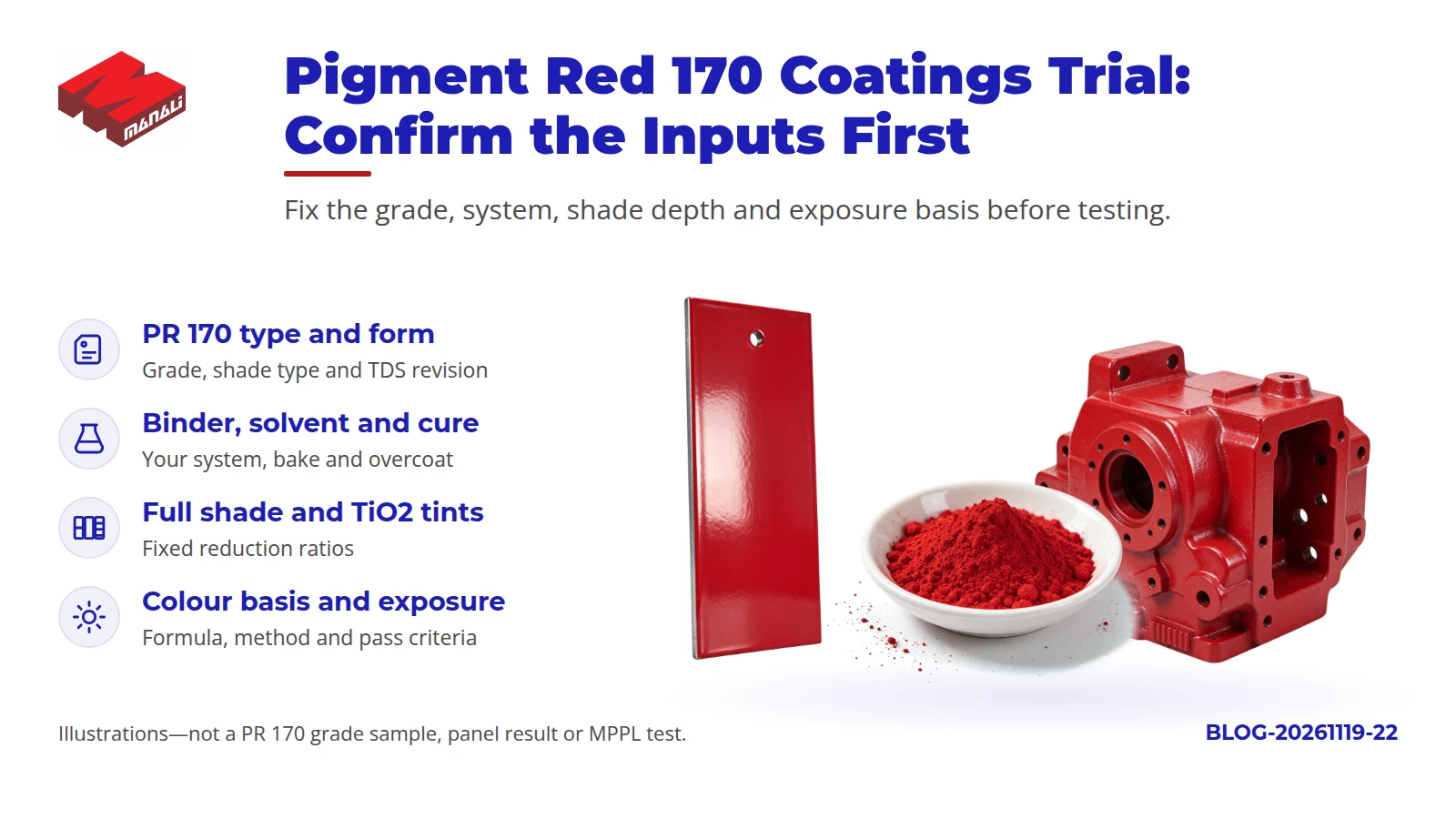
Before testing Pigment Red 170 (PR 170) in an industrial coating, confirm the exact grade and type, the coating system it must work in, the shade depths to test, the dispersion and cure conditions, the colour measurement basis, the exposure method and the acceptance rule. A PR 170 result is only meaningful for the system, film build and test conditions behind it. Supplier fastness ratings are useful for screening, but they do not replace a controlled trial in your own binder, at your own TiO2 reduction and through your own cure and overcoat schedule.
Why “Pigment Red 170” alone does not define the trial material
Pigment Red 170 is a Colour Index name. It identifies a chemical constitution, not a single commercial product. PR 170 is C.I. Pigment Red 170, Colour Index constitution number 12475, CAS 2786-76-7, a naphthol AS monoazo red with the molecular formula C26H22N4O4 [3]. Several suppliers can sell pigments under this name that behave differently in the same coating.
The difference begins in the solid state. Crystal-structure work on PR 170 has shown that the pigment exists in more than one crystal form, and that the molecular packing differs between them [2]. A 2023 study describes an unstable initial phase that has to be converted into more stable phases before practical use. The same study reports that the after-treatment changed hue, tinctorial strength, flowability, particle-size distribution and thermal stability, and that surface modification is also used to adjust properties [1]. For a trial, the phase name on a document matters less than the supplier’s statement of which commercial type the grade is.
For a buyer, the practical consequence is simple. Two materials that are both “PR 170” can differ in shade, opacity, strength, dispersibility, rheology and durability. A trial that does not record which commercial type was tested cannot be repeated or compared fairly. If you need a refresher on how Colour Index names and numbers work in purchasing, see the Colour Index reference and the guide to pigment Colour Index names and numbers.
One CI name, several commercial types
PR 170 is commonly offered in more yellowish and more bluish shade types. An industry evaluation of organic colour pigments describes PR 170 as coming “in a yellow shade and a blue shade” [10]. Supplier catalogues also separate higher-opacity types from more transparent types and use their own grade codes for them. Those codes are not standardised across manufacturers. A code that looks familiar on one supplier’s list may describe a different particle size, surface treatment or opacity on another’s.
Opacity and transparency change the job the pigment does in the film. A more opaque type is often considered where hiding in solid shades matters. A more transparent type may be considered where clean tints, depth or effect finishes matter. Neither is better in general. Each must be tested for the colour, film build and durability your coating needs.
Ask which type the grade is, not only which pigment
The trial request should name the supplier, the grade designation, the shade type, the product form and the revision of the technical data sheet (TDS) the sample was matched to. If you are comparing two suppliers, record the same details for both. If a supplier proposes a different type from the one you currently use, treat it as a reformulation rather than a like-for-like replacement.
The Organic Azo Pigments pillar explains where monoazo pigments such as PR 170 sit within the wider organic azo family. This article stays with one narrower question: what must be fixed before a PR 170 coatings trial begins. For printing-ink trials rather than coatings, the companion guides on Pigment Red 112 for printing inks and Pigment Yellow 13 for printing inks apply the same trial discipline to ink systems.
Define the coating system before requesting a sample
Most disagreements about PR 170 performance are disagreements about the system. Weathering, bleed, overcoat behaviour, gloss and heat stability are properties of the pigment in a particular binder, solvent package, film build and cure. Change one of those and the result can change.
Write the system down before the sample arrives. A short trial brief should state the binder chemistry and how it cures, the solvent package or carrier, the main additives such as dispersants and wetting agents, the extenders and other pigments in the formula, the substrate and pretreatment, the primer and topcoat or clearcoat in the build, the application method and the dry film thickness. That brief becomes the reference every later result is attached to.
Air-drying, baking and powder systems ask different questions
In an air-drying alkyd or similar ambient-cure system, the main questions are usually dispersion, shade, gloss, drying and exterior durability at the shade depths you use. In a stoving or baking enamel, add heat exposure during cure, possible overbake, and the behaviour of a white or light topcoat applied over the red. In a powder coating, the pigment must survive premixing, extrusion and the cure schedule, and dispersion depends on the extrusion step rather than a mill.
The same PR 170 grade can be suitable in one of these routes and need more care in another. A supplier data page for PR 170, for example, reports results separately for an air-drying alkyd system and a baked alkyd-melamine system [9]. Do not assume a rating from one system carries across to the other.
Name the topcoat, clearcoat and substrate
If the red sits under a clearcoat or is overcoated with another colour, the trial has to include that layer. Some pigment-related problems only appear when solvent from a later coat or the heat of a later bake reaches the red layer. The substrate also matters because it affects film appearance, adhesion behaviour and how panels are prepared for measurement and exposure.
Fix the shade depths: full shade and TiO2 reductions
A red used as a solid full shade and the same red used in a pale tint with titanium dioxide (TiO2) are effectively two different tests. Fastness data for organic pigments are commonly reported at several depths, such as full shade, deep shade and standard-depth reductions with TiO2. Supplier data for PR 170 show lightfastness and weathering ratings that change with the reduction level and with the exposure duration [9].
Choose the depths that represent your real products. For an industrial machinery red, that may be the full shade only. For a colour system or a range of tinted shades, it should include the lightest tint you actually sell. Fix the reduction ratios by mass, record the white pigment grade, and keep them identical across every candidate.
Testing tints also exposes problems that full shade can hide. Flocculation, poor colour development and fading often show more clearly in a reduction with TiO2. An industry evaluation also found that performance in tints and masstones does not always follow the same pattern, so neither depth should be assumed from the other [10].
Agree dispersion and strength comparisons
Dispersion decides how much of the pigment’s colour and gloss potential you actually see. An under-dispersed PR 170 can look weaker, dirtier or less glossy than a well-dispersed sample of the same grade. The trial must therefore fix the dispersion route before comparing grades.
Record the mill or disperser type, the grinding media, the grind time or energy input, the pigment loading in the mill base, the dispersant and its level, and the let-down procedure. Use the same route for every candidate. If one grade needs a longer grind to reach the same result, that is a finding about processing cost, not something to hide by adjusting the procedure silently.
Fineness of grind is a dispersion check, not a particle-size measurement
A Hegman-type gauge reading is a quick, widely used check on whether a mill base or paint has been dispersed enough for a smooth film. ASTM D1210 describes it as a measure of whether pigment agglomerates have been broken up sufficiently not to interfere with the smoothness of the finished film [4]. It does not measure particle-size distribution, colour strength or durability. Use it to confirm that the dispersion step was completed consistently. Do not use it to rank PR 170 types against each other.
A rub-out or flocculation check on a tinted drawdown is a useful companion. If colour strength or shade changes noticeably after rubbing the wet film, the pigment may be flocculating in that system. That points to dispersant or formulation questions to resolve before durability testing begins.
Relative tinting strength needs a named reference
Colour strength is always relative to something. ISO 787-24:2026 sets out photometric methods for comparing the tinting strength of two similar coloured pigments dispersed in an alkyd test paste with white pigment. The result is expressed as a percentage of an agreed reference pigment [5]. The method applies to pigments that are similar in colour, and the test report records the reference pigment, the measuring geometry and any deviations.
This has two consequences for a PR 170 trial. First, a “strength 100 %” or “strength 105 %” figure means nothing without knowing the reference pigment and method behind it. Second, strength measured in a standard test paste does not automatically carry over to your binder and TiO2 level. Measure strength in your own system as well, at the reduction you will use, against a retained reference you control.
Check cure, overcoat and solvent bleed in the real build
Heat and solvent are where many coatings trials of organic reds reveal their limits. During a bake, pigment can be affected by temperature and time. When a white or light coat is applied over a cured red layer, solvent and heat from that coat can draw colour into it. This is often called bleeding or overcoat bleed.
The same supplier page reports overpainting fastness that changes with the bake temperature used for the overcoat, alongside a heat-stability value that applies to the conditions that supplier tested [9]. That pattern is the important lesson. Ask for the conditions behind any heat or overcoat rating, then reproduce your own worst realistic case: the highest bake you run, the longest dwell, a possible overbake and the overcoat you actually apply.
Solvent resistance belongs in the same group. Bleeding generally increases with stronger solvents, and an industry comparison of organic pigments reported more bleeding as the solvent changed from aliphatic to aromatic to lacquer-type solvents [10]. If your formula, thinners or cleaning solvents include strong solvents, test with them rather than relying on a generic rating.
The same comparison also offers a substitution warning. It noted that Pigment Red 3, whose poor bleed resistance limits it to air-dry systems, has seldom succeeded as a substitute for PR 170 [10]. Any change into or out of PR 170 should be treated as a reformulation with its own cure and overcoat tests.
Agree the colour measurement basis before the first panel
Colour acceptance is easiest to dispute after the panels are made. Agree the basis first. ASTM D2244-25 explains how colour differences are calculated from instrumental colour coordinates and stresses three points that matter here [6]. Colour differences calculated with different formulas are not directly comparable, and there is no simple conversion factor between them. The purchaser and seller should agree the tolerance and the calculation method. Other appearance factors, such as gloss and texture, affect how well instrumental differences match what people see.
Write down the colour-difference formula, such as CIEDE2000 (ΔE00) or CIELAB ΔE*ab, the illuminant and observer, the instrument geometry and whether specular reflection is included or excluded, the reference standard and how it is stored, and the tolerance for each shade depth. ASTM D2244-25 recommends CIEDE2000 for small colour differences, which is the range where most coatings acceptance decisions sit [6]. Do not compare a ΔE from one formula with a tolerance written in another.
A red that matches under daylight may not match under factory or showroom lighting. Where the final article is viewed under several light sources, check the standard and the trial panel visually under each one and record the result.
Gloss belongs in the same record because it changes perceived colour. ISO 2813 describes gloss measurement at 20°, 60° and 85° for non-textured coatings on flat, opaque substrates [7]. Measure initial gloss with the same geometry you will use after exposure.
Choose the exposure method and read fastness data in context
Weathering is often the deciding property for an industrial red, and it is also the property most often overstated. Decide in advance how durability will be judged: outdoor exposure, laboratory exposure, or both; the duration; the shade depths exposed; and how change will be measured.
Read supplier fastness tables as system-specific
PR 170 data sheets commonly report lightfastness on the Blue Wool scale and weathering on the grey scale. They report these values for a named binder system, shade depth and exposure period. Supplier pages also state that such data are not binding and that customers must test suitability in their own formulations [9]. Treat any headline rating as a screening input. It tells you which candidates are worth testing, not whether your coating will pass.
The rating scale matters too. An industry study comparing visual Blue Wool ratings with an instrumental percent-fade measurement found that the Blue Wool scale can understate real differences between red pigments in tints. It also described Blue Wool assessment as subjective [10]. If durability is critical, measure colour and gloss change instrumentally on the exposed panels and keep unexposed controls.
The same study offers a reminder about scope. It described PR 170 as a workhorse for general industrial liquid and powder coatings, including automotive applications requiring less than the ultimate UV resistance [10]. That is a statement about typical use, not a guarantee for every grade, shade depth or system. Your exposure plan should confirm it for the coating you make.
Laboratory exposure is not a service-life prediction
Xenon-arc exposure is widely used to compare coatings under controlled light, temperature and moisture. ISO 16474-2 specifies methods for exposing coatings to filtered xenon-arc light with moisture in order to reproduce weathering effects of daylight or window-glass-filtered daylight [8]. It also notes that specimen preparation and evaluation of results are covered by other standards. The filter type, cycle, irradiance and duration all have to be stated for a result to mean anything.
Accelerated hours do not convert into years of outdoor service by a universal factor. Use laboratory exposure to rank candidates against a known reference in the same test run. Where your customers depend on long-term exterior performance, add outdoor exposure at a relevant site and decide in advance how the two will be weighed.
Request the right documents with the sample
A controlled trial needs a controlled sample. Ask for the following with every PR 170 candidate.
The technical data sheet (TDS) should give the grade identity, shade type and typical properties, together with the systems, depths and methods behind any fastness, heat or solvent data. The safety data sheet (SDS) gives hazard, handling, storage and disposal information for the grade. A certificate of analysis (COA) or lot-quality record links the sample to an identified production lot and the checks reported for it. Ask whether the sample is from a production lot and keep a retained portion for later comparison.
Ask the supplier which regulatory or market-specific statements apply to the exact grade and destination market, and obtain them in writing. Do not infer compliance from the CI name. The paint pigment TDS checklist covers how to compare data sheets across suppliers before sampling. To see how Manali Pigments approaches quality documentation, review the Quality & Compliance page.
Pigment Red 170 coatings trial map and decision logic
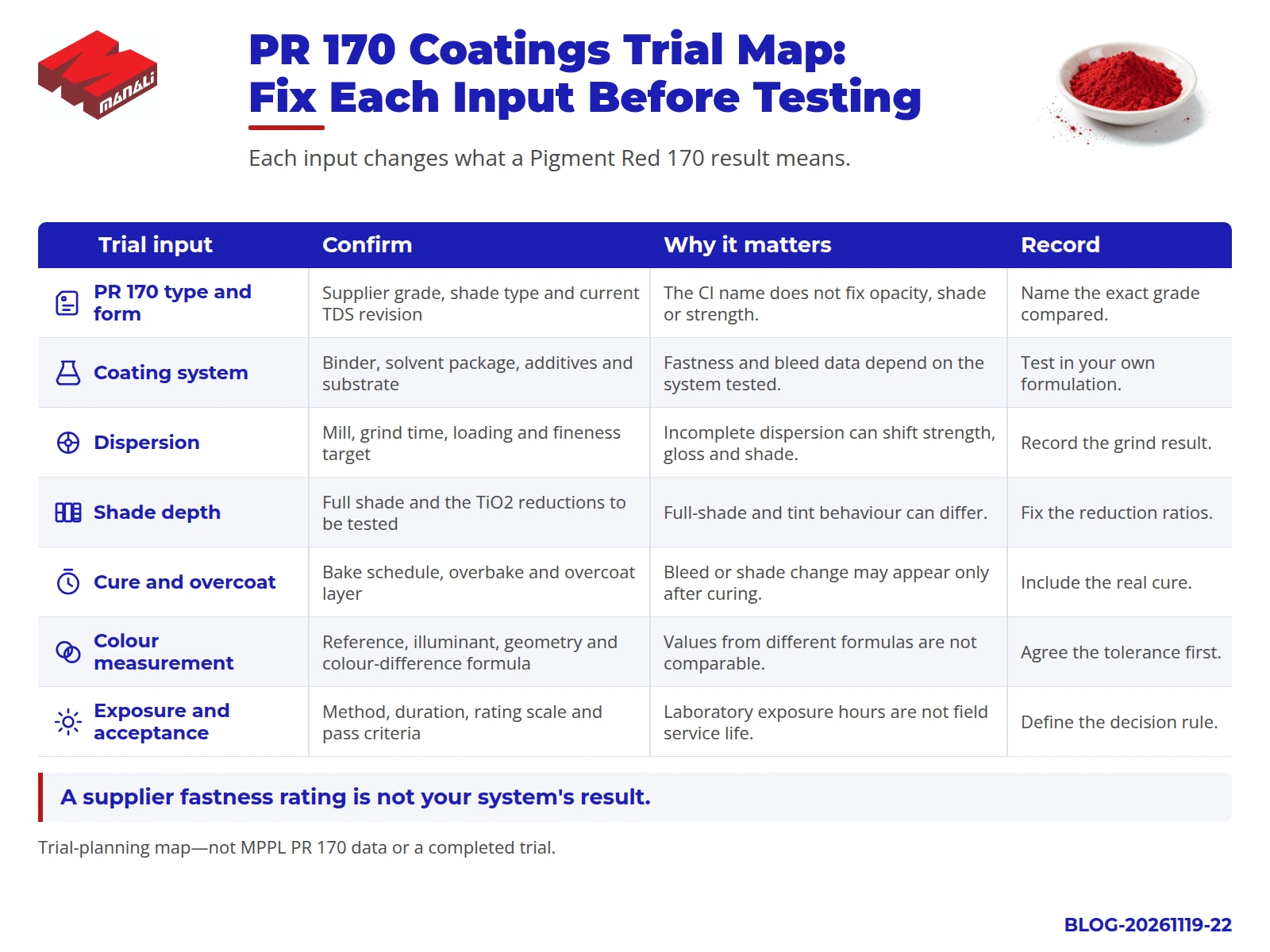
Use the map below as the trial brief. Every row should be filled in for your coating before the first panel is sprayed or drawn down.
| Trial input | Confirm | Why it matters | Record |
|---|---|---|---|
| PR 170 type and form | Supplier grade, shade type and current TDS revision | The CI name does not fix opacity, shade or strength. | Name the exact grade compared. |
| Coating system | Binder, solvent package, additives and substrate | Fastness and bleed data depend on the system tested. | Test in your own formulation. |
| Dispersion | Mill, grind time, loading and fineness target | Incomplete dispersion can shift strength, gloss and shade. | Record the grind result. |
| Shade depth | Full shade and the TiO2 reductions to be tested | Full-shade and tint behaviour can differ. | Fix the reduction ratios. |
| Cure and overcoat | Bake schedule, overbake and overcoat layer | Bleed or shade change may appear only after curing. | Include the real cure. |
| Colour measurement | Reference, illuminant, geometry and colour-difference formula | Values from different formulas are not comparable. | Agree the tolerance first. |
| Exposure and acceptance | Method, duration, rating scale and pass criteria | Laboratory exposure hours are not field service life. | Define the decision rule. |
Then use three questions to keep the decision bounded:
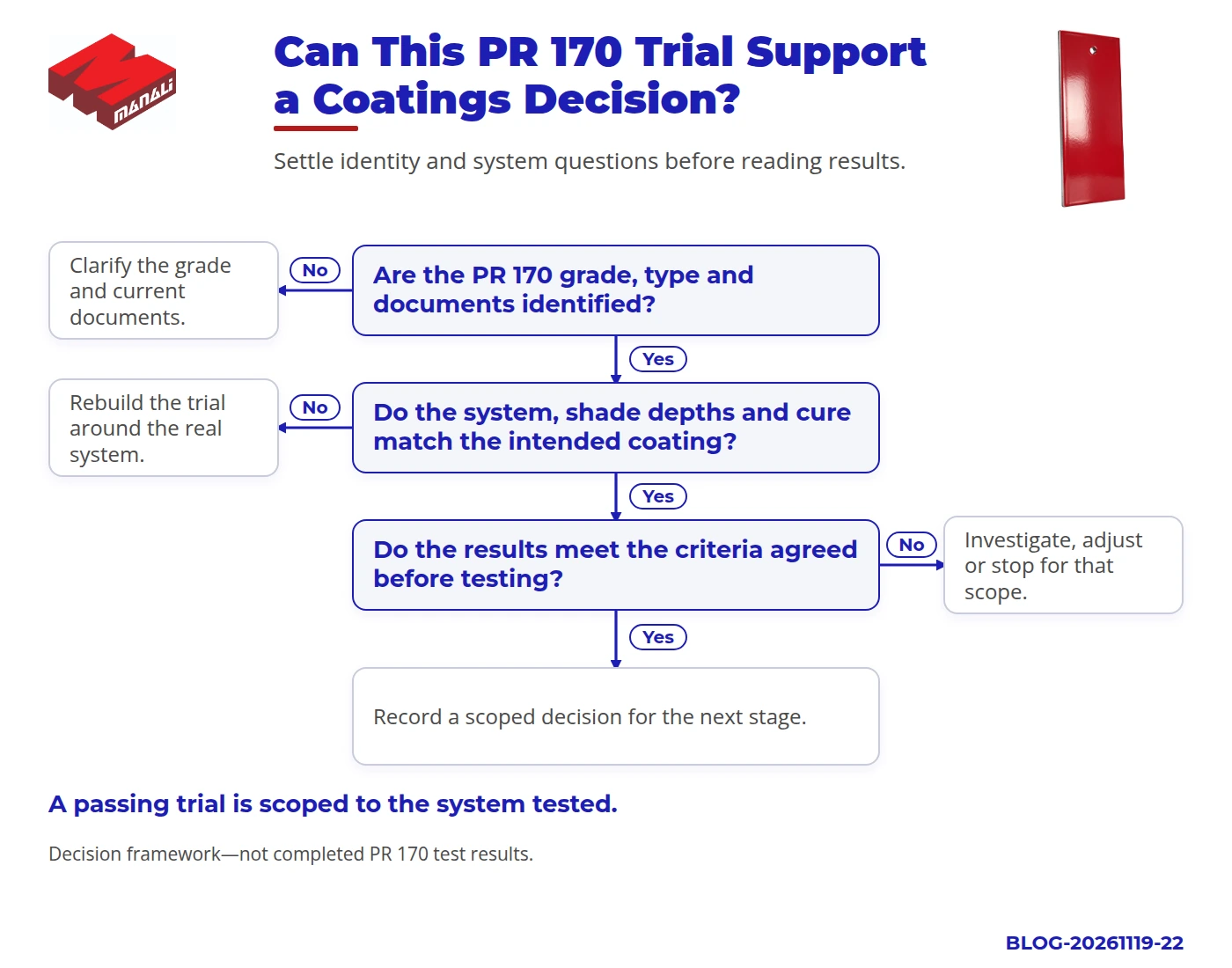
- Are the PR 170 grade, type and documents identified?
No → Clarify the grade and current documents.
Yes → Proceed to question 2. - Do the system, shade depths and cure match the intended coating?
No → Rebuild the trial around the real system.
Yes → Proceed to question 3. - Do the results meet the criteria agreed before testing?
No → Investigate, adjust or stop for that scope.
Yes → Record a scoped decision for the next stage.
The first question prevents a result from being attached to the wrong material. The second prevents a convenient laboratory system from standing in for the coating you will actually make. The third asks whether the evidence meets the rule you wrote before testing, not a rule adjusted to fit the panels. A No at any stage is a finding, not a failure of the supplier. Once the issue is resolved, return to that question. No route leads to automatic approval.
The final record should name the grade and lot tested, the full trial brief, the results at each shade depth, the colour and exposure basis, any deviations, and the next stage, such as a pilot batch, extended exposure or customer approval. A scoped decision for one coating does not approve the same grade for a different binder, cure or market.
Frequently asked questions
Is Pigment Red 170 one standard product?
No. Pigment Red 170 is a Colour Index name for one chemical constitution, C.I. 12475. Suppliers sell several commercial types under that name that can differ in crystal form, particle size, surface treatment, shade and opacity. Record the supplier, grade and shade type for every sample you test.
What is the difference between yellowish and bluish PR 170 types?
Suppliers commonly offer PR 170 in a more yellowish shade and a more bluish shade, and they often describe the types as differing in opacity or transparency. The grade codes are supplier-specific and not standardised. Compare the actual grades in your system at the shade depths you use rather than relying on the code.
Can supplier fastness ratings be used as acceptance criteria?
Use them for screening, not acceptance. Published ratings are tied to the binder, shade depth, exposure method and duration the supplier tested, and they are usually stated as non-binding. Acceptance should be based on your own trial results against criteria agreed before testing.
Why test TiO2 reductions as well as full shade?
Full shade and tints can behave differently in colour strength, flocculation, lightfastness and weathering. Problems such as flocculation and fading often show more clearly in a reduction with TiO2. Test the lightest tint you actually sell as well as the full shade.
Does a Hegman reading show that PR 170 is fully dispersed?
A Hegman-type gauge shows whether agglomerates are broken down enough not to spoil film smoothness. It does not measure particle-size distribution, colour development or strength. Combine it with a strength comparison and a rub-out check in your own system.
Which colour-difference formula should we use?
Use the formula both parties agree in writing and use it consistently. ASTM D2244-25 recommends CIEDE2000 for small colour differences. Never compare a value calculated with one formula against a tolerance written in another, and record the illuminant, observer and instrument geometry.
Can accelerated xenon testing predict outdoor life?
Not by a fixed conversion. Xenon-arc exposure compares coatings under controlled conditions and is useful for ranking candidates against a reference in the same run. Where long-term exterior performance matters, add outdoor exposure and decide in advance how the two will be weighed.
Can PR 170 replace another red in an existing formula without retesting?
No. A change into or out of PR 170, or between PR 170 types, changes shade, opacity, strength and possibly bleed and durability. Treat it as a reformulation and repeat the dispersion, cure, overcoat, colour and exposure checks.
What should I provide when requesting a PR 170 sample for a coatings trial?
Provide the coating system and cure, the substrate and layer build, the shade depths and TiO2 reductions you will test, the colour and exposure methods, your acceptance basis and the documents you need, such as the TDS, SDS and a lot-linked COA. The clearer the brief, the more relevant the grade proposal.
References
- Lv et al., “Preparation of γ-phase pigment Red 170 through hydrothermal treatment and kaolin coating modification”, RSC Advances, 2023. Peer-reviewed study describing PR 170 crystal phases, conversion of the unstable phase and the effect of treatment on hue, strength, flowability, particle-size distribution and thermal stability.
- Schmidt, Hofmann, Buchsbaum and Metz, “Crystal Structures of Pigment Red 170 and Derivatives, as Determined by X-ray Powder Diffraction”, Angewandte Chemie International Edition, 2006. Crystal-structure determination showing that PR 170 exists in more than one crystal form.
- PubChem compound summary for C.I. Pigment Red 170 (CID 5359812). Chemical identity record with molecular formula, molecular weight and systematic name.
- ASTM D1210-05(2022) — Fineness of Dispersion of Pigment-Vehicle Systems by Hegman-Type Gage. Official scope for judging whether pigment agglomerates are broken up enough not to interfere with film smoothness.
- ISO 787-24:2026 — Photometric methods for determining the relative tinting strength of coloured pigments. Official record for comparing the tinting strength of two similar coloured pigments against an agreed reference.
- ASTM D2244-25 — Calculation of Color Tolerances and Color Differences from Instrumentally Measured Color Coordinates. Official scope covering colour-difference formulas, their non-comparability and the need for agreed tolerances.
- ISO 2813:2014 — Paints and varnishes — Determination of gloss value at 20°, 60° and 85°. Official scope for gloss measurement of non-textured coatings on flat, opaque substrates.
- ISO 16474-2:2013 — Paints and varnishes — Methods of exposure to laboratory light sources — Part 2: Xenon-arc lamps. Official scope for xenon-arc exposure of coatings; specimen preparation and evaluation are covered by other standards.
- Sudarshan, Novoperm Red F3RK 70 for paints and coatings. Example of a supplier PR 170 data page reporting fastness by binder system, shade depth, exposure period and overcoat bake temperature, with a non-binding data statement. Values on that page belong to that supplier’s grade.
- PCI Magazine, “Evaluation of Various Organic Color Pigments”. Industry evaluation discussing PR 170 shade types and typical coatings use, bleed behaviour across solvent types, and the limits of Blue Wool ratings compared with instrumental fade measurement.
Explore organic azo pigments for your coatings trial
Manali Pigments Private Limited manufactures its pigment categories in-house. Whether a PR 170 grade suits your coating still depends on the type, the system and the conditions it has to survive. Review the Organic Azo product information, then bring your coating system, cure and overcoat schedule, shade depths, colour and exposure methods, and document needs into a grade-specific discussion.
The link below opens the Organic Azo Pigments product page, where you can review the range and discuss the grade, sample and documents your coatings trial needs.