Organic Azo Pigments · Technical guide
Pigment Red 112 for Printing Inks: What Formulators Should Validate Before a Trial
A useful Pigment Red 112 trial begins with a defined ink system, controlled inputs, documented test conditions and acceptance criteria agreed before the sample is evaluated. For MANALI RED 111217, the trial should identify the intended printing process, formulation basis, substrate, control sample, application method and evaluation criteria before comparing the candidate material. Do not infer suitability from the CI name alone; confirm the exact grade in the intended formulation and process.
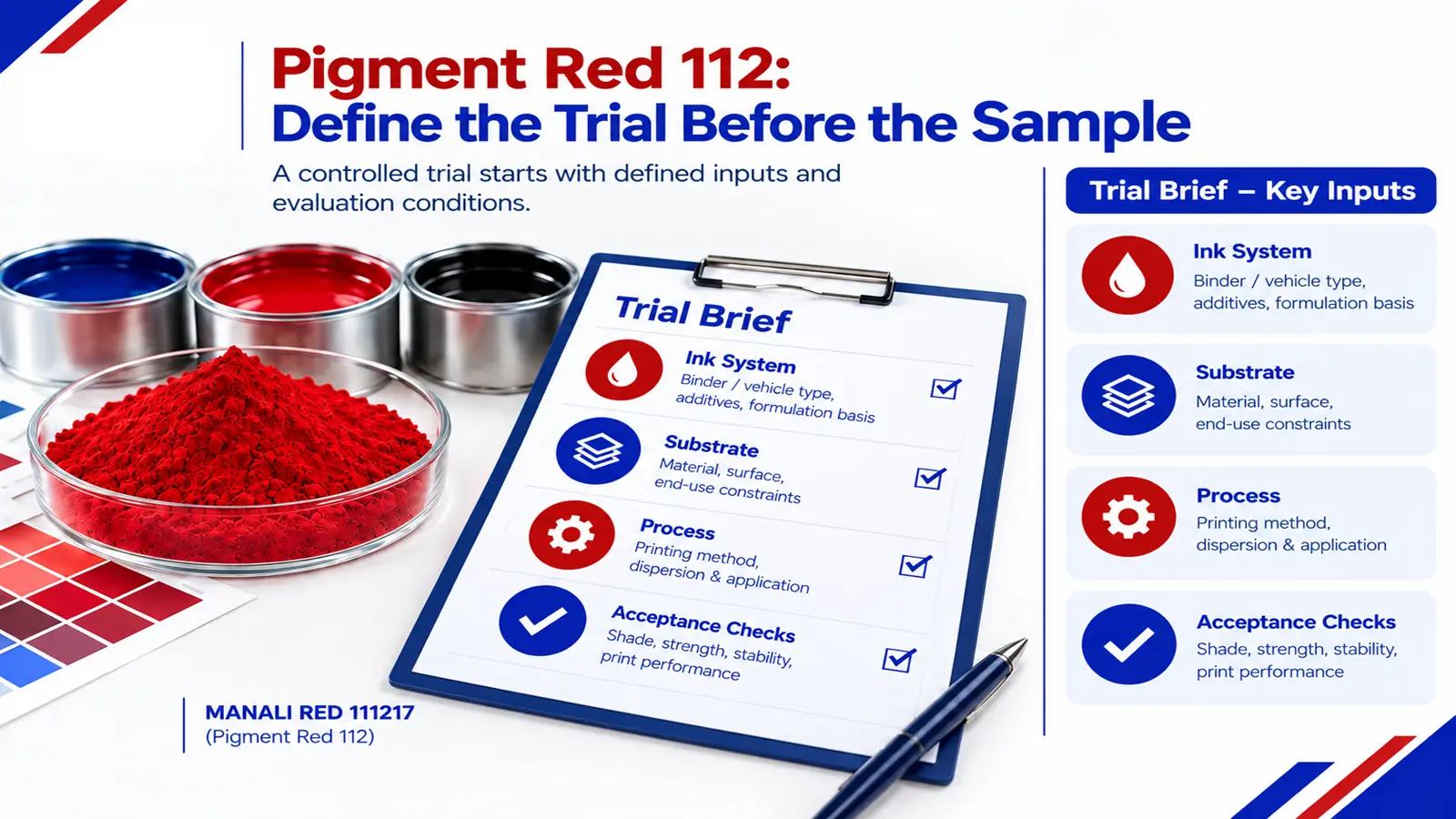
Definition: A grade trial is a controlled comparison of a named sample under documented formulation, processing and evaluation conditions.
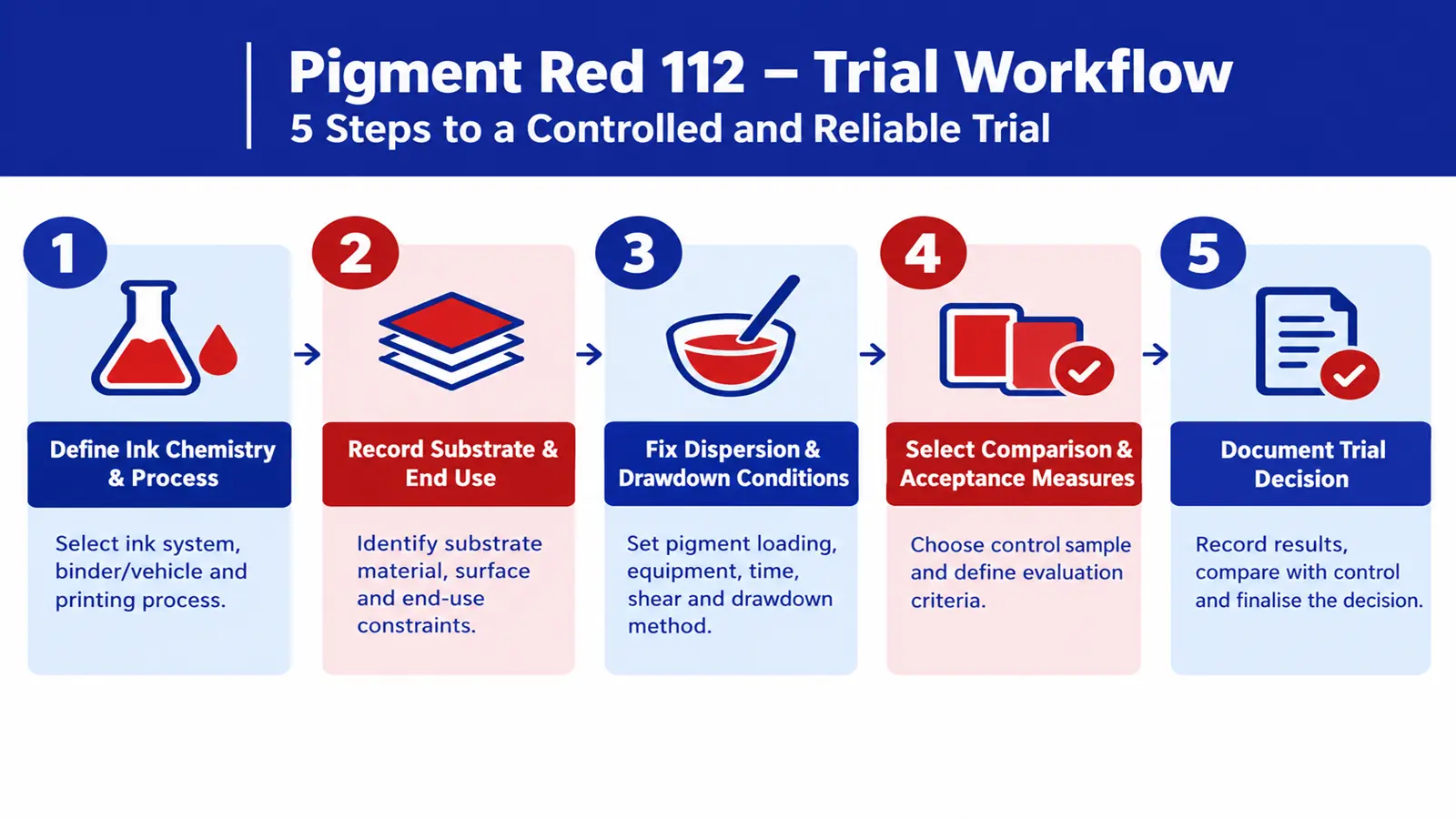
Five-step trial checklist
- Define ink chemistry and printing process.
- Record substrate and end-use constraints.
- Fix dispersion and drawdown conditions.
- Select comparison and acceptance measures.
- Document the trial decision.
Define the Question the Trial Must Answer
A printing-ink trial should answer a specific technical question rather than a broad question such as "Does PR 112 work?" The first step is to define the printing process and the ink system in which the pigment will be evaluated.
For MANALI RED 111217, the supplied technical data identifies the material as Pigment Red 112 and describes it as a Naphthol AS pigment. The TDS lists applications including decorative paints, water-based paints, textile and dispersions. These application references do not, by themselves, establish suitability for every printing-ink system. [1]
The trial brief should therefore identify the printing process, binder or vehicle family, substrate, end use and the decision that the trial is intended to support. The decision may concern whether the candidate can be taken forward for a particular formulation and process after comparison with the approved control.
The broader Organic Azo Pigments technical hub provides category context, while the Organic Azo Pigments page is the relevant product-category route for a sample request.
Pigment identity should also be kept separate from commercial-grade identity. CI Numbers and Technical Reference can identify the CI reference, but the commercial trial must use the exact MPPL grade: MANALI RED 111217.
Lock the Formulation and Process Inputs
Define the vehicle
The binder or vehicle is a trial variable that must be identified before evaluation. Water-based, solvent-based and other ink systems can impose different dispersion, viscosity, drying and application requirements. Identify the system being tested rather than treating a generic formulation as universally applicable.
The supplied water-based ink testing method provides a controlled preparation method for a water-based emulsion. It specifies pigment, emulsifier, dispersing agent, silicone defoamer, water and glass beads, followed by a defined shaking sequence. Those quantities belong to the approved method and should be used only within its applicable scope. [2]
Fix pigment loading and formulation basis
Pigment loading must be defined on a stated formulation basis before a comparison is made. A candidate and its control should not be judged from preparations made on different bases because the resulting shade, strength or flow observations may not be directly comparable.
The trial record should identify the pigment loading basis, total formulation basis and any permitted adjustment. Do not change the formulation after seeing the result unless the change is documented as a separate trial condition.
Record dispersion equipment and time
Dispersion conditions should be fixed and recorded because equipment, energy input, time and sequence can affect the state of the prepared dispersion. The trial record should capture the equipment used, operating conditions, processing time and any relevant temperature or pass information specified by the approved method.
For the supplied water-based method, the preparation includes glass beads and a defined shaking sequence. The method also defines separate preparations for mass tone and tint tone evaluation. These controlled preparation details should be retained in the laboratory record. [2]
Control viscosity adjustment and addition order
Fix the addition sequence before preparation and record when each component is introduced. Document any dilution or viscosity adjustment and apply the same agreed measurement stage to the candidate and control.
Viscosity should be evaluated under equivalent conditions for the sample and control. The approved Ford Cup procedure requires a calibrated cup, controlled temperature, valid flow-time readings and a consistent measurement procedure. Three valid readings are taken and the mean flow time is recorded. [3]
Ford Cup seconds represent flow time, not cP. Where an applicable cup-specific relationship is used, report the converted quantity and units separately; flow-cup documentation describes conversion to kinematic viscosity in centistokes. Any dilution or viscosity adjustment should be recorded rather than treated as an undocumented correction. [6]
Choose the Comparison and Observations
A comparison requires a current approved control with a known identity and status. For MPPL, the approved reference definition identifies RED 111217 as the reference standard used as a benchmark for quality and colour matching. "Same as STD" means the current batch matches the RED 111217 reference; "Comparable" means equivalent or comparable in quality and colour to that reference. [4]
The sample and control should be prepared and evaluated under equivalent conditions. The comparison can then be structured around the observations required by the approved method.
For colour evaluation, the supplied documentation distinguishes full tone and tint tone. The completed COA for MANALI RED 111217 records both as "Same as STD." The supplied water-based method also defines mass-tone and tint-tone preparation. Where the laboratory trial uses an automatic applicator and drawdown, the drawdown conditions should be controlled and recorded in the approved trial record rather than assumed from the pigment identity.
Opacity or transparency should be evaluated only where the approved method calls for it. The completed COA records opacity as comparable to the approved standard. [5] Likewise, flow or viscosity should be compared using the approved measurement method and equivalent test conditions.
The purpose is to separate an observation from an acceptance decision. "Same as STD" or "comparable" is a controlled comparison outcome; it should not be expanded into a general claim of universal printing performance.
For supporting technical documentation, see the quality documentation route.
Set Acceptance Criteria Before Evaluation
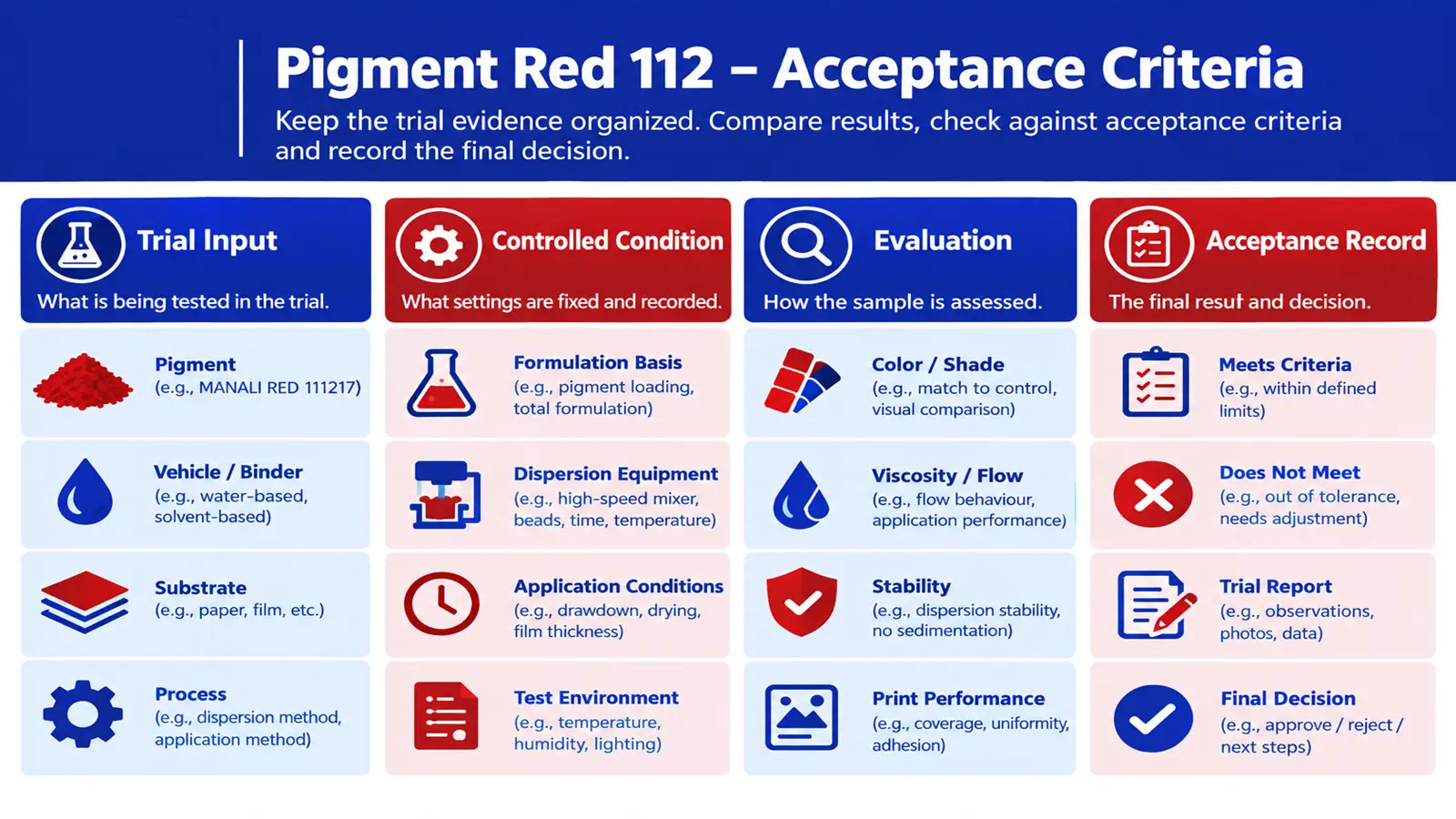
Acceptance criteria should be defined before the candidate result is reviewed. Each criterion should identify the method, unit or comparison basis, tolerance where applicable, approver and final disposition.
The following table distinguishes method-based comparison records from the specific batch-quality entries in the supplied documents. The final two rows are COA records, not automatic printing-ink acceptance criteria. For the trial itself, use the agreed method-specific criterion rather than an assumed numerical limit.
| Trial input | Controlled condition | Evaluation | Acceptance record |
|---|---|---|---|
| Full tone | Sample and approved RED 111217 standard compared under equivalent preparation/application conditions | Full-tone colour comparison | Same as STD where the approved comparison is met |
| Tint tone | Sample and approved RED 111217 standard compared under equivalent preparation/application conditions | Tint-tone colour comparison | Same as STD where the approved comparison is met |
| Water-based ink preparation | Approved preparation method and defined preparation sequence | Prepared emulsion / tone sample | Record according to approved trial method |
| Viscosity | Ford Cup, controlled temperature and valid repeated readings | Mean flow time | Compare with approved product/reference tolerance |
| Pigment powder pH — batch-quality record | Controlled laboratory test | pH value | COA specification: 6–9; recorded result for Lot 038PR1120526: 6.8 |
| Heat stability — batch-quality record | Controlled test condition | Heat stability | COA record: 180°C for 05 minutes |
The completed COA for MANALI RED 111217 also records volatile matter, water solubility, oil absorption, Hegman gauge, residue on sieve and other quality observations. These are product-quality records and should not automatically be presented as printing-ink trial acceptance criteria unless the approved trial method assigns them that role. [5]
Interpret a Failed or Ambiguous Result
A result that does not match the control should not automatically be attributed to the pigment. Possible causes can arise from sample identity, preparation, formulation, dispersion, application or measurement.
The first response should be to verify that the correct commercial grade and control were used and that the comparison conditions were equivalent. The laboratory should then review preparation records, equipment, measurement conditions and any permitted formulation adjustments.
For viscosity, invalid Ford Cup runs should be rejected and investigated, and valid repeat readings should be obtained according to the approved measurement procedure. The method requires three valid readings for the reported mean and calls for investigation of invalid runs. [3]
For shade or tone differences, the trial record should distinguish an observed difference from the reason for that difference. A controlled repeat or escalation should follow the approved internal trial rule. Use the repeat count and exception authority documented in the applicable method.
The objective is a traceable decision: proceed, repeat, investigate or escalate, with the reason recorded.
Convert the Result Into a Supplier Discussion
An ink formulator sending a sample request or technical-data request should provide enough non-confidential information for the grade to be assessed in the intended application. A useful technical brief includes:
- Exact printing process.
- Binder or vehicle family.
- Substrate.
- End use.
- Pigment loading basis.
- Dispersion equipment and conditions.
- Viscosity or rheology target where relevant.
- Current control/reference.
- Required observations and acceptance criteria.
- Destination-market requirement only when applicable and verified.
For MANALI RED 111217, the control should be identified clearly as the approved RED 111217 reference where that is the intended comparison basis. If the customer needs a shade or performance match to another commercial pigment, the exact reference, application and comparison conditions should be stated.
Share only the non-confidential information needed for the enquiry. Do not disclose customer names, contact details, prices or confidential commercial information without authorization. The complete guidance on this page is available without registration; requesting a physical sample is optional.
Ready to discuss your trial?
Share your application brief with the Organic Azo team. A sample enquiry is optional and does not restrict access to this guide.
Request a product sampleFrequently Asked Questions
What must be defined before requesting a PR 112 sample?
Define the exact commercial grade, printing process, binder or vehicle family, substrate, end use, formulation basis, comparison standard and acceptance criteria. The CI identity alone is not enough to establish application suitability. For this article, the MPPL commercial grade is MANALI RED 111217, while the trial method and application conditions must be matched to the intended ink system.
Does the PR 112 CI name identify a complete commercial grade?
No. Pigment Red 112 is an identity reference, while a commercial grade also requires the specific manufacturer and grade designation. The MPPL grade addressed here is MANALI RED 111217. Trial conclusions should therefore be tied to the named grade and the documented formulation and process conditions rather than to the CI name alone.
Which ink-system details belong in the trial brief?
Record the printing process, binder or vehicle family, substrate, end use, pigment loading basis, dispersion conditions, application method and relevant viscosity or rheology target. These details define the boundary of the comparison. A trial that changes these variables without recording them makes it harder to determine whether an observed difference is related to the pigment or the process.
How should a control sample be selected?
Use a current approved reference with known identity and status. The supplied MPPL definition identifies RED 111217 as the approved reference standard for quality and colour matching. The sample and control should be prepared and evaluated under equivalent conditions so that the comparison has a defined basis.
Which acceptance criteria should be agreed in advance?
Each criterion should identify the evaluation method, unit or comparison basis, tolerance where applicable, approver and disposition. Colour comparisons may use full-tone and tint-tone observations; viscosity should use the approved Ford Cup procedure where applicable. Use only the numerical limits defined for the applicable trial and method.
When should an ink trial be repeated?
Repeat or investigate when the result is invalid, ambiguous or not directly comparable under the approved conditions. For viscosity, invalid Ford Cup runs should be rejected and investigated, with valid readings obtained according to the method. For broader trial outcomes, follow the approved internal retest and escalation rule rather than applying an assumed repeat count.
Sources and document scope
The MPPL document titles below identify the records underlying the grade-specific statements. Batch and method records apply only within their stated scope; they do not establish suitability for every printing-ink system. The full guidance on this page is freely readable without downloading a source file.
- Red 111217 TDS.docx — MPPL Technical Data Sheet for MANALI RED 111217 / Pigment Red 112.
- WaterBased Ink Testing Method Ford Cup Updated.docx — MPPL water-based ink preparation and tone-evaluation method.
- Viscosity Measurement.docx — MPPL Ford Cup measurement procedure; the method-specific reading count described in this article is not a universal instruction.
- Definition of STD, Same as STD, Comparable and standard submitted.docx — MPPL reference definitions and RED 111217 comparison basis.
- 111217 COA.docx — MPPL Certificate of Analysis dated 01-05-2026, Lot 038PR1120526. Its batch-quality entries are not a universal ink-trial specification.
- Elcometer FORD/ASTM Viscosity Cups — Public instrument guidance on flow time and applicable conversion to centistokes. Read the instrument guidance
Article credits
- Author
- Santosh Saini
- Technical review
- SantoshOrganic Azo Product Lead
- Application review
- AadarshInk Application Lead
Published by Manali Pigments Private Limited.