
A Color Index name improves pigment identity, but an unambiguous purchase specification also needs the exact commercial grade, application, document revision, test methods and acceptance requirements. Use pigment color index names and numbers to identify the colorant, then connect that identity to a named supplier, the intended process and an agreed specification. This gives procurement and technical teams a shared record for ordering, assessment and change control.
CI identity does not make different commercial grades interchangeable and does not establish application fitness.
A Color Index designation is a standardized colorant identity; it is not a complete commercial-grade specification.
Use pigment Color Index names and numbers to remove naming ambiguity
Start by separating identifiers that purchasing records often combine. A C.I. Generic Name identifies the essential colorant. Pigment Blue 15:2 is a full Generic Name; PB 15:2 is its abbreviation. A C.I. Constitution Number is a separate identifier in the Colour Index system. Neither the abbreviation nor a supplier's commercial code should be entered as that Constitution Number. [1]
Keep separate fields for the full name, its shorthand where useful, and the Constitution Number when verified. For example, the supplied MANALI BLUE 115211 technical data sheet lists Pigment Blue 15:2 under “C.I. Name” and 74160 under “C. I. Constitution No.” These are supplier-reported identifiers, not evidence of an independently checked Colour Index registration. [2]
For broader reference context, see CI Numbers and Technical Reference. The purchasing decision adds another layer: which supplier product, in which form, for which process, under which agreed requirements? A shorthand label such as “blue pigment” cannot answer those questions. The designation reduces identity ambiguity; the complete specification controls what the buyer orders.
Break down a complete pigment identity
Class and number
Retain the complete designation, including its suffix: Pigment Blue 15:2. The supplied TDS and SDS both use this name. Removing “:2” would discard information from the documented identity. Keep the full name readable on the specification and purchasing record. [2] [3]
Commercial grade
The MPPL example is commercial grade B115211. Its TDS is headed MANALI BLUE 115211 and identifies it as Pigment Blue 15:2. Record the purchase code and printed product name together so the supplier can confirm their correspondence. B115211 is the commercial grade code; PB 15:2 abbreviates the Generic Name. [2]
The Phthalocyanine Blue and Green pigments family page provides product navigation, including Blue 15-family entries. It does not replace this grade's documentation. [4]
Supplier
Name Manali Pigments Private Limited as the supplier of the B115211 example. The SDS names Manali Pigments as the supplier and identifies Pigment Blue 15:2, but it does not print B115211 or MANALI BLUE 115211. Confirm that this SDS applies to the commercial grade before treating the shared CI name as a grade-specific match. [3]
Document revision
Control the two documents separately. The supplied TDS states no issue date or revision identifier. The SDS prints an issue date of 01 January 2025 but no separate revision identifier. Ask for the applicable current versions and record the response; do not assign either document an invented revision. [2] [3]
Add the application context
A usable buyer brief describes the system in which the pigment will be assessed. Identify the resin or vehicle, whether the formulation is an ink, coating or plastic system, the substrate and the intended end use. Include the relevant processing conditions and the properties that determine acceptance.
For a coating trial, describe the binder and solvent system, preparation route, application method and reference shade. For an ink trial, identify the vehicle, printing process, substrate and relevant requirements for appearance or processing. For a plastic trial, identify the polymer and processing route. These are selection questions, not claims that B115211 suits each system.
Separate the desired result from the assessment method. “Match the approved shade” becomes useful only when the agreed reference, preparation conditions and comparison procedure are identifiable. Similarly, a processing requirement should describe the buyer's actual conditions rather than copy a supplier's headline property into an unrelated process.
Where details are confidential, share the information needed for technical assessment through the agreed commercial channel. Keep enough context in the controlled specification to explain the approval decision. A successful assessment in one formulation should not automatically authorize use in another formulation or process.
Add documentary requirements
A technical data sheet (TDS) supplies technical information for the stated product. The supplied B115211 TDS contains Product Information, Application Profile, Technical Performance and Physical Properties sections. Its physical-property fields include oil absorption, specific gravity, bulk density, volatile matter and pH, with method references alongside several entries. Those fields are available for discussion; they are not automatically agreed purchase limits. [2]
A Safety Data Sheet (SDS) addresses safety-related information within its stated scope. The supplied Pigment Blue 15:2 SDS covers identification, hazards, handling and storage, exposure controls and other safety topics. Use it for those purposes, subject to confirmation that it applies to B115211. Its content does not establish color performance or compatibility with a buyer's formulation. [3]
A certificate of analysis (COA), if required and supplied, reports information for an identified production lot. The TDS and SDS do not establish the results of a specific production lot. Specify whether the order requires a lot-specific COA, which agreed fields it must report and how the lot identifier connects to the shipment.
Make requests proportional to the order and application. The quality and compliance documentation page provides a navigation point for further discussion; any particular certificate or status still needs its own relevant evidence.
Have procurement and the technical approval owner retain the same agreed specification. If particular TDS fields are expressly adopted, identify their version, methods, units, conditions and acceptance rules. A referenced document can form part of the agreed specification when the parties clearly define what is incorporated.
Build the purchase-specification template
Use the following record as a template, completing application and acceptance requirements with the supplier and buyer's authorized technical team. The B115211 example clarifies identity; it does not supply trial results or authorize substitution.
| Specification field | Required entry | Source | Approval owner |
|---|---|---|---|
| Colorant identity | Pigment Blue 15:2; PB 15:2 as shorthand; supplier-reported Constitution Number 74160 recorded separately | MANALI BLUE 115211 TDS, Product Information; SDS corroborates Generic Name [2] [3] | Technical documentation owner |
| Supplier and grade | Manali Pigments Private Limited; buyer-specified ordering code B115211; printed product name MANALI BLUE 115211; confirm the code-to-product correspondence | TDS heading; SDS Section 1; supplier confirmation of code and SDS applicability [2] [3] | Procurement and technical owner |
| Application and process | Record the actual resin or vehicle, substrate, processing conditions and intended use | Buyer formulation brief and agreed trial record | Application technical owner |
| Packaging and handling | Agree pack format and identification; confirm applicable handling instructions | Order agreement and applicable SDS, including Section 7 [3] | Procurement and responsible handling owner |
| TDS version | Supplied TDS has no stated date or revision; obtain and retain the applicable current version | MANALI BLUE 115211 TDS [2] | Technical documentation owner |
| SDS version | Supplied issue date: 01 January 2025; no separate revision printed; confirm current applicability to B115211 | Pigment Blue 15:2 SDS, heading and Section 1 [3] | Safety documentation owner |
| Tests and acceptance | Record each agreed test, method version, unit, conditions, limit and decision rule | Buyer-approved specification and expressly adopted supplier fields | Technical approval owner |
| Lot evidence | Define whether a lot-specific COA is required and its agreed reporting fields | Order requirement; actual lot COA when supplied | Incoming quality owner |
| Approval and changes | Record specification identifier, revision, authorized approval and change disposition | Buyer–supplier agreement and change record | Authorized procurement and technical owners |
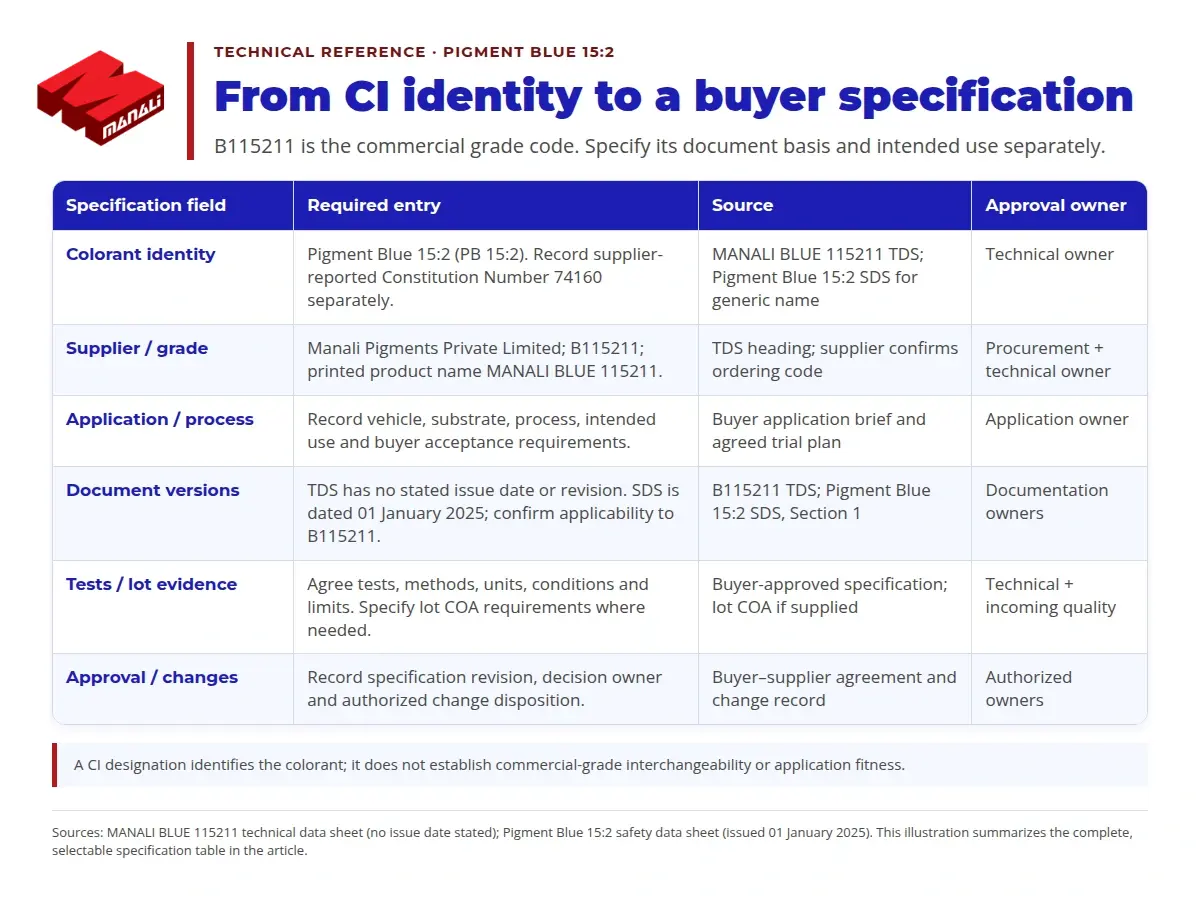
Keep the same field names in the purchase order or its incorporated specification. Missing methods or limits should trigger a focused agreement before acceptance, rather than a guessed number.
- Record the full CI name and number.
- Name the supplier and commercial grade.
- State the application and process context.
- Attach current TDS/SDS/COA requirements.
- Define tests, limits and change control.
Here, “name and number” means preserving the Generic Name and recording the Constitution Number separately where verified. Attaching requirements means controlling the documents appropriate to the transaction; it does not imply public downloads or an already supplied COA.
Prevent substitution and revision errors
Set a documented change process before placing repeat orders. Begin by receiving a change notice and identifying the affected commercial grade, document versions and production lots or orders. Ask what changed and when the change becomes effective. A revised file date alone does not explain technical relevance.
Next, have the appropriate technical owner assess the change against the approved application and acceptance requirements. Decide whether document review is sufficient or whether a comparative trial or fresh approval is needed. If a trial is required, agree the preparation, measurement and comparison conditions before using its results to authorize the change.
Finally, record the authorized disposition: accepted, rejected or accepted only within a defined scope. Update the specification revision, document attachments and purchasing instructions together. Make clear which version governs existing stock and subsequent deliveries.
Use the same sequence for a proposed same-CI substitution. A shared designation does not answer whether differences in physical form, formulation or processing matter to the buyer's system. Preserve the approval history so a later reorder does not silently replace the reviewed commercial grade with a broadly described equivalent.
Frequently asked questions
What does a pigment Color Index name identify?
It identifies the essential colorant rather than the complete supplier product. Record the full C.I. Generic Name, including any suffix, and keep the commercial grade in a separate field. The official Colour Index explanation distinguishes that identity from commercial-product properties. Buyers still need the grade's own documentation and application assessment before approving use. [1]
Is a CI number the same as a supplier grade?
No. A supplier grade identifies a commercial product, while the Generic Name and Constitution Number are separate CI identifiers. Here, B115211 is the buyer-specified MPPL ordering code and Pigment Blue 15:2 is the documented Generic Name. Keep those entries separate and confirm the ordering code with the supplier; shorthand is not a complete purchase description. [2]
What should a purchase order include besides the CI name?
Include the supplier, exact grade, application context and a reference to the controlled specification, with relevant document versions and agreed acceptance requirements. Add packaging, lot-evidence and change-notification requirements where needed. Have procurement and the technical owner check the same record. A purchase order should not turn an unqualified supplier value into an assumed guaranteed acceptance limit.
Can two grades with the same CI designation be substituted?
Only after documented review and any necessary application approval. Compare the proposed grade's documentation with the existing specification and decide whether differences require a matched trial. Record the outcome before changing the purchasing instruction. The common designation provides an identity reference; it does not establish equivalent processing behavior, safety information or suitability for the buyer's end use.
Which document revisions should be controlled?
Control the agreed specification and each incorporated supplier document separately, including the applicable TDS and SDS. Keep required lot-specific evidence associated with the actual lot. For this example, the TDS has no stated date or revision and the SDS has an issue date. Obtain supplier confirmation of current applicability rather than inventing matching revision numbers. [2] [3]
How should an approved specification change be recorded?
Record the previous and new specification revisions, reason for change, affected grade and orders or lots, assessment evidence and authorized decision. Include the effective date and update the linked purchasing instructions and documents. The approval should define its scope: accepting a document correction does not necessarily authorize a formulation change, a different commercial grade or unrestricted substitution.
References
- Colour Index™ Online, About Us, published by SDC and AATCC; essential-colorant and commercial-product distinction. Accessed 6 October 2026.
- Manali Pigments Private Limited, Technical Data Sheet — MANALI BLUE 115211. No issue date or revision identifier stated; Product Information, Application Profile, Technical Performance and Physical Properties sections.
- Manali Pigments Private Limited, Safety Data Sheet — Pigment Blue 15:2. Issued 01 January 2025; no separate revision identifier stated; no B115211 commercial-grade code printed.
- Manali Pigments, Phthalocyanine Blue & Green, used for listed product-family navigation only. Accessed 6 October 2026.