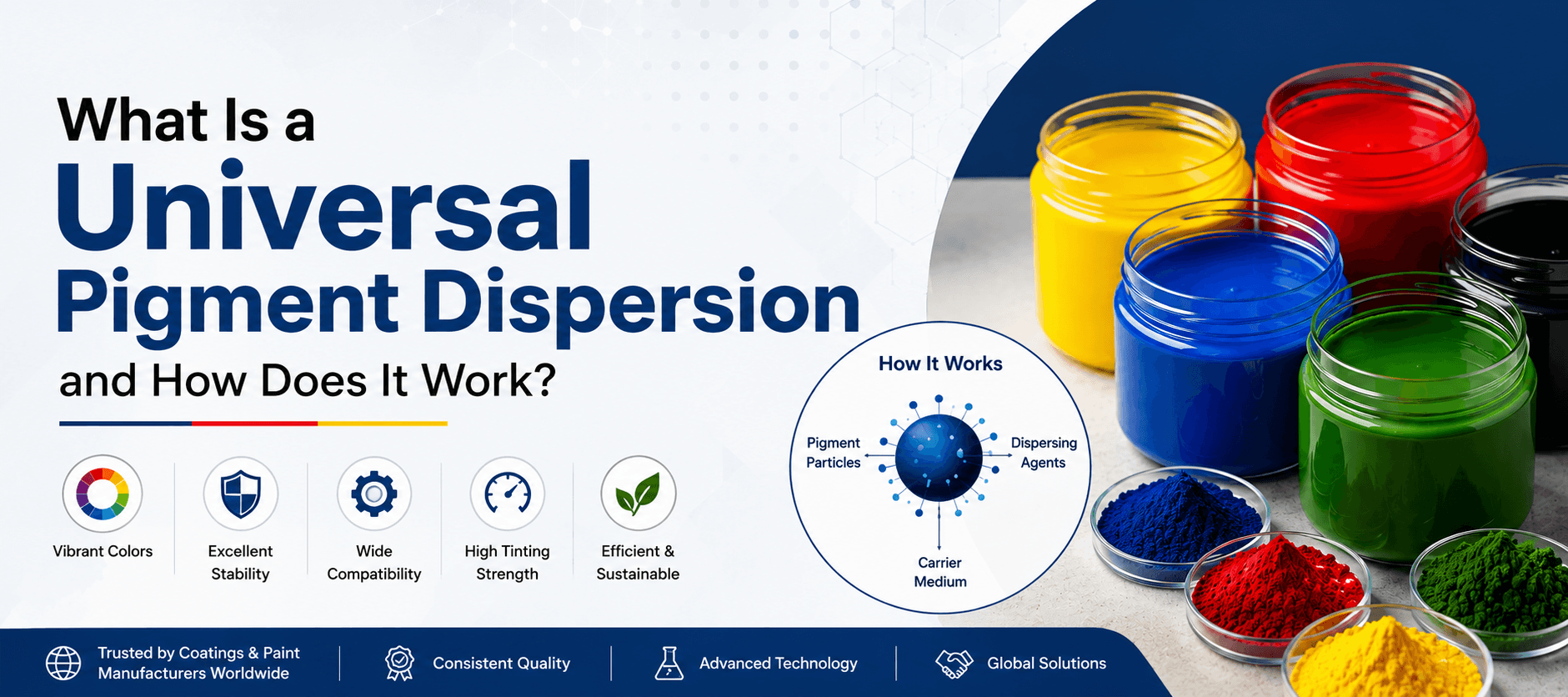
In today's coatings and color manufacturing industry, achieving consistent color, excellent compatibility, and efficient production is essential. This is where universal pigment dispersions have become an indispensable solution. Designed to work across multiple binder systems, these dispersions simplify manufacturing while delivering vibrant, stable, and high-performance colors.
Whether you're producing architectural paints, industrial coatings, wood finishes, or specialty products, understanding how universal pigment dispersions work can help improve both product quality and production efficiency.
In this guide, we'll explain what universal pigment dispersions are, how they function, their benefits, applications, and why manufacturers worldwide trust companies like Manali Pigments for reliable pigment solutions.
What Is a Universal Pigment Dispersion?
A universal pigment dispersion is a ready-to-use liquid color concentrate in which finely ground pigment particles are evenly dispersed in a specially formulated carrier system. The term "universal" refers to its ability to remain compatible with multiple paint and coating formulations, including both water-based and solvent-based systems.
Unlike dry pigments, universal pigment dispersions eliminate the need for complex grinding and dispersion processes during manufacturing. They are engineered to provide:
- Excellent color strength
- Uniform particle distribution
- Superior tinting performance
- High stability during storage
- Broad compatibility across different resin systems
These characteristics make them ideal for manufacturers seeking flexibility without compromising quality.
Want to see sustainability in action? Discover how Pigment Yellow 12 helps manufacturers reduce environmental impact while maintaining exceptional color performance in our detailed guide on sustainable manufacturing.
How Does a Universal Pigment Dispersion Work?
Universal pigment dispersions work by suspending pigment particles in a carefully balanced combination of dispersing agents, wetting agents, stabilizers, and carriers.
The process involves several key steps:
1. Pigment Wetting
The pigment particles are thoroughly wetted using specialized additives that reduce surface tension. Proper wetting allows every pigment particle to become fully surrounded by the liquid medium.
2. Fine Grinding
High-energy milling equipment reduces pigment particles into microscopic sizes. Smaller particles create:
- Better color development
- Improved gloss
- Higher tinting strength
- More uniform appearance
3. Particle Stabilization
Dispersing agents prevent pigment particles from reuniting or settling. This ensures long-term storage stability and consistent color performance.
4. Universal Compatibility
Specially selected additives allow the dispersion to blend effectively with various resin systems, including:
- Acrylic coatings
- Vinyl coatings
- Alkyd paints
- Waterborne coatings
- Solventborne coatings
- Hybrid coating systems
The result is a versatile color concentrate suitable for numerous industrial applications.
Looking for the ideal blue pigment for printing inks? Discover why Pigment Blue 15:0 is a preferred choice for manufacturers
seeking exceptional color strength, durability, and print quality in our detailed guide.
Components of Universal Pigment Dispersions
High-quality universal pigment dispersions generally consist of the following components:
Pigments
These provide the desired color and opacity. Depending on the application, manufacturers may use:
- Organic pigments
- Inorganic pigments
- High-performance pigments
Dispersing Agents
These chemicals keep pigment particles separated, preventing flocculation and sedimentation.
Wetting Agents
Wetting agents improve pigment incorporation and help achieve smoother dispersion.
Carrier Liquid
The carrier acts as the medium that transports the pigment throughout the formulation while maintaining compatibility with different coating systems.
Stabilizers
These additives improve shelf life and ensure consistent performance over time.
Choosing the right pigment is just as important as selecting the right dispersion. Explore our detailed comparison of Pigment Violet 15 and other violet pigments to find the best option for your industrial application.
Advantages of Universal Pigment Dispersions
Universal pigment dispersions offer numerous benefits for manufacturers worldwide.
Excellent Compatibility
One dispersion can often be used across multiple coating formulations, reducing inventory complexity.
Consistent Color Quality
Uniform particle distribution delivers repeatable color matching across production batches.
Improved Manufacturing Efficiency
Ready-to-use dispersions significantly reduce processing time compared to dispersing dry pigments.
Better Storage Stability
Proper stabilization minimizes settling and makes dispersions easier to remix after storage.
High Tinting Strength
Finely dispersed pigments provide vibrant colors with lower dosage levels.
Reduced Production Costs
Manufacturers can streamline inventory management while minimizing waste and production downtime.
Choosing the right universal pigment dispersion is only half the equation. Equally important is selecting a reliable supplier that delivers consistent quality, technical support, and dependable global supply. Learn what to look for in our supplier evaluation guide.
Industries That Use Universal Pigment Dispersions
Because of their versatility, universal pigment dispersions are widely used across numerous industries.
Architectural Paints
Interior and exterior wall coatings require consistent colors and excellent durability.
Industrial Coatings
Machinery, equipment, and structural coatings benefit from reliable tinting and long-term stability.
Wood Coatings
Furniture manufacturers use universal pigment dispersions for decorative and protective finishes.
Decorative Paints
Bright colors, easy tinting, and smooth application make them ideal for decorative coatings.
Construction Materials
Colored cement products, concrete coatings, and specialty construction materials also utilize pigment dispersions.
Printing Inks
Certain pigment dispersions are formulated specifically for high-performance ink systems.
Selecting the right pigment dispersion supplier is essential for achieving consistent color, batch stability, and dependable technical support. Explore our guide to discover the key factors every importer should evaluate before placing an order.
Universal Pigment Dispersions vs. Dry Pigments
|
Feature |
Universal Pigment Dispersions |
Dry Pigments |
|
Ready to Use |
Yes |
No |
|
Processing Time |
Low |
High |
|
Color Consistency |
Excellent |
Depends on dispersion quality |
|
Dust Generation |
Minimal |
High |
|
Storage Stability |
Excellent |
Good |
|
Ease of Mixing |
Very Easy |
Requires specialized equipment |
For manufacturers seeking greater efficiency and consistent quality, universal pigment dispersions offer significant operational advantages.
Not sure whether a pearlescent or metallic pigment is the right choice for your application? Explore our detailed comparison to understand the differences in appearance, durability, weather resistance, and long-term performance.
How to Choose the Right Universal Pigment Dispersion
Selecting the right dispersion depends on several factors:
- Compatibility with your resin system
- Required color strength
- Lightfastness requirements
- Weather resistance
- Heat stability
- Chemical resistance
- End-use application
- Regulatory compliance for target markets
Working with an experienced pigment manufacturer helps ensure the dispersion meets both technical and commercial requirements.
Why Choose Manali Pigments?
At Manali Pigments, we manufacture high-quality universal pigment dispersions designed to meet the needs of paint, coatings, plastics, construction, and industrial manufacturers across global markets.
Our solutions are engineered to provide:
- Excellent compatibility across multiple coating systems
- Superior color consistency
- High tinting strength
- Outstanding storage stability
- Reliable batch-to-batch quality
- Customized color solutions for diverse industrial applications
With a commitment to quality, innovation, and customer support, Manali Pigments helps manufacturers achieve efficient production while maintaining exceptional product performance.
Conclusion
Universal pigment dispersions have transformed the way manufacturers develop colors for paints and coatings. Their ability to deliver consistent color, broad compatibility, improved efficiency, and long-term stability makes them an essential component in modern manufacturing.
Whether you produce architectural paints, industrial coatings, wood finishes, or specialty products, investing in high-quality universal pigment dispersions can improve production efficiency while ensuring reliable color performance.
Partnering with an experienced manufacturer like Manali Pigments gives businesses access to advanced pigment technologies, dependable quality, and customized solutions that support success in competitive global markets.
Frequently Asked Questions
1. Can universal pigment dispersions be used in both water-based and solvent-based paints?
Yes. High-quality universal pigment dispersions are formulated to be compatible with both water-based and solvent-based coating systems.
2. What industries use universal pigment dispersions?
They are commonly used in architectural paints, industrial coatings, wood coatings, decorative paints, printing inks, and construction materials.
3. Why are universal pigment dispersions better than dry pigments?
They reduce processing time, improve color consistency, minimize dust generation, and provide better storage stability and ease of use.
4. How should universal pigment dispersions be stored?
Store them in tightly sealed containers at recommended temperatures, away from direct sunlight and extreme environmental conditions to maintain optimal performance.
5. Can universal pigment dispersions be customized?
Yes. Manufacturers like Manali Pigments can develop customized dispersions based on color requirements, resin compatibility, and specific industrial applications