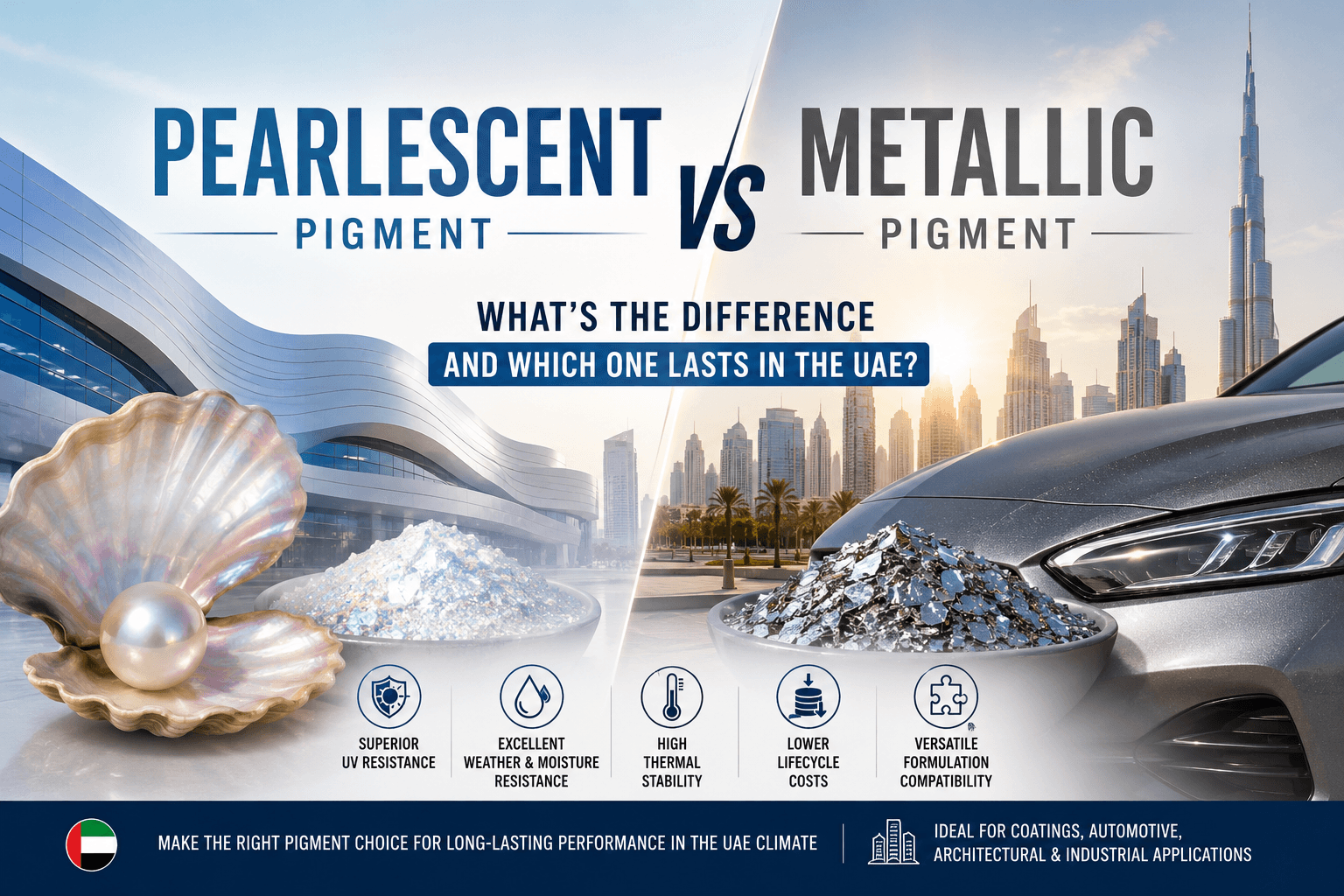
If you're sourcing pigments for coatings, automotive finishes, or architectural applications in the UAE, you've likely faced a frustrating reality: colors that look stunning on day one start fading, chalking, or peeling within months. The culprit often isn't the paint itself; it's the wrong pigment choice for the environment. Understanding the difference between pearlescent pigment and metallic pigment isn't just a technical exercise; it's a decision that directly impacts your repainting costs, product lifespan, and client satisfaction.
According to a 2023 report by MarketsandMarkets, the global special effect pigments market, which includes pearlescent and metallic variants, is projected to reach USD 1.9 billion by 2028, driven largely by demand from the construction, automotive, and coatings industries in high-UV, high-humidity regions like the Middle East.
Let's break down exactly what sets these two pigment types apart and why it matters for your operations in the UAE.
What Is a Pearlescent Pigment?
Pearlescent pigment is a light-interference pigment that mimics the iridescent shimmer of natural pearls. Unlike solid-color pigments, it doesn't absorb or reflect light in a simple, direct way. Instead, it refracts and reflects light at multiple angles, creating a soft, luminous depth of color that shifts depending on the viewing angle.
The most common and reliable form is mica-based pearlescent pigment, where thin platelets of natural or synthetic mica are coated with titanium dioxide (TiO₂) or iron oxide. This layered structure is what produces the optical interference effect, and it's also what gives this pigment its impressive durability.
Key characteristics of pearlescent pigment:
- Soft, multi-dimensional shimmer (not a flat metallic shine)
- Available in a wide range of pearlescent color pigments, from subtle silvers to bold golds, blues, and greens
- Chemically stable and inert
- Highly compatible with water-based and solvent-based coating systems
- Non-toxic and RoHS-compliant variants widely available
Explore how green chrome oxide pigment is transforming industries from coatings and ceramics to construction and refractory applications with its exceptional heat resistance, durability, and color stability.
What Is Metallic Pigment?
Metallic pigments are typically made from fine flakes of actual metals, most commonly aluminum, bronze, copper, or zinc. They produce a mirror-like, high-gloss metallic finish that is visually striking but structurally quite different from pearlescent pigments.
Key characteristics of metallic pigments:
- High reflectivity and a "true metal" appearance
- Heavier particle density compared to mica platelets
- More prone to oxidation and reactivity with moisture
- Often require protective topcoats to maintain finish integrity
- Can be challenging to disperse evenly in formulations
While metallic pigments produce a bold, industrial aesthetic, their performance in demanding outdoor environments, particularly in regions like the UAE, raises significant concerns.
Pigment Green 7 continues to play a major role across Canada’s coatings, plastics, and printing industries due to its excellent durability and color stability. Explore how different industries use this high-performance pigment in our detailed guide on Pigment Green 7 applications in Canada.
Why the Difference Matters for Coating Professionals in the UAE
The UAE presents one of the most challenging climatic environments for coatings and pigments in the world:
- UV Index: Regularly exceeds 10–11 (extreme category) for 6–8 months of the year
- Temperature range: Surfaces can reach 70–80°C in direct summer sun
- Humidity: Coastal cities like Abu Dhabi and Dubai experience relative humidity of 80–90% in summer
- Rainfall and sandstorms: While infrequent, these cause rapid mechanical and chemical stress on coatings
For metallic pigments, this environment is especially unforgiving. Aluminum flakes oxidize when exposed to moisture, leading to a dull, grey haze on coated surfaces. Thermal expansion and contraction cause metallic flake-based coatings to crack and delaminate faster, significantly increasing your maintenance and repainting frequency.
Mica-based pearlescent pigments, by contrast, are chemically inert, non-metallic, and inherently resistant to these stressors. The TiO₂ coating on mica platelets actually acts as a UV-scattering layer, protecting both the pigment and the binder system beneath it.
Canada’s pearlescent pigment industry is evolving rapidly with growing demand for eco-friendly coatings, premium finishes, and high-performance industrial applications. Discover the future trends shaping the pearlescent pigments market in Canada and what industries can expect by 2030+.
Key Advantages of Pearlescent Pigment for UAE Applications
Here's why procurement managers, formulators, and coating applicators across the UAE are shifting toward pearlescent color pigments:

1. Superior UV Resistance
Mica-based pearlescent pigments do not fade or chalk under prolonged UV exposure. The inorganic oxide coatings on the mica platelets are photostable, meaning your colors stay true for years, not months.
2. Excellent Weather and Moisture Resistance
Unlike metallic flakes, mica platelets do not oxidize or react with humidity. This is critical for coastal applications in Dubai, Sharjah, and Ras Al Khaimah, where salt air and high humidity accelerate coating failure.
3. Thermal Stability
Pearlescent pigments are stable at temperatures exceeding 800°C in many grades, making them suitable for industrial coatings, automotive applications, and even building exteriors that face extreme heat.
4. Lower Lifecycle Costs
Because pearlescent pigments maintain their integrity longer, recoating intervals extend significantly. For large commercial or infrastructure projects, this translates directly into reduced labor, material, and downtime costs.
5. Versatile Formulation Compatibility
Pearlescent pigments integrate cleanly into solvent-based, water-based, and powder coating systems, giving formulators flexibility without compromising performance.
Pearlescent vs Metallic Pigment: Quick Comparison
Choosing the right pigment is not just about visual appeal. Performance under UV exposure, moisture, and extreme heat plays a major role in determining long-term coating durability in the UAE climate.
|
Property |
Pearlescent Pigment |
Metallic Pigment |
|
Base Material |
Mica + oxide coating |
Metal flakes (Al, Cu, Bronze) |
|
UV Stability |
Excellent |
Moderate to Poor |
|
Moisture Resistance |
High |
Low (prone to oxidation) |
|
Thermal Stability |
Very High |
Moderate |
|
Finish Type |
Soft iridescent shimmer |
High-gloss mirror shine |
|
Maintenance Cost |
Low |
High |
|
Toxicity |
Non-toxic (most grades) |
Varies (some reactive) |
|
Ideal Use |
Exterior, automotive, industrial |
Interior, decorative, short-cycle applications |
As the comparison shows, pearlescent pigments offer superior durability, weather resistance, and lower maintenance costs, making them a more reliable choice for demanding outdoor and industrial applications in the UAE.
Want to make smarter pigment sourcing decisions? Explore our complete guide to phthalocyanine pigments for industrial buyers, covering applications, performance benefits, and how to choose the right pigment grade for your industry.
How to Choose the Right Pigment for Your Application
Follow this simple framework when evaluating pigment options for UAE-based projects:
- Assess the exposure conditions
Is the application exterior or interior? Direct sun or shaded? Coastal or inland? - Define the performance life expectancy
A 1-year interior display versus a 10-year building facade requires entirely different pigment grades. - Check formulation compatibility
Confirm whether your binder system is solvent, water, or powder-based, and match pigment particle size accordingly. - Request technical datasheets
Any reputable pearlescent pigment manufacturer should provide full specifications including light fastness ratings, chemical resistance, and heat stability data. - Prioritize certified suppliers
Look for manufacturers complying with REACH, RoHS, and ISO quality standards. Sourcing from a pearlescent pigment manufacturer in India with established export credentials to the GCC region can offer both quality assurance and cost efficiency.
Conclusion: Make the Right Pigment Decision for the UAE Market
When it comes to long-term coating performance in the UAE, the choice between pearlescent and metallic pigment is clear. Metallic pigments can deliver a striking initial visual impact, but their vulnerability to UV exposure, humidity, oxidation, and thermal stress makes them a costly long-term choice in this climate.
Pearlescent pigment, especially mica-based variants, offers the durability, stability, and visual sophistication that demanding UAE applications require. Whether you're formulating coatings for a luxury residential tower in Dubai, a commercial fleet in Abu Dhabi, or infrastructure projects across the Emirates, the right pearlescent pigment can dramatically reduce your lifecycle costs while elevating your finish quality.
Partnering with an experienced pearlescent pigment manufacturer who understands the technical demands of the GCC market is the first step toward getting this right.
Ready to evaluate pearlescent pigments for your next project? Request a technical sample or consult with our formulation experts to find the grade that matches your exact application needs.
Frequently Asked Questions
1. What is mica-based pearlescent pigment used for?
Mica-based pearlescent pigment is widely used in architectural coatings, automotive paints, cosmetics, plastics, printing inks, and industrial finishes. Its UV stability and weather resistance make it particularly well-suited for exterior applications in high-UV environments like the UAE.
2. Can pearlescent pigments be used in exterior architectural coatings?
Yes. High-quality pearlescent pigments with TiO₂ or iron oxide coatings are specifically engineered for exterior durability. They resist UV degradation, moisture, and thermal cycling, all critical factors for coatings in the UAE climate.
3. How do pearlescent color pigments differ from standard colored pigments?
Standard colored pigments absorb certain wavelengths of light and reflect others to produce a flat color. Pearlescent color pigments work through optical interference. Light passes through and reflects off multiple thin layers, creating a depth and shift of color that changes with the viewing angle.
4. Why source from a pearlescent pigment manufacturer in India?
India has emerged as a globally competitive hub for specialty pigment manufacturing, offering high-grade mica reserves, advanced processing infrastructure, and competitive pricing. Many Indian manufacturers are ISO certified and export extensively to the Middle East, making them reliable partners for UAE-based buyers.
5. Is pearlescent pigment safe to use in water-based coatings?
Yes. Most mica-based pearlescent pigments are inert, non-toxic, and fully compatible with water-based coating systems. They also meet international safety standards, making them suitable for both industrial and consumer applications.
6. What minimum quantities do pearlescent pigment manufacturers typically offer?
This varies by manufacturer and grade. Many pearlescent pigment manufacturers offer MOQs starting from 25 kg for specialty grades, with bulk pricing available for orders exceeding 100–500 kg. It's advisable to request samples before committing to full production quantities.