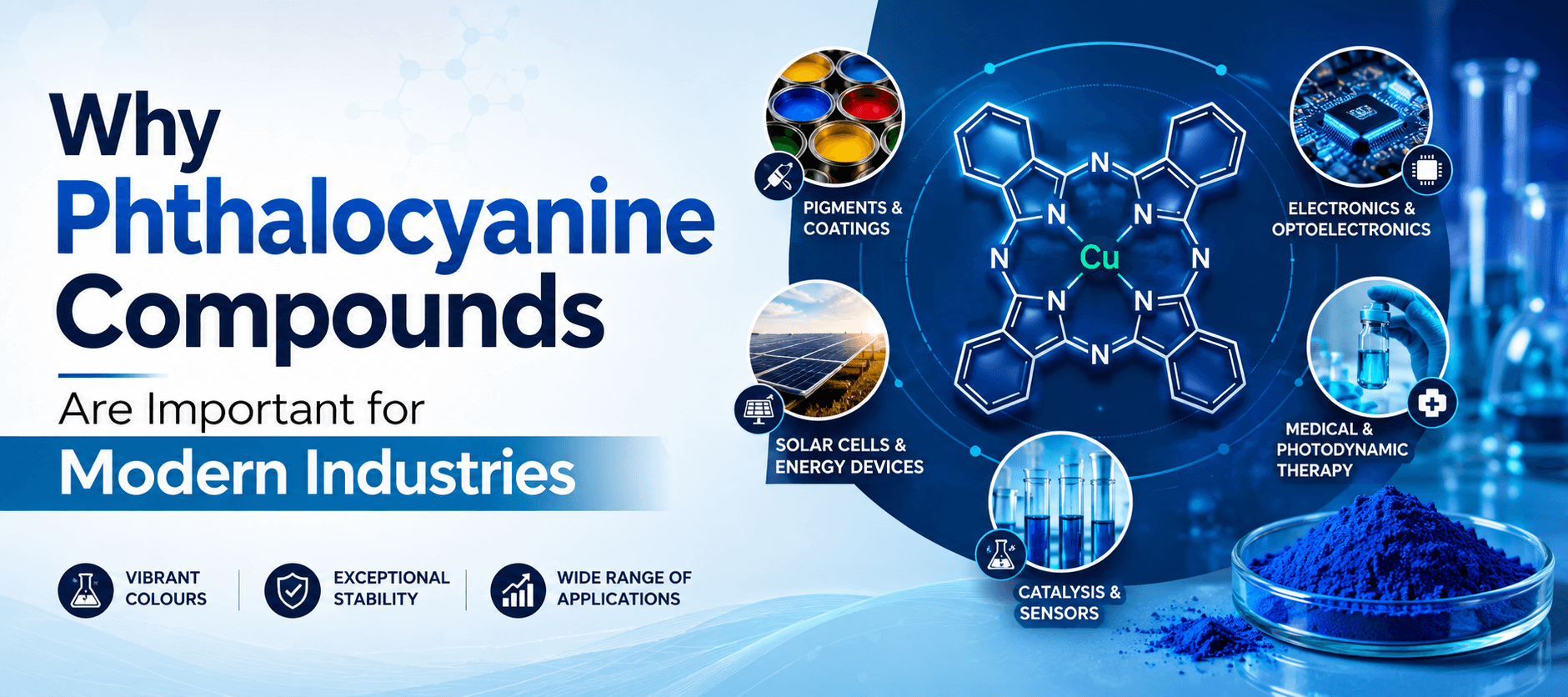
Phthalocyanines are a class of intensely coloured, highly stable synthetic macrocyclic compounds first discovered in the early 20th century. What began as an accidental pigment discovery has evolved into one of the most versatile and industrially significant families of organic compounds in modern chemistry. Today, phthalocyanines are indispensable to industries ranging from printing and coatings to semiconductors, photovoltaics, and advanced medical therapies.
This blog explores what phthalocyanines are, why they matter, and how their unique chemical architecture makes them irreplaceable in manufacturing and technology.
What Is Phthalocyanine?
Phthalocyanine is a large, planar aromatic molecule consisting of four isoindole units linked by nitrogen bridges. Its distinctive ring structure, similar in some respects to biological porphyrins such as haemoglobin and chlorophyll, gives it an extraordinary capacity to absorb light, conduct electricity, and coordinate with a wide array of metal ions.
The molecular formula of the parent compound is C₃₂H₁₈N₈, and it can be synthesised with more than 70 different metal centres at its core, from copper and iron to zinc, cobalt, and titanium.
Key characteristics that define this compound family include:
- Outstanding thermal and chemical stability (stable up to 500°C in many forms)
- Intense absorption in the visible and near-infrared spectrum
- Tunable optical, electrical, and catalytic properties depending on the central metal ion
- Ease of functionalisation, allowing peripheral substituents to alter solubility and reactivity
If you’re interested in industrial pigments and colour technologies, explore how Ultramarine Blue pigments are transforming manufacturing, plastics, coatings, and packaging industries in Brazil.
The Broader Family: Phthalocyanines in High-Tech Applications
Beyond pigmentation, phthalocyanines have become integral to a range of advanced technology sectors. Their unique combination of optical activity, semiconducting behaviour, and catalytic functionality opens doors that few other compound classes can match.
Organic Electronics and Semiconductors
Metal phthalocyanines, particularly those of copper, zinc, and titanyl, are intrinsic p-type organic semiconductors. Their flat, aromatic structure promotes efficient pi-pi stacking, enabling charge transport along molecular layers. This makes them critical in:
- Organic thin-film transistors (OTFTs)
- Organic photovoltaic (OPV) cells and perovskite solar cell hole-transport layers
- Organic light-emitting diodes (OLEDs)
- Non-volatile memory devices
Photodynamic Therapy (PDT) in Medicine
Certain phthalocyanines, especially zinc and aluminium complexes, are potent photosensitisers. When activated by light, they generate reactive oxygen species (ROS) that destroy cancer cells. Several phthalocyanine-based PDT agents are approved or under clinical investigation for:
- Skin and mucosal cancers
- Age-related macular degeneration
- Antimicrobial photodynamic inactivation
Gas Sensing and Environmental Monitoring
The electrical conductivity of phthalocyanine thin films changes measurably in the presence of trace gases such as NO₂, NH₃, H₂S, and volatile organic compounds. This makes them excellent candidates for chemical sensors used in industrial safety monitoring.
Catalysis
Iron, cobalt, and manganese phthalocyanines are effective catalysts for oxidation reactions. They are employed in petroleum sweetening processes, desulphurisation, and the synthesis of fine chemicals.
If you’re sourcing high-quality colourants for industrial applications, learn how to choose reliable solvent dye suppliers for consistent quality, technical support, and long-term manufacturing performance.
Water-Soluble Phthalocyanine: Expanding the Application Space
A longstanding limitation of classical phthalocyanines has been their extremely low solubility in water and polar solvents. This restricts their use in biological applications, aqueous processing, and certain catalytic systems. The development of water-soluble phthalocyanine derivatives has been a major breakthrough.
How Water Solubility Is Achieved
Peripheral functionalisation of the phthalocyanine ring with hydrophilic groups introduces water solubility without destroying the core electronic properties:
- Sulphonic acid groups (-SO₃H), the most common approach, producing tetra- or octa-sulphonated derivatives
- Ammonium and carboxylate groups for pH-responsive behaviour
- Polyethylene glycol (PEG) chains for bioconjugation compatibility
Key Applications of Water-Soluble Phthalocyanines
The growing versatility of water-soluble phthalocyanines has opened opportunities across multiple industries, particularly in healthcare, environmental technology, textiles, and digital printing. The table below highlights some of their most important applications and benefits.
|
Application |
Key Benefit |
Industry Sector |
|
PDT anticancer agents |
Biocompatible and tumour-targeting |
Oncology / Pharma |
|
Wastewater treatment catalysts |
Degrades organic pollutants under light |
Environmental |
|
Textile dyeing (direct dyes) |
Excellent wash fastness in aqueous baths |
Textiles |
|
Inkjet printing inks |
Aqueous formulation with vivid blue and green colours |
Digital Printing |
|
Biosensors |
Compatible with physiological media |
Diagnostics |
Water-soluble phthalocyanine derivatives are particularly promising for wastewater treatment, photocatalytic degradation of persistent organic pollutants, and advanced pharmaceutical research.
If you want to explore more about the global pigment industry, discover how the Ultramarine Blue market in Mexico is expanding across plastics, coatings, construction materials, and packaging applications.
Future Directions: What's Next for Phthalocyanines?
The next decade promises exciting developments in phthalocyanine science and engineering.
Next-Generation Solar Cells
Phthalocyanines are being integrated into perovskite and dye-sensitised solar cell architectures as hole-transport materials and co-sensitisers. Their near-infrared absorption complements the blue-green absorption of many co-pigments, enabling broader sunlight harvesting.
Hydrogen Production via Electrocatalysis
Cobalt and iron phthalocyanines are among the most active non-precious-metal catalysts for the oxygen reduction reaction (ORR) and CO₂ electroreduction, critical reactions in hydrogen fuel cells and carbon capture electrochemistry.
If you want to understand how manufacturers achieve uniform shades and reliable product quality, explore how pigment dispersions improve color consistency across coatings, plastics, inks, and textile applications.
Quantum Information Science
Single phthalocyanine molecules can be deposited on surfaces with atomic precision and have demonstrated molecular-scale electronic switching. As quantum computing progresses, engineered phthalocyanine architectures may serve as qubits or spin logic elements.
Sustainable Synthesis
Current large-scale production of copper phthalocyanine involves phthalic anhydride, urea, and copper salts at high temperatures. Green chemistry initiatives are exploring solvent-free mechanochemical synthesis, microwave-assisted routes, and biobased precursors to reduce environmental impact.
Conclusion
Phthalocyanine compounds exemplify how a single molecular scaffold, when properly engineered, can serve an astonishing breadth of industrial and technological purposes. From the omnipresent copper phthalocyanine pigments that colour packaging and publications worldwide, to sophisticated water-soluble phthalocyanine derivatives advancing cancer therapy and environmental remediation, this compound family continues to prove its value.
Understanding the self-assembly behaviour of phthalocyanine associates and harnessing the collective properties of phthalocyanines in thin-film and nanostructured formats will be central to the next wave of innovations in energy, electronics, and medicine.
For industries and researchers globally, phthalocyanines represent not only a mature and reliable class of industrial materials, but also a frontier of active scientific discovery with immense future potential.
FAQs About Phthalocyanine Compounds
1. What are phthalocyanines used for?
Phthalocyanines are widely used in pigments, printing inks, plastics, coatings, textiles, electronics, solar cells, sensors, catalysts, and medical therapies such as photodynamic therapy (PDT).
2. Why is copper phthalocyanine important in industry?
Copper phthalocyanine is one of the most widely produced organic pigments because of its excellent colour strength, heat resistance, UV stability, and chemical durability. It is commonly used in paints, inks, plastics, and packaging materials.
3. What colour is phthalocyanine pigment?
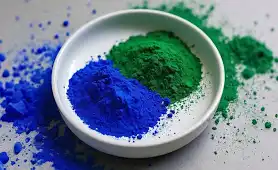
Phthalocyanine pigments are mainly known for their intense blue and green shades. Pigment Blue 15 and Pigment Green 7 are among the most common industrial phthalocyanine pigments.
4. Are phthalocyanines used in electronics?
Yes. Certain metal phthalocyanines function as organic semiconductors and are used in OLEDs, organic solar cells, sensors, and thin-film transistors.
5. What makes phthalocyanines chemically stable?
Their large aromatic ring structure and strong molecular bonding provide excellent resistance to heat, light, oxidation, and chemical exposure, making them highly durable in industrial applications.
6. What are water-soluble phthalocyanines?
Water-soluble phthalocyanines are modified derivatives designed with hydrophilic groups that allow them to dissolve in water. They are commonly used in medical imaging, photodynamic therapy, wastewater treatment, and aqueous ink formulations.
7. How are phthalocyanines used in medicine?
Phthalocyanines are used as photosensitisers in photodynamic therapy. When activated by light, they produce reactive oxygen species that help destroy cancer cells and harmful microorganisms.
8. What are phthalocyanine associates?
Phthalocyanine associates are molecular aggregates formed through pi-pi stacking interactions between phthalocyanine molecules. These structures influence optical, electronic, and sensing properties.