
- Home
- Pigments for Printing Inks
- Article
Pigment Blue 15:3 vs 15:4 for Flexographic and Gravure Inks: A Selection Checklist
Compare Pigment Blue 15:3 and 15:4 only as named commercial grades in the same ink system, using the same preparation, test conditions and pre-agreed decision criteria. For this MPPL example, that means evaluating MANALI BLUE 115318 and MANALI BLUE 115418 against a defined flexographic or gravure application brief rather than treating either Color Index designation as a complete performance specification.
The Color Index designation alone does not prove performance in flexographic or gravure inks; grade, formulation and test conditions remain material.
In this guide
- Define the ink decision
- Confirm grade identity
- Review the evidence matrix
- Flexographic trial controls
- Gravure trial controls
- Interpret and select
- Frequently asked questions
- References
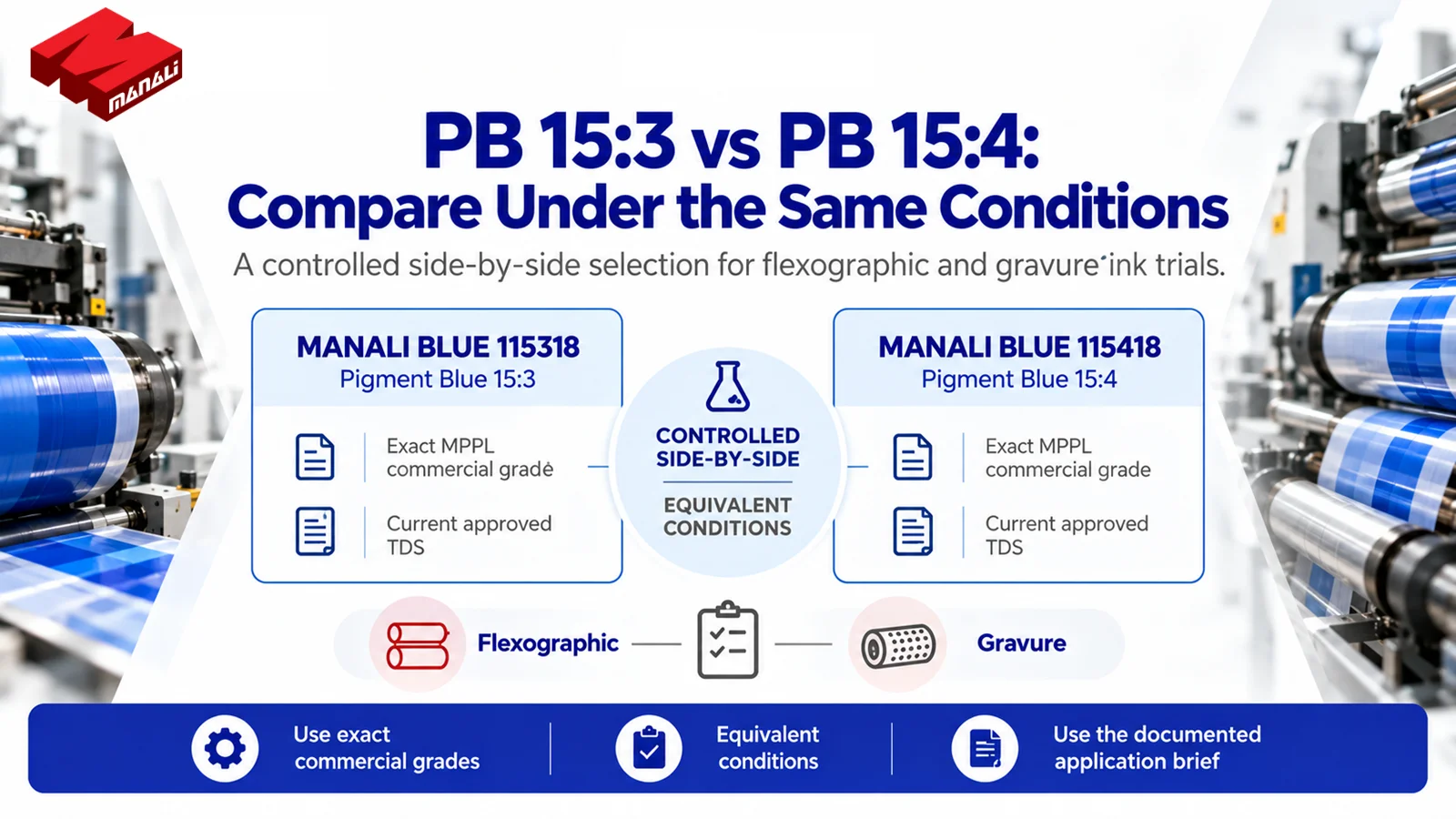
Conceptual comparison framework—not a photograph of MPPL equipment, a completed trial or a calibrated pigment-shade comparison.
A controlled pigment comparison changes the pigment candidate while keeping the relevant formulation, process and evaluation conditions equivalent.
- Verify each exact commercial grade.
- Hold the ink system and process constant.
- Compare approved TDS fields side by side.
- Run equivalent dispersion and print evaluations.
- Select against the documented application brief.
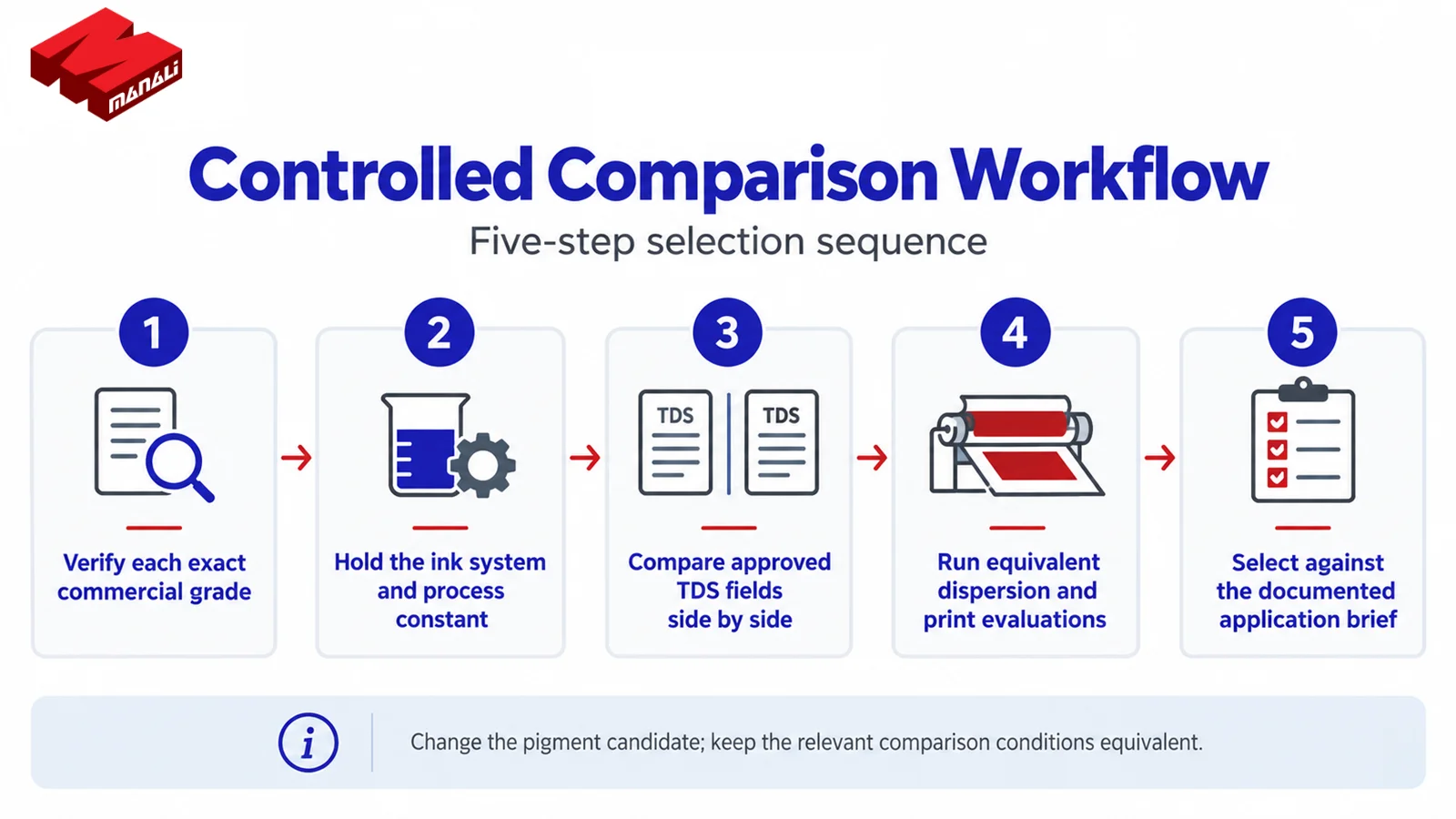
The five steps describe how to conduct a controlled comparison; they do not establish that every condition was matched in a particular trial.
Use Pigment Blue 15:3 vs 15:4 for a Defined Ink Decision
PB 15:3 and PB 15:4 are Color Index identities. The candidates here are MANALI BLUE 115318, identified as Pigment Blue 15:3, and MANALI BLUE 115418, identified as Pigment Blue 15:4. Their technical data sheets (TDSs) place both products within the Phthalocyanine Blue and Green pigments family. [1]
A commercial grade is the supplier product tied to its technical documentation. A control/reference is the approved comparison sample used to interpret a trial. Equivalent conditions keep the relevant formulation, preparation and evaluation basis the same between candidates. An application brief defines what the intended ink must achieve.
MPPL’s application clarification identifies solvent-based nitrocellulose (NC) systems with 12% pigment loading. It specifies biaxially oriented polypropylene (BOPP) film for flexographic evaluation and polyethylene (PE) film for gravure evaluation, both using an automatic film applicator. The percentage denominator and complete formulation are not specified in that clarification. [3]
The decision is therefore not simply “Which pigment is better?” It is whether a named grade meets a documented requirement under a defined process. The broader Pigments for Printing Inks guide supplies the application context. Laboratory drawdowns support evaluation; they do not, by themselves, demonstrate production-press or finished-packaging performance. The recorded flow times below are observations, not a universal grade ranking.
Confirm Identity Before Comparing Properties
Confirm the CI designation
MANALI BLUE 115318 is documented as Pigment Blue 15:3, while MANALI BLUE 115418 is Pigment Blue 15:4. Both TDSs identify the chemical type as phthalocyanine and list C.I. Constitution No. 74160. [1] The CI Numbers and Technical Reference page explains the identity context; selection still requires the exact commercial-grade documentation.
Record the commercial grade
Record the supplier name and complete grade code alongside every result. The two identities in this example are MANALI BLUE 115318 and MANALI BLUE 115418—not every product sold under PB 15:3 or PB 15:4. Match the sample identification to the grade record before using a result in a purchasing or formulation decision.
Check supplier document revision
MPPL’s document-control clarification identifies TDS document numbers 115318 and 115418, gives 1 January 2024 as their revision/date, and names Adarsh Vishwakarma as approver. [3] Those details come from the clarification record; the TDS pages themselves do not display that revision information. Keep both records together when tracing the basis of a comparison.
Match the test method
A Zahn-cup reading measures flow time in seconds. Different cup sizes have different orifices and measurement ranges, so “Zahn cup” alone does not identify a complete measurement setup. An applicable cup-specific method is needed before converting a time into another viscosity unit. [7]
The reported trial sheet gives times but does not identify the cup number, test temperature or replicate readings. It also does not expressly confirm matched candidate preparation or solvent adjustment. [6] Consequently, the measurements can be reported as recorded observations, but equivalent-condition performance and pass/fail conclusions are not established by that sheet alone.
Build the Side-by-Side Evidence Matrix
A useful matrix separates three things: supplier information, measured observations and a decision against an application requirement. Both TDSs recommend NC inks, which supports considering these products for evaluation. It does not establish that either grade has passed the intended trial. [1]
The recorded flow times are 24 and 14 seconds for flexographic ink, and 30 and 15 seconds for gravure ink. [6] MPPL’s application clarification states a requirement of less than 20 seconds. [3] The lower recorded numbers are numerically below that threshold, but a qualification decision also needs the applicable cup method, conditions and confirmed comparison basis. A filename describing “matched” trial data does not supply those details.
On smaller screens, scroll the table horizontally to read all five columns.
| Decision criterion | PB 15:3 grade data | PB 15:4 grade data | Method/condition | Decision |
|---|---|---|---|---|
| Commercial-grade identity | MANALI BLUE 115318; PB 15:3. [1] | MANALI BLUE 115418; PB 15:4. [2] | TDS identity; document-control clarification. [3] | Correct identities for the proposed comparison. |
| NC ink recommendation | Recommended. [1] | Recommended. [2] | Supplier application profiles, not trial results. | Both remain candidates for evaluation. |
| Flexographic flow time | 24 s reported. [6] | 14 s reported. [6] | Zahn cup stated; cup number, temperature and executed equivalence not recorded. | NON-COMPARABLE for qualification on these records alone. |
| Gravure flow time | 30 s reported. [6] | 15 s reported. [6] | Zahn cup stated; cup number, temperature and executed equivalence not recorded. | NON-COMPARABLE for qualification on these records alone. |
| Bulk density | 0.32 ± 0.1 g/ml. [1] | 0.54 ± 0.1 g/ml. [2] | Test method not stated in the TDSs. | NON-COMPARABLE for selection; no performance ranking. |
| Heat stability | 280°C for 5 minutes. [1] | 260°C for 10 minutes. [2] | Different exposure durations. | NON-COMPARABLE; do not rank by temperature alone. |
The limitation is not that the recorded numbers must be wrong. It is that the available information does not demonstrate an equivalent basis for a selection claim. Keep the source, revision and conditions attached to each entry, using the relevant quality documentation rather than merging unrelated properties into one score.
Control the Flexographic Trial
MPPL’s flexographic application clarification specifies solvent-based NC ink, 12% pigment loading, BOPP film and an automatic film applicator. The named reference is the standard approved flexographic ink sample. [3] That reference description identifies its role, but the trial record should also connect the actual retained sample to the measurements being evaluated.
The flexographic standard operating procedure (SOP) specifies 60 minutes in a vibro shaker for mixing and pigment wetting/dispersion. It calls for cooling or resting the sample to ambient temperature if heat develops, and checking or adjusting the ink using a Zahn/flow cup where required. [4] Candidate comparisons should therefore record any solvent adjustment, rather than assuming that the same nominal pigment loading guarantees an identical measurement basis.
The procedure then describes film application, drying and evaluation against a standard reference. Its evaluation includes L, a, b* color coordinates, color difference (ΔE), optical density and inspection for speckles, agglomerates or streaks. [4] These are method requirements, not published results showing an advantage for either candidate. The example rod thickness and applicator-speed ranges in the SOP are not evidence of the settings used for these measurements.
The reported flow-time entries are 24 seconds for the PB 15:3 candidate and 14 seconds for the PB 15:4 candidate. [6] Treat them as a reason to examine the measurement record, not as a completed approval. Before applying the less-than-20-second requirement, identify the cup, temperature, sample preparation and adjustment history, and confirm that the criterion applies to that setup. No storage-performance conclusion follows from this comparison.
Control the Gravure Trial
The gravure example is a separate solvent-based NC application, also recorded at 12% pigment loading. MPPL specifies PE film, an automatic film applicator and the standard approved gravure ink sample as the reference. [3] The shared binder family and nominal percentage do not prove that the entire formulation or measurement setup is identical to the flexographic system.
The gravure SOP specifies 60-minute vibro-shaker preparation and controlled film application. It describes the use of milling media where a fine dispersion is required, but this does not identify the media actually used in the recorded trial. The procedure includes visual checks for transparency, gloss, coverage and undispersed pigment, together with L, a, b* and ΔE evaluation against an approved reference. [5]
Maintain the gravure-specific substrate, applicator setting, drying condition and reference in the comparison record. Example thicknesses, speed ranges and alternative drying arrangements in a procedure are choices to control, not executed values to assume. Likewise, a listed evaluation step is not proof that comparative gloss or color results were obtained.
The recorded gravure flow times are 30 seconds for the PB 15:3 candidate and 15 seconds for the PB 15:4 candidate. [6] As with flexographic evaluation, the record does not establish the cup number, test temperature or matched adjustment history. The lower recorded time is therefore an observation, not proof of better gravure suitability. A defensible decision needs the result linked to the applicable method and acceptance basis, followed by the other requirements of the intended print application.
Interpret Trade-Offs and Select a Trial Candidate
Organize the decision into must-have requirements, preferred attributes and observations. Must-have requirements include correct grade identity, a defined ink system, a documented comparison method and the application’s acceptance criteria. Preferred attributes should be specified by the application owner; they should not be invented after the results are known.
Here, the documents establish the two commercial identities, NC recommendations, process/substrate descriptions, reported flow times and a stated less-than-20-second requirement. [1] [3] They do not establish every execution condition needed to turn the recorded times into a qualified comparative result. The next decision is to verify those conditions or run a controlled comparison—not to label either grade universally superior.
If an appropriately documented repeat comparison meets an applicable flow-time criterion, that supports only that criterion for the tested ink. Additional requirements remain separate. Heat-stability entries with different durations, or bulk-density values without matched methods, should not compensate for missing application evidence through an improvised average or composite score.
A practical trial brief should identify both candidate codes, the reference sample, ink system, loading basis, intended substrate and measurement method. State which observations are mandatory for the intended print job and who will authorize the next step. Record a change to those conditions as a new comparison rather than extending an earlier conclusion.
Retain a clear decision record linking the candidate, reference, method, observations, requirement and disposition. Distinguish a request for further evaluation from approval for production use. This keeps a practical selection checklist useful even when supplier information is incomplete, without treating an unrecorded condition as a favorable result.
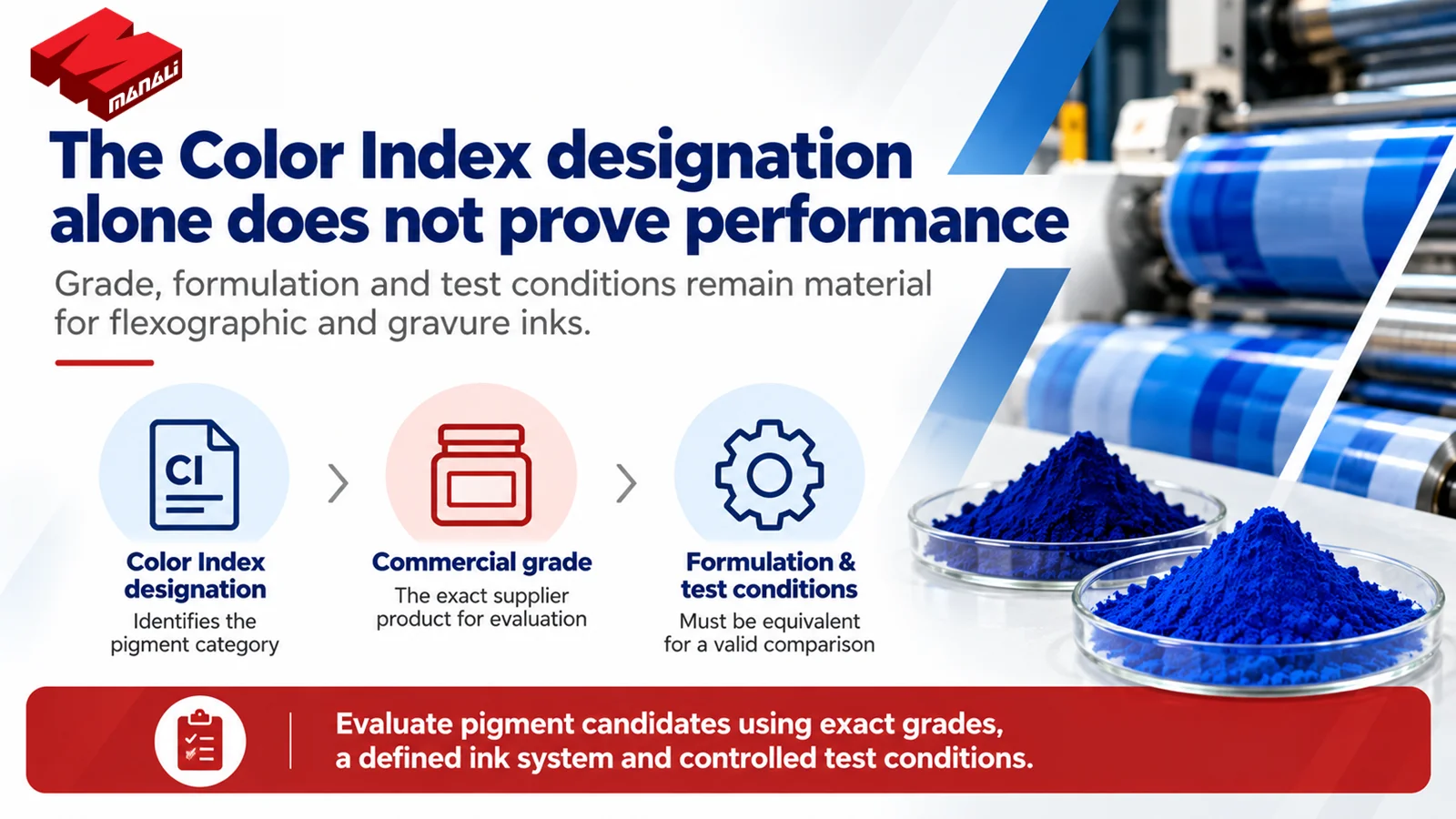
Conceptual decision boundary: exact grade and equivalent conditions are needed for a valid comparison. Displayed colors and printing equipment are illustrative, not test evidence.
For grade-specific documentation or application discussion, Request the relevant TDS / discuss the application.
Frequently Asked Questions
What is the practical difference between PB 15:3 and PB 15:4?
For formulation decisions, establish the difference between named commercial grades rather than assuming it from CI labels. MANALI BLUE 115318 and MANALI BLUE 115418 have separate TDS identities. Their recorded flow times differ, but the supplied measurement record does not establish all conditions needed for a qualified performance ranking in either ink process. [1] [6]
Can a CI designation alone determine ink suitability?
No. A CI designation identifies the pigment in the product record; it does not demonstrate performance in a particular formulation. Evaluate the exact commercial grade using its documentation, the intended ink system and controlled application tests. In this example, an NC recommendation supports trial candidacy rather than final approval for use. [1]
Should flexographic and gravure trials use the same acceptance criteria?
Not automatically. Define criteria for each application and method before interpreting results. MPPL’s clarification states a less-than-20-second requirement for this example, but its use depends on the applicable measurement setup. Flexographic evaluation uses BOPP film and gravure evaluation uses PE film; the processes and their other acceptance requirements remain separate. [3]
Which conditions must be held constant in a comparison?
Control the formulation basis, pigment loading, dispersion procedure, sample adjustment, measurement method, temperature, application setup, drying and reference wherever they affect the decision. Record the actual conditions, not only the procedure title. The supplied trial sheet names a Zahn cup but does not document its number, temperature or matched candidate preparation. [4] [6]
How should supplier TDS values be compared?
Compare values only when definitions, units, methods and conditions support the comparison. Equal units are insufficient. Here, the heat-stability entries use different durations: five minutes for MANALI BLUE 115318 and ten minutes for MANALI BLUE 115418. They are non-comparable for ranking, rather than evidence that the higher-temperature entry is automatically better. [1]
When is an application trial still required?
An application trial remains necessary when the decision depends on the actual formulation, process, substrate and acceptance framework. TDS recommendations identify candidates; they do not replace performance verification. For these two grades, a selection conclusion requires documented comparison conditions and relevant application results, not merely the reported flow times or a shared pigment-family description.
References
The MPPL records below identify the documentary basis of this article. They are not represented as independently reproduced test results or publicly downloadable source files.
Source 1
Manali Pigments Private Limited. Technical Data Sheet: MANALI BLUE 115318. Supplied as Blue115318TDS.pdf. Document number 115318 and revision/date 1 January 2024 are identified in Source 3.
Source 2
Manali Pigments Private Limited. Technical Data Sheet: MANALI BLUE 115418. Supplied as Blue115418TDS.pdf. Document number 115418 and revision/date 1 January 2024 are identified in Source 3.
Source 3
Manali Pigments Private Limited. Data for approval. Supplied as Dataforapproval.pdf; undated. Documents TDS control details, application context, reference descriptions and the stated flow-time requirement.
Source 4
Manali Pigments Private Limited. Flexographic Ink Trial SOP. Supplied as FlexographicInkTrialSOP.pdf; no issue date stated. Preparation, film application and evaluation sections.
Source 5
Manali Pigments Private Limited. Gravure Ink Trial SOP. Supplied as GravureInkTrialSOP.pdf; no issue date stated. Preparation, film application and evaluation sections.
Source 6
Manali Pigments Private Limited. Matched Application Trial Data. Supplied as MatchedApplicationTrialData.pdf; undated. Reports four Zahn-cup times without a complete executed-method record.
Source 7
Elcometer. Elcometer 2210 Zahn Viscosity Dip Cups. Instrument description, cup-specific ranges and flow-time conversion guidance. Accessed 25 September 2026. Cited for general measurement terminology, not as identification of MPPL’s instrument.