Pigment Supplier Batch-Consistency Checklist: Samples, COAs and Retained Lots
Published
When qualifying pigment suppliers for recurring orders, connect the same agreed grade and specification to identified production lots, representative samples, lot-matched certificates of analysis (COAs), comparable test conditions and suitable retained specimens. Several passing documents are not enough when their sample identities, methods or measurement bases differ. A repeat-order decision also needs declared acceptance criteria, relevant application evidence and a follow-up plan that states what the evidence does—and does not—cover.
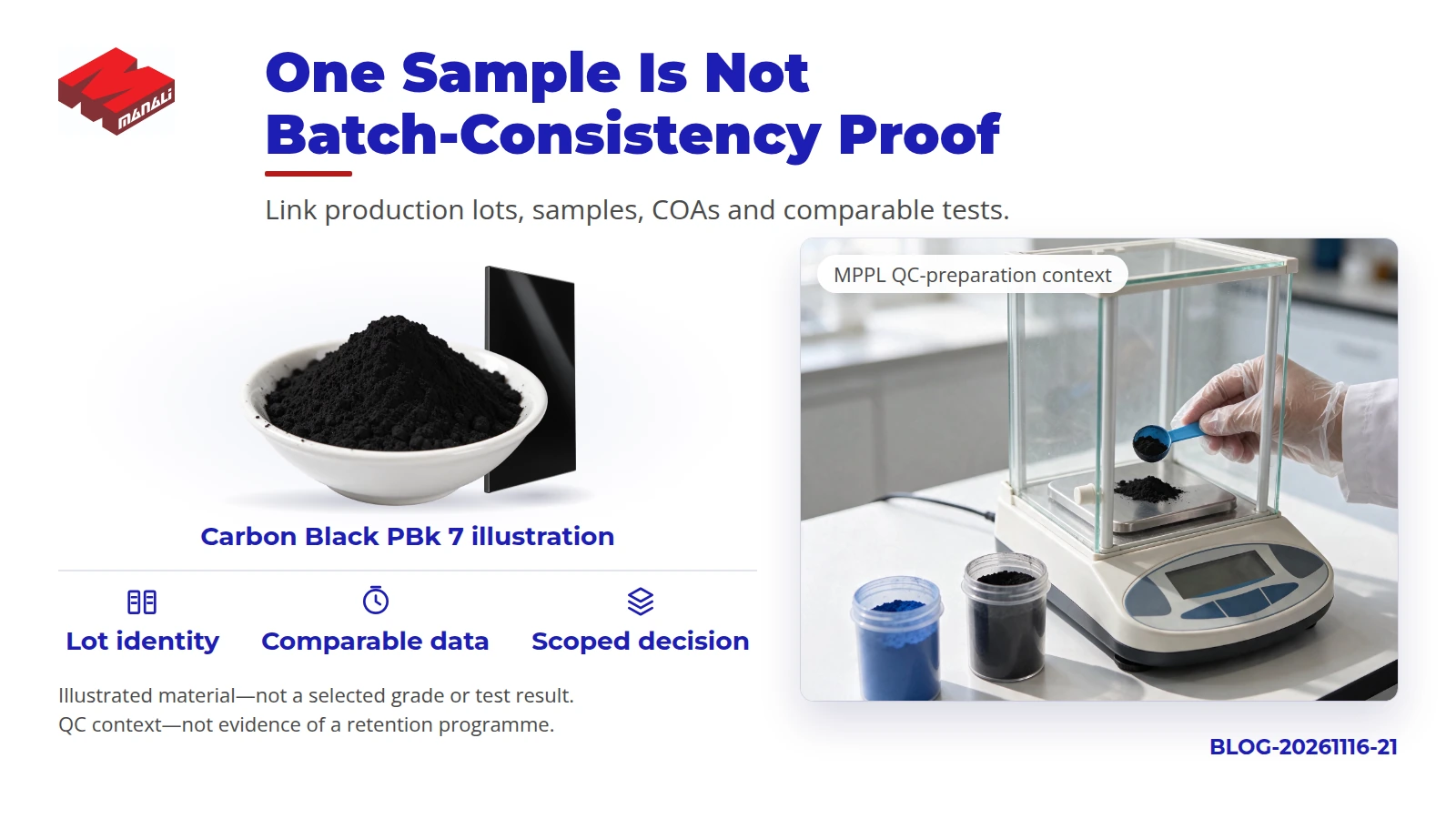
Why one sample and one COA cannot establish recurring consistency
A commercial sample can answer whether a material is worth discussing. It may be a curated specimen, a convenient jar or material prepared for an initial application trial. A production-lot-linked sample carries a documented connection to a particular lot or consignment. A properly selected specimen is intended to represent that defined lot or consignment under an agreed sampling approach. These are different levels of evidence.
A successful trial on one sample is useful within the formulation, preparation and conditions tested. It does not show how later production lots will compare. A COA is similarly bounded: it reports declared checks for an identified material under stated conditions. It does not automatically prove the homogeneity of every package, a stable process, finished-use suitability or future supply consistency.
Separate same-supplier lot-to-lot assessment from cross-supplier comparison. When the same agreed grade is followed across relevant production lots, the question is whether the evidence supports repeat supply for that defined use. When two suppliers are compared, the question may instead be whether their candidate grades are equivalent for the application. A shared Colour Index name does not establish identical grade identity or interchangeable behaviour. Within-lot variation, between-lot variation, preparation variation and measurement variation are separate questions.
Missing links deserve clarification, not accusations. The absence of a document link does not prove counterfeit material. Repeatedly identical-looking COA values may reflect rounding or a reporting convention and are not automatically fraudulent. Ask for controlled records and an explanation of the reporting basis before drawing a conclusion.
The documents also have distinct roles. A technical data sheet (TDS) provides grade-level technical and application guidance, which may include typical rather than release values. A safety data sheet (SDS) communicates hazards, handling, storage and disposal information. A certificate of analysis (COA) or applicable lot-quality record reports declared checks for a defined batch. A production lot or batch is the identified quantity made or released under the supplier’s documented production definition. A retained specimen is controlled material kept from an identified lot for later comparison or an agreed repeat test. No one of these documents replaces the others.
In this article, “retained lots” means controlled retained material from identified lots. It does not mean holding entire production lots indefinitely. The goal is to preserve a retrievable comparison material with enough identity and context to support a bounded decision.
Lock the grade, application and acceptance basis first
Define what remains the same across the lots
Record the exact supplier grade identity, current agreed specification and revision, relevant product form, intended use and any declared product or supplier changes. A trade name or CI identifier helps identify a material, but it is not the complete grade definition. If the specification, product form or revision changed, do not quietly combine the earlier and later material as one unchanged population.
Carbon Black, identified commercially as Pigment Black 7 (PBk 7), is useful here only as an illustrative category context. The exact grade remains unspecified. Use the pigment identification and technical reference to distinguish identity terminology from grade equivalence. Two materials can share a CI designation while differing in grade, structure, processing history, application scope or agreed specification.
Write down the application decision as well. A pigment used in a liquid coating, printing ink, plastic compound or another system may need a different comparison basis. Define the finished system, the relevant processing conditions and the person or team authorized to accept the evidence. This prevents a grade-level document from being treated as a universal approval for every use.
Agree the decision before relying on pass or fail
List the critical-to-use properties, units, method and revision, reference material where relevant, specification limits where actually agreed, application requirement, uncertainty treatment and disposition authority. Distinguish an actual measured value from a conformity statement. “Typical,” “within specification” and “consistent for this application” are not interchangeable claims.
ILAC G8:09/2019 addresses decision rules and statements of conformity. Use it narrowly: define how measurement uncertainty is considered when a conformity statement is issued, and agree the rule with the customer or responsible decision-maker when it is not already inherent in the applicable requirement. The guidance does not impose one tolerance, guard band, uncertainty value or COA format on every pigment supplier.
A result near a limit may require clarification of the rule and uncertainty rather than a quick pass or fail. Ask whether the reported line is a measurement, a limit, or a conformity statement, and whether the necessary decision context is recorded in a controlled supporting document. Do not reconstruct a compliance calculation when the agreed specification and rule are not available.
For broader manufacturing and quality context, see manufacturing excellence and quality-evidence guidance. Use it alongside the grade, application and decision basis defined for the specific enquiry.
Choose production-lot evidence rather than convenient samples
Agree coverage that matches recurring supply
Ask how the evidence lots relate to normal production and the orders being considered. Record relevant origin and time sequence, production campaigns where they matter, product revisions and known changes. Agree the lot coverage with the buyer’s risk and actual sourcing pattern. There is no universal lot count or consecutive-lot number that suits every pigment, package, application or supply arrangement.
The same claimed grade should be checked across relevant independent production lots, not merely several jars drawn from one lot. Record whether each specimen came from production, dispatch, customer receipt or a reference collection. A convenient commercial sample can support an initial discussion, but it should not silently become recurring-supply evidence.
A change in grade, manufacturing location, formulation, specification revision, packaging or test method should remain visible in the record. It may require an agreed review proportionate to the risk. It does not automatically mean that every previous lot must be recalled or that every change legally requires the same requalification route.
Understand representation before testing
ISO 15528:2020 covers sampling of paints, varnishes and raw materials used in their manufacture, including powdered, granulated and pasty materials. Its public scope includes sampling from containers and other defined locations. It also states that preparation and reduction of samples for testing are outside that sampling document. The practical lesson is that sample selection affects how later results can be interpreted; the standard does not prescribe this article’s universal bag count, lot plan or retention period.
Ask for the sampling record: lot or consignment identity, container links, defined locations or increments where appropriate, selection procedure, date, sampler, handling and deviations. A top-of-bag grab or convenient jar is not proof that every package is represented. Follow the actual product information, SDS and approved equipment precautions rather than improvising sampling or handling instructions from a general article.
Keep sample identity intact when the material is transferred or reduced for testing. If the laboratory specimen is prepared from a larger obtained sample, record the preparation relationship. That distinction helps the reviewer understand whether a later result describes the delivered material, the reduced test portion or only a convenient subset.
Connect the sample to its COA and supply record
The evidence chain should be explicit: purchase or intended supplier identity → grade and specification → production lot → selected or received sample → applicable COA or quality record → test specimen and result → relevant application observation and decision. Each arrow answers a different question. A broken link makes the inference uncertain even when the document itself looks professional.
Cross-check supplier and sample identifiers, lot or batch references, document revision and date, property and method information, units, and whether each line is an actual result, a limit or a conformity statement. Do not demand one universal COA template or assume every possible field must appear on every certificate. If necessary context is held in a controlled supporting record, identify that record and its relationship to the COA.
Copied generic or typical values without a lot link are not established lot-specific measured data. Conversely, several identical values are not automatically proof of copying or fraud. Rounding, a reporting convention or a specification-based statement may produce repeated text. Ask the supplier to clarify the basis and provide the controlled record needed for the decision.
A document layout is not a quality conclusion. A management-system certificate, neat report, signed cover letter or familiar logo does not prove identical pigment performance.
Align test conditions before judging variation
Compare the same property on the same basis
Define the property or measurand, method and revision, reporting units and basis, reference material, preparation and conditioning, relevant apparatus or endpoint, and data treatment. If conditions differ, resolve the difference or qualify the comparison before attributing an apparent change to a production lot. Do not normalize or rebase unrelated results into a fabricated common number.
Eurachem’s Terminology in Analytical Measurement — Introduction to VIM 3 distinguishes concepts such as measurement comparability, metrological traceability and measurement uncertainty. Metrological traceability is a documented relationship of a measurement to a reference through a calibration chain. Material lot traceability is the identity and custody relationship connecting a pigment to its production and sample records. These are not the same thing. A calibrated instrument does not make different methods interchangeable, and a lot identifier does not by itself establish measurement validity.
When a supplier and buyer use different preparation routes, reference materials, instruments or endpoints, ask whether the results answer the same technical question. If not, either repeat under an aligned basis or record the comparison as qualified rather than presenting the numbers as direct evidence of lot variation.
Use carbon-black tint strength only within its proper scope
ASTM D3265-24a is a relative carbon-black tint-strength method using an industry tint reference black. Its public scope and significance statements identify reference and preparation considerations, and note that tint strength can depend on particle size, structure and aggregate-size distribution. The method was developed primarily for specified rubber-grade series.
For a carbon-black comparison, ask whether the method edition, actual reference identity, preparation route, apparatus, units and endpoint are aligned. The method is not a universal finished-coating jetness test, a direct particle-size measurement, a blanket approval method for every PBk 7 grade or proof of within-lot homogeneity or process stability.
If the buyer requires liquid-coating appearance or dispersion evidence, define a separate controlled application comparison in the actual or justified representative system with the appropriate method. Do not call that test ASTM D3265 unless it actually follows the applicable method. One tint-strength result cannot decide every application question.
Compare application behaviour without changing the test silently
Consider a procurement and coatings/QC team assessing repeat supply of one agreed carbon-black grade. They link each relevant production lot to a sample and COA, align the laboratory-data basis and compare controlled preparations against the same accepted reference in a declared coating system. They record the formulation and addition basis, vehicle, preparation, substrate or film, cure history and appearance or dispersion method relevant to the intended decision. No grade code or measured winner is assumed.
Changing the dispersant, loading, vehicle or preparation to improve one specimen creates a different comparison unless the change is declared and justified. A failed or non-comparable preparation should be investigated, not silently removed. A confirmed unsuitable result cannot be waived because the COA is within unrelated batch checks.
An application trial supplements, rather than universally replaces, lot release and documentation. Its result covers only the tested system and conditions. A black film photograph does not establish plastics UV performance, rubber reinforcement, chemical compliance or production consistency. The same discipline applies to any pigment category: make the finished-use question and comparison conditions visible before interpreting the result.
Make retained specimens useful and retrievable
Retain material with a controlled identity and context
Consider a risk-based buyer–supplier agreement for retained material from selected identified lots. Record the lot and sampling link, container or seal identity, date, amount sufficient for the agreed repeat test where defined, custody, storage conditions appropriate to the product and intended tests, retrieval process and disposal or replacement rule. These are protocol questions for the buyer and supplier to agree for the specific supply arrangement.
The cited references do not mandate one retention period, cabinet, temperature, sample quantity or specimen count. Do not borrow pharmaceutical or medical retain rules for bulk pigment, and do not impose an arbitrary AQL scheme. Follow the actual grade, SDS and agreed handling and storage requirements. A retained specimen should be accessible to the people authorized to conduct the comparison, with its history protected from casual relabelling or substitution.
Verify that an old specimen is still a valid comparator
Before using an older specimen, consider contamination, moisture, container opening and history, material changes, storage conditions and suitability for the planned repeat preparation or test. A retained specimen is not timeless ground truth. It can change or cease to represent the delivered condition. Compare it under declared conditions and preserve its history rather than treating a shelf label as proof.
An independently obtained buyer specimen or agreed third-party confirmation can strengthen a dispute or confirmation comparison only when sampling, identity, storage and method remain valid. A supplier retain is not automatically independent evidence, and a cabinet photograph does not prove chain of custody. If a specimen is unsuitable, record that limitation and select the next valid comparison route.
Read repeated evidence without overstating statistical confidence
Review relevant lots and test dates in their proper order and on the same measurement basis. Discuss observed variation, repeated direction or change, and exceptions while keeping test repeatability and uncertainty separate from true material variation. A few apparently passing lots support a bounded judgement; they do not prove permanent supplier approval or a stable process.
Being within specification does not prove that there was no lot-to-lot shift or that the pigment is fit for every application. Customer specification limits and statistically derived process-control limits serve different purposes. Without a suitable actual dataset and defined analysis, do not invent a control chart, capability index, significance test, trend line, consistency percentage or numerical tolerance.
State what further evidence is needed for the specific decision. It may involve more appropriately identified lots, a comparable method, an application trial, a valid retained specimen or review of a changed grade or method. Do not require every supplier to use one statistical method when the risk, application and specification call for a different justified approach.
Resolve exceptions and record a repeat-order decision
When a mismatch appears, log it and hold the affected decision or material under the buyer’s actual procedure where appropriate. Verify identity, sampling and method before judging the result. Use a suitable retained specimen for an agreed repeat or independent comparison when the specimen remains valid. Record the supplier’s explanation, any corrective action and the authorized disposition. A hold or quarantine is not automatically a recall, and a discrepancy is not automatically counterfeit material or supplier blame.
A confirmation test should address the original comparable question, not shop for a favourable method. Record deviations transparently. The next step may be to proceed within the agreed scope, clarify or repeat the comparison, revise the requirement or application, or stop for that use. None of those outcomes promises that all future lots will be identical.
When discussing evidence and technical follow-up, use the quality and documentation information. For category and sample context, review Carbon Black product information and confirm which documents, tests and retained-sample arrangements apply to the grade under consideration. Keep the final decision tied to the actual grade, lot evidence, test basis and application.
Multi-lot evidence map and decision tree
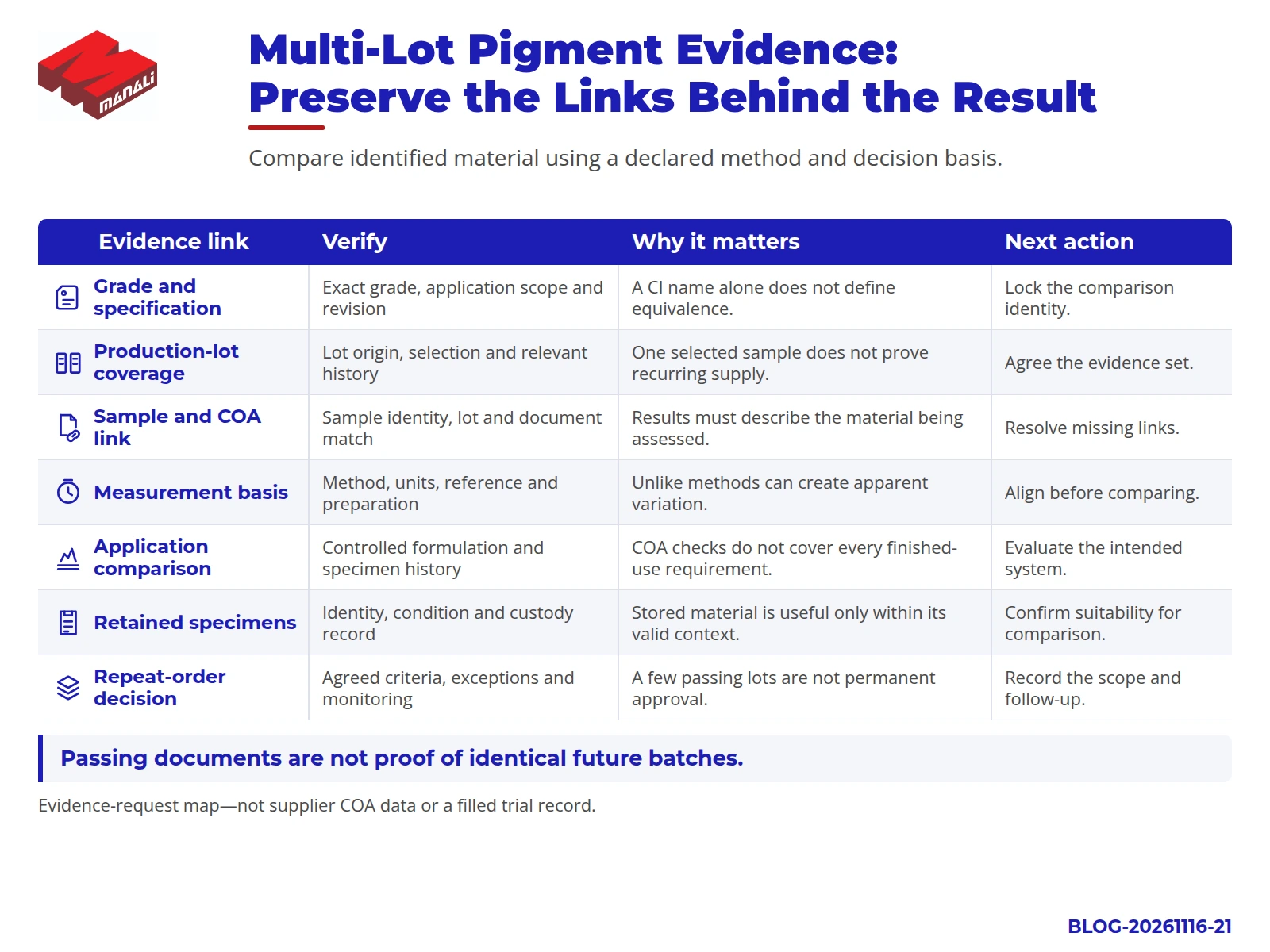
Use the following buyer map to plan the evidence request before the comparison starts.
| Evidence link | Verify | Why it matters | Next action |
|---|---|---|---|
| Grade and specification | Exact grade, application scope and revision | A CI name alone does not define equivalence. | Lock the comparison identity. |
| Production-lot coverage | Lot origin, selection and relevant history | One selected sample does not prove recurring supply. | Agree the evidence set. |
| Sample and COA link | Sample identity, lot and document match | Results must describe the material being assessed. | Resolve missing links. |
| Measurement basis | Method, units, reference and preparation | Unlike methods can create apparent variation. | Align before comparing. |
| Application comparison | Controlled formulation and specimen history | COA checks do not cover every finished-use requirement. | Evaluate the intended system. |
| Retained specimens | Identity, condition and custody record | Stored material is useful only within its valid context. | Confirm suitability for comparison. |
| Repeat-order decision | Agreed criteria, exceptions and monitoring | A few passing lots are not permanent approval. | Record the scope and follow-up. |
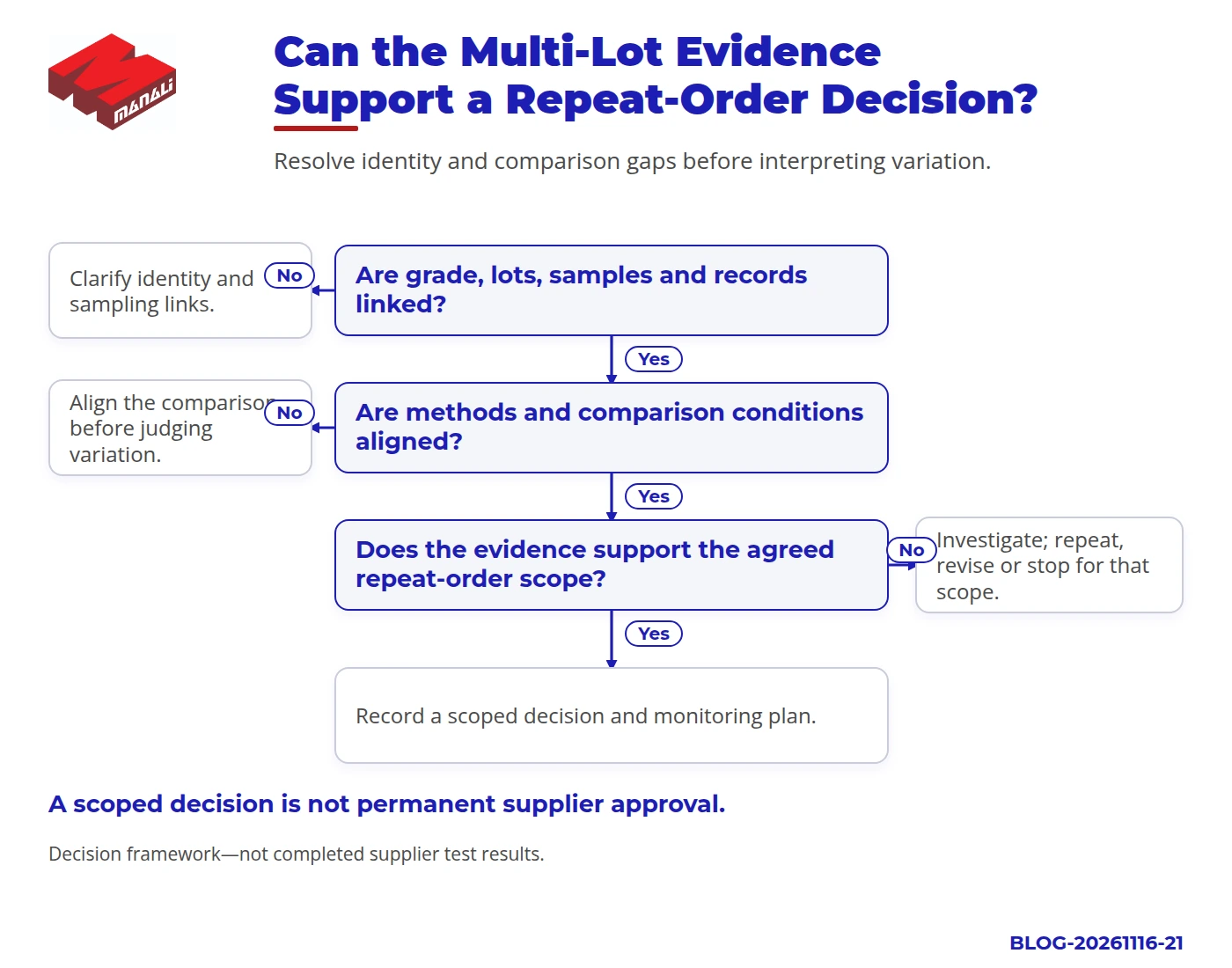
Use three questions to keep the decision bounded:
- Are grade, lots, samples and records linked?
No → Clarify identity and sampling links.
Yes → Proceed to question 2. - Are methods and comparison conditions aligned?
No → Align the comparison before judging variation.
Yes → Proceed to question 3. - Does the evidence support the agreed repeat-order scope?
No → Investigate; repeat, revise or stop for that scope.
Yes → Record a scoped decision and monitoring plan.
The first gate prevents a result from being attached to the wrong grade, lot or specimen. The second prevents unlike methods or preparations from being described as material variation. The third asks whether the assembled evidence is sufficient for the defined repeat-order scope, not whether a supplier has earned permanent approval. After clarification or alignment, return to the relevant question once the issue is addressed; no route leads to automatic approval. A missing link is not proof of failure, and a Yes outcome is a recorded scope and monitoring decision.
The final record should link the evidence set, agreed specification and decision rule, relevant application scope, exceptions, disposition owner and next monitoring or review trigger. No universal calendar, quantitative score or permanent approval status is supplied by this protocol.
Frequently asked questions
Does one successful pigment sample prove batch consistency?
No. One sample can support an initial application observation for the tested material and conditions. Recurring consistency requires links to relevant production lots, representative sampling, comparable measurements and a decision scope that matches the intended orders.
Does a COA prove every package in a lot is homogeneous?
No. A COA is bounded evidence about declared checks on an identified material and method. It does not automatically prove every package is homogeneous, that the process is stable or that the pigment will suit every finished system. Ask how the sample was selected and what the COA covers.
Can results from different methods be compared directly?
Not automatically. Compare the same property using aligned method revisions, units, reference materials, preparation, conditioning, apparatus and endpoint. If those conditions differ, resolve the difference or qualify the comparison before attributing an apparent change to a production lot.
Does the same Pigment Black 7 identity mean the same grade?
No. Pigment Black 7 is an identity designation, not a complete grade specification. Grades can differ in structure, processing history, form, application scope and agreed requirements. Confirm the exact grade and current specification before comparing samples or COAs.
Is carbon-black tint strength the same as finished-coating jetness?
No. Carbon-black tint strength is a defined relative comparison within the scope of its applicable method. Finished-coating appearance and dispersion depend on the grade, vehicle, formulation, preparation and measurement system. Define a separate controlled coating comparison when that is the buyer’s requirement.
How many lots or retained specimens should a buyer request?
There is no universal number. Agree coverage with the risk, sourcing pattern, application and specification. The evidence set should represent the recurring supply being considered, and any retained material should be selected, identified, stored and retrievable for the agreed comparison. Avoid treating a convenient count as a technical rule.
How long should pigment samples be retained?
Set the period through a risk-based buyer–supplier agreement that considers the material, shelf life, storage, dispute window, test needs and logistics. The references used here do not prescribe one retention duration, sample quantity or storage temperature. Confirm that an older specimen remains suitable before using it as a comparator.
Does passing several COAs mean permanent supplier approval?
No. Passing COAs support only the properties, lots, methods and decision rule they cover. Review lot sequence, comparable test conditions, application evidence, exceptions and any changes before recording a scoped repeat-order decision. Continue the agreed monitoring or review process rather than treating several passes as a lifetime guarantee.
What should I provide for a recurring Carbon Black qualification enquiry?
Provide the intended application, exact grade or specification under consideration, required product form, production or order scope, critical properties, test methods and references, acceptance basis, sample identity requirements and relevant document needs. Explain whether you need lot-matched COAs, application comparisons or retained specimens, and identify the conditions under which the decision will be made.
References
- ISO 15528:2020 — Paints, varnishes and raw materials for paints and varnishes — Sampling. Official scope for sampling relevant paints, coating powders and raw materials, including powdered and granulated materials; sample preparation and reduction for testing are outside this document.
- ASTM D3265-24a — Standard Test Method for Carbon Black—Tint Strength. Official scope for relative carbon-black tint strength against an industry reference, with stated limitations around grade series, preparation, structure and aggregate-size effects.
- ILAC-G8:09/2019 — Guidelines on Decision Rules and Statements of Conformity, also listed in the ILAC Guidance Documents G Series. Official guidance on defining decision rules, conformity statements and the treatment of measurement uncertainty; it does not set a universal pigment tolerance, lot count or retention schedule.
- Eurachem Guide: Terminology in Analytical Measurement — Introduction to VIM 3, second edition 2023. Terminology and explanation for measurement comparability, metrological traceability and uncertainty; it is not a pigment specification, COA-content mandate or retention standard.
Explore carbon black pigments for your qualification enquiry
Manali Pigments Private Limited manufactures its pigment categories in-house. Qualifying a carbon-black grade for recurring orders still depends on the grade, the lot evidence and the application it has to serve. Review the Carbon Black product information, then bring your intended application, grade or specification, lot-evidence question, comparison methods and document or sample requirements into a grade-specific technical discussion.
The link below opens the Carbon Black product page, where you can review the range and discuss the samples and documents your qualification needs.
Explore Carbon Black Pigments for Your Qualification Enquiry