Concrete Color Pigments: How to Evaluate Weathering and Alkali-Resistance Data
Published
Evaluate concrete color pigments by checking whether weathering and alkali-resistance evidence identifies the test method, specimen, exposure, conditioning, measurement, control and pre-agreed acceptance criteria. Read these together before applying a result to outdoor cementitious use. Confirm the pigment’s document identity, distinguish supplier ratings from application reports, and use a relevant concrete mock-up to connect laboratory observations with the intended mix, cure, finish and approval decision.
A laboratory result is meaningful only within its stated method and conditions; it does not guarantee performance in every cement, aggregate, cure or climate.
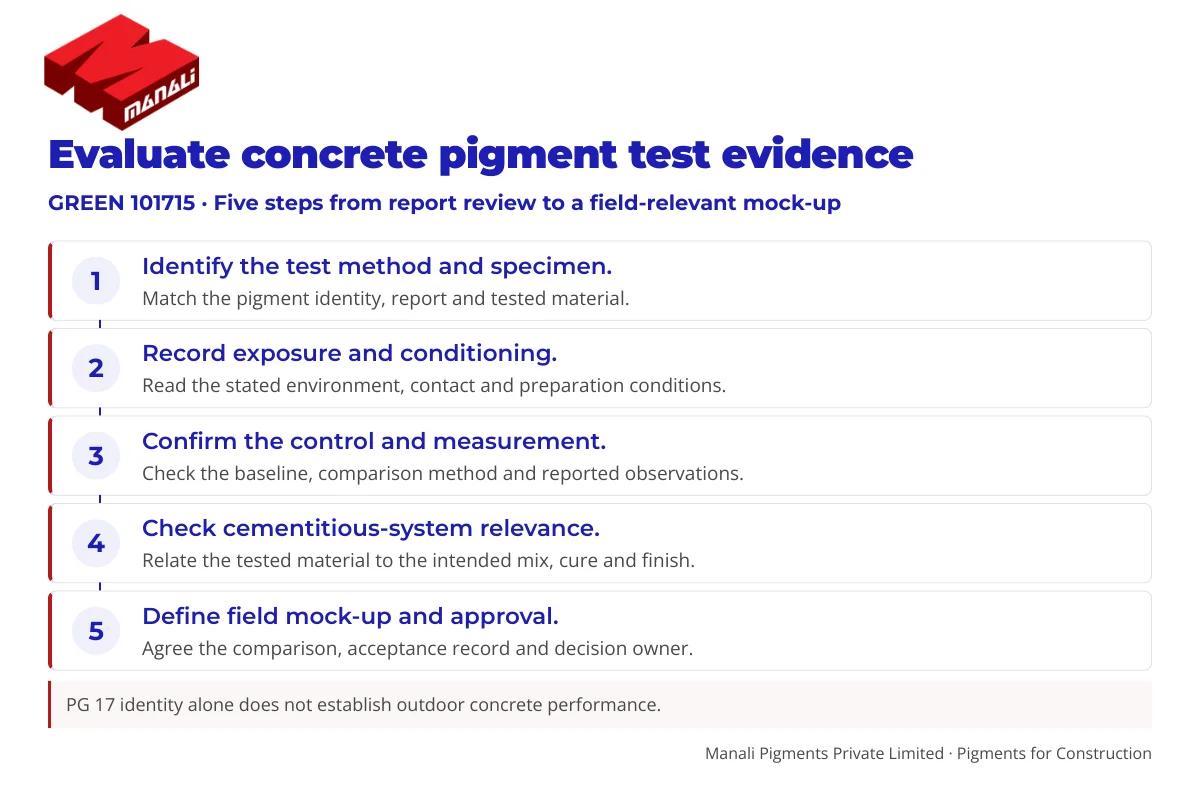
Weathering and alkali-resistance data describe observations from defined tests; interpretation requires the complete test context.
Start with the outdoor-use decision for concrete color pigments
Start with the element being coloured: a paving unit, precast panel or another specified cementitious component. Record whether its visible face receives direct sunlight, regular wetting or sheltered exposure. Describe the appearance requirement and identify who owns the acceptance decision. A report can screen a candidate; project approval needs evidence relevant to that actual configuration.
The broader Pigments for Construction context helps locate this decision, but a product-family description cannot replace the test record. Define the cementitious system, intended finish and reference appearance before comparing candidate documents.
GREEN 101715 illustrates the distinction between pigment identity and application approval. Its technical data sheet (TDS) prints MANALI GREEN 101715, identifies chromium oxide and Colour Index (C.I.) Pigment Green 17, and gives constitution number 77288 and Chemical Abstracts Service (CAS) number 1308-38-9. The safety data sheet (SDS, also called MSDS) names Pigment Green 17 and the same CAS number, but does not print the commercial grade code. [1] [2] This supports a family-identity connection to Chrome Oxide Green pigments, while leaving grade-specific SDS applicability distinct from outdoor-concrete approval.
Read weathering evidence as a complete method
Specimen
Identify what was exposed: pigment preparation, coating, mortar or cured concrete. Read its composition, preparation, cure and surface finish. A result on one material does not automatically describe another.
Exposure source
Distinguish outdoor natural exposure from accelerated laboratory exposure.
Q-Lab’s explanation of ASTM G154 fluorescent-UV exposure illustrates why lamp type, moisture and exposure cycle belong in the test record. It is general method guidance, not a weathering report for GREEN 101715; the conditions actually used must come from the applicable test report. [4]
Duration or cycle
Read duration alongside the exposure sequence, wet/dry stages, lamp or filter and specimen-temperature conditions where applicable. Hours alone do not define an exposure or establish a conversion into outdoor years. Lightfastness describes response to light under stated conditions; it is not comprehensive all-weather durability.
Measurement
Check whether observations are visual or instrumental. Identify the baseline, specimen conditioning and measurement geometry. If colour difference is reported, retain the named calculation formula and assessment method; differently calculated numbers are not automatically equivalent.
Control
Identify the reference or control, its preparation and how it was assessed alongside the candidate. Keep observations separate from a proposed explanation of why the surface changed.
Read alkali-resistance evidence in context
Read an alkali-resistant pigment claim as a test-context statement. Identify the medium, concentration or defined environment, specimen preparation, contact conditions, duration, conditioning, endpoint and control. Establish whether the observation concerns colour, another measured property or a supplier rating. Do not infer acid resistance, concrete-strength effects or whole-life durability from an alkali observation.
A powder or liquid-contact test is not identical to testing cured concrete. The first can inform pigment screening; the second evaluates a specified cementitious configuration. Follow-up evidence should address the buyer’s matrix and how the pigment is incorporated, cured and assessed.
The ASTM C979/C979M specification for pigments for integrally coloured concrete provides a relevant specification scope for powder pigments used in integral concrete colour. Its scope does not establish compatibility with other admixtures without combined testing and excludes determining pigment stability for accelerated steam or autoclave curing. Referencing this specification does not establish that GREEN 101715 complies with it. [3]
The GREEN 101715 TDS reports “Resistance to Alkali” as 5 on its 1–5 scale, labelled 1—poor; 5—excellent. It does not identify the alkali medium, contact procedure, exposure conditions or endpoint behind that rating. [1] Treat it as supplier-reported technical information rather than a documented ASTM pass or concrete-system guarantee. Carry the rating into a discussion about applicable supporting evidence and project validation.
Check system variables before extrapolating
Specify cement type and colour, supplementary cementitious materials, aggregate and water. Record the admixtures and the pigment dosage basis, rather than comparing unnamed percentages. Describe mixing sequence, incorporation, curing, surface finish and anticipated exposure. These are variables to control and document, not a universal recipe for outdoor colour.
Keep three decisions distinct. Pigment-only qualification concerns the identified material under a stated test. Formulation-specific validation concerns that material in a particular mix and process. Project appearance acceptance concerns the finished element against agreed criteria. Evidence supporting one decision should not silently be presented as proving all three.
A surface colour change needs investigation before it is attributed to pigment failure. Examine cementitious-matrix changes, surface condition, deposits, cure and measurement geometry as possible variables.
For identity terminology, use CI Numbers and Technical Reference, then match the family designation to the commercial grade and report. A common C.I. name does not make all grades, lots or formulations interchangeable.
Compare candidates without overstating differences
Compare reports only after aligning specimen, method, conditions and assessment. Similar rating labels cannot establish a ranking when their scales or procedures differ. Use quality documentation to organise the distinct roles: a TDS supplies technical information, an SDS addresses identity and handling within its scope, a COA concerns a lot, and an application report describes the tested system.
GREEN 101715: what the TDS and MSDS establish
The one-page TDS names MANALI GREEN 101715 and recommends cement and pavers. It has no printed issue or revision date. The five-page SDS, issued 1 January 2025, names Pigment Green 17 and lists MPPL as supplier, but identifies coatings, rubber and plastics as uses. [1] [2] Neither document is a method-qualified weathering report or a record of a completed concrete trial.
The SDS identifies chromium oxide in its composition section but also contains lead-related statements in Sections 11 and 15. These statements are internally inconsistent and do not establish GREEN 101715’s verified lead content or grade-specific safety classification. [2] Grade applicability and the document inconsistency require supplier clarification; this article draws no lead-free, composition or handling conclusion from them.
Atlas’s overview of weathering standards and test methods distinguishes fluorescent-UV and xenon-arc exposure practices. Results from different light sources or cycles should not be treated as directly interchangeable merely because both reports are labelled “weathering”. [5]
| Evidence field | Weathering check | Alkali check | Buyer decision |
|---|---|---|---|
| Pigment identity and document traceability. | Match MANALI GREEN 101715, PG 17 and CAS 1308-38-9 in the undated TDS to the report. [1] | Retain the TDS rating of 5 on its 1–5 scale; the SDS dated 1 January 2025 names PG 17 without the grade code. [1] [2] | Confirm grade applicability and clarify the SDS’s conflicting lead statements with the supplier. |
| Specimen and preparation. | Identify the exposed material, preparation and surface. | Identify the tested preparation and contact surface. | Match the specimen to the intended application. |
| Test method and version. | Record the exposure and assessment method versions. | Record the alkali procedure and assessment version. | Compare reports using compatible procedures. |
| Exposure or contact conditions. | Read the source, moisture cycle and applicable temperatures. | Confirm the medium and contact conditions in the report. | Establish whether the conditions address the project. |
| Duration and conditioning. | Read exposure duration and pre-measurement conditioning together. | Read contact duration and subsequent conditioning together. | Interpret duration within the actual method. |
| Control and baseline. | Identify the reference and initial measurement. | Identify the control and initial observation. | Check that the comparison has a documented baseline. |
| Measurement and reported observations. | Retain the measurement method and specimen-specific observations. | Retain the endpoint and contact-test observations. | Separate measured findings from proposed causes. |
| Cementitious-system relevance. | Compare the tested mix, cure, finish and exposure. | Assess relevance to the intended cementitious matrix. | Define the additional mock-up evidence needed. |
| Acceptance, limitations and approval record. | Retain agreed criteria and exposure limitations. | Retain agreed criteria and contact-method limitations. | Record the accepted configuration and decision owner. |
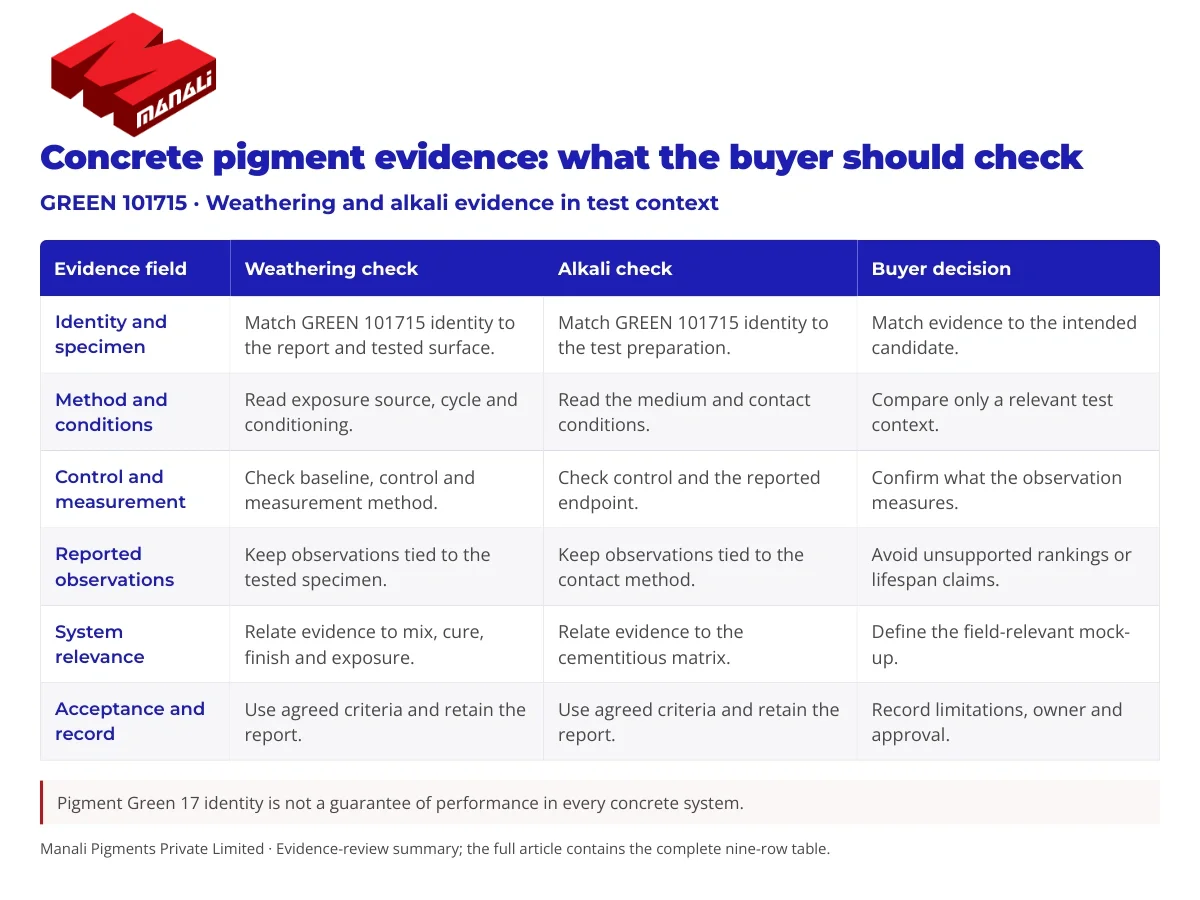
Move from data review to a field-relevant mock-up
Use these five actions to connect report review with a documented project decision:
- Identify the test method and specimen.
Match the commercial grade, report and tested material. Use a traceable candidate batch and a documented control appropriate to the comparison.
- Record exposure and conditioning.
Preserve the reported conditions and define those for the mock-up, including preparation, cure, finish and observation state.
- Confirm the control and measurement.
Agree the baseline, comparison method and observation record. Keep candidate and control assessments under comparable conditions.
- Check cementitious-system relevance.
Use the actual project mix and relevant process. Document any difference between the report specimen and the mock-up rather than assuming equivalence.
- Define field mock-up and approval.
Agree the acceptance method and limit with the project owner. Retain observations, limitations and accountable sign-off for the sampled configuration.
A mock-up validates the configuration examined; it does not prove performance in every future climate. Bring the intended element, mix, cure, finish, exposure, appearance requirement, candidate identity and available reports into the supplier discussion. That information makes the next evidence request specific and keeps approval connected to the project.
FAQs
What information should weathering data include?
Weathering data should identify the pigment, specimen, preparation, exposure method, source, cycle or duration, conditioning, control and measurement procedure. The report should connect observations to that specimen and agreed criteria. Read these details together: a result without its exposure and assessment context cannot establish suitability for the buyer’s particular outdoor concrete system.
How should alkali-resistance data be interpreted?
Interpret alkali-resistance data within the reported medium, preparation, contact conditions, duration, endpoint and control. Preserve a supplier rating’s stated scale without inventing its procedure. GREEN 101715’s TDS rating is supplier information, not a documented concrete-system pass. Relevant application evidence is needed before extending a pigment-contact observation to a cured cementitious formulation.
Why do substrate and curing conditions matter?
Substrate and curing conditions define the system whose appearance was assessed. Cement, supplementary materials, aggregate, moisture state and finish are variables to record when relating a test to a project. Comparing differently prepared or conditioned surfaces can obscure what the observation describes. Document these differences before attributing a change to the pigment itself.
Can laboratory results predict every outdoor exposure?
No. Laboratory results describe behaviour under specified conditions and can support a defined screening or validation decision. They do not represent every climate, surface condition, concrete mix or maintenance history. Accelerated exposure hours should not be converted into universal service years. Connect the evidence to relevant project conditions and retain its stated limitations.
When is a concrete mock-up required?
A concrete mock-up is appropriate when pigment-only evidence does not resolve the intended mix, cure, finish or appearance decision, or when the project specification calls for one. Use a traceable candidate and documented comparison. Agree assessment conditions and acceptance before judging the sample; its approval applies to the configuration examined, with recorded limitations.
Which records should be retained after approval?
Retain the commercial grade and batch identity, applicable technical documents, test reports, mix and process record, control, baseline, conditioning and observations. Keep the agreed acceptance criteria, limitations, decision owner and sign-off together. These records allow later changes to be assessed against what was actually approved rather than against a general product-family description or rating.
Effective supplier discussions connect the identified candidate with complete test context and the intended concrete configuration. Review the evidence, define the relevant comparison and record the decision without extending it beyond its support.
Explore Chrome Oxide Green pigments and discuss your application
- Manali Pigments Private Limited. TECHNICAL DATA SHEET — MANALI GREEN 101715, p. 1; no issue or revision date printed.
- Manali Pigments Private Limited. SAFETY DATA SHEET — Pigment Green 17, issued 1 January 2025, pp. 1–5; identification in Section 1, composition in Section 3 and lead-related statements in Sections 11 and 15.
- ASTM International. ASTM C979/C979M-24 — Standard Specification for Pigments for Integrally Colored Concrete. Public abstract and scope.
- Q-Lab. ASTM G154 — UV Exposure Testing for Materials. General fluorescent-UV exposure guidance.
- Atlas Material Testing Technology. Standards and Test Methods. General exposure-method overview.