
What Is Ultramarine Violet? How Industries Use This Versatile Pigment
Ultramarine violet is a high-performance inorganic pigment widely used across industrial sectors that demand consistent color, durability, and regulatory compliance. From coatings and plastics to cosmetics and construction materials, manufacturers rely on ultramarine violet pigment for its stability, non-toxicity, and cost efficiency.
As industries in the USA continue to prioritize sustainable, heat-stable, and UV-resistant color solutions, the demand for ultramarine violet color has grown significantly. Understanding its properties, manufacturing process, and applications can help buyers select the right pigment supplier and improve product quality.
What Is Ultramarine Violet Pigment?
Ultramarine violet pigment is an inorganic pigment derived from a complex sodium aluminosilicate structure containing sulfur. It belongs to the ultramarine family, known for producing stable blue, violet, and pink hues.
Chemical Composition
It is typically produced from:
- Kaolin clay
- Sodium carbonate
- Sulfur
- Silica
These materials are calcined at high temperatures to form a stable aluminosilicate structure that produces the characteristic violet shade.
Pigment Category
Classification determines performance characteristics and application compatibility.
- Inorganic pigment
- Non-bleeding and insoluble in solvents
- Suitable for high-temperature processing
Key Characteristics
These features make ultramarine violet a preferred choice across demanding manufacturing environments.
- Distinct ultramarine violet color
- Excellent lightfastness
- High thermal stability.
- Environmentally safe and non-toxic
Key Properties of Ultramarine Violet
Its technical properties are what make ultramarine violet reliable for large-scale manufacturing.
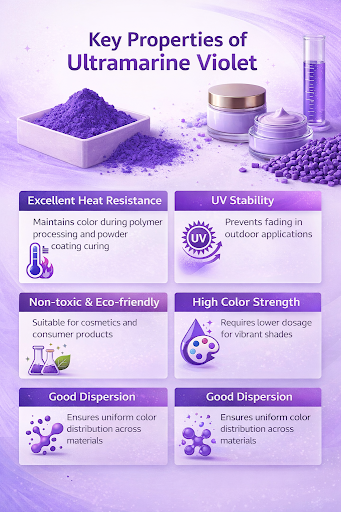
- Excellent heat resistance – Maintains color during polymer processing and powder coating curing
- UV stability – Prevents fading in outdoor applications
- Non-toxic & eco-friendly – Suitable for cosmetics and consumer products
- High color strength – Requires lower dosage for vibrant shades
- Good dispersion – Ensures uniform color distribution across materials
Industrial Applications of Ultramarine Violet
Its versatility allows manufacturers across industries to achieve consistent and durable coloration.
Paints & Coatings
Ensures long-lasting color and weather resistance for protective and decorative surfaces.
- Decorative and architectural paints
- Industrial coatings and powder coatings
- Anti-corrosion and protective coatings
Plastics & Polymers
Maintains color integrity during high-temperature processing.
- PVC pipes and fittings
- Packaging films and containers
- Household and automotive plastic parts
Printing Inks
Provides vibrant, stable shades for high-speed printing processes.
- Flexographic and gravure inks
- Packaging and label printing
- Publication and specialty inks
Textiles
Delivers consistent dyeing results for synthetic fibers and specialty fabrics.
- Synthetic fiber coloration
- Fabric printing and dye blending
- Specialty textile finishes
Cosmetics
Offers a safe and stable pigment option for personal care products.
- Eye shadows and pressed powders
- Soaps and personal care products
- Color cosmetics requiring non-toxic pigments
Construction Materials
Enhances the aesthetic appeal and durability of building products.
- Colored cement and concrete
- Paver blocks and tiles
- Decorative stone coatings
Benefits of Using Ultramarine Violet in Manufacturing
These advantages directly impact production efficiency and product performance
1. Color Consistency
Ensures uniform shades across production batches, protecting brand identity.
2. Durability in Harsh Environments
Resists UV exposure, heat, and chemicals, making it ideal for outdoor and industrial applications.
3. Cost-Effective Pigmentation
High tinting strength reduces pigment usage, lowering formulation costs.
4. Compatibility with Various Materials
Performs well in coatings, polymers, inks, textiles, and construction products.
Why Choose Us as Your Ultramarine Violet Manufacturer
Partnering with a reliable supplier like Manali Pigments ensures consistent quality, dependable bulk supply, and uninterrupted production.
1. Bulk Supply Capability
Stable production capacity to support large-scale manufacturing.
2. Custom Formulations
Tailored pigment grades to meet specific industry requirements.
3. Strict Quality Control
Batch-to-batch consistency through advanced testing and color matching.
4. Competitive Pricing
Cost-efficient solutions designed for bulk buyers.
5. Technical Support
Expert assistance with formulation, dispersion, and application challenges.
How to Select the Right Violet Pigment for Your Industry
Evaluating these factors helps buyers choose pigments that meet performance and compliance needs.
Heat Resistance Needs
Choose pigments that withstand processing temperatures in plastics and coatings.
Regulatory Compliance
Ensure compliance with cosmetic, environmental, and safety standards.
Application Compatibility
Evaluate dispersion, tint strength, and chemical resistance for your specific use.
Conclusion: Partner with a Trusted Ultramarine Violet Supplier
In today’s competitive manufacturing landscape, choosing the right pigment can significantly impact product quality, durability, and cost efficiency. Ultramarine violet pigment delivers consistent color, excellent stability, and versatile performance across industries.
Ready to Elevate Your Product Quality?
- Request product samples for evaluation
- Submit bulk inquiries for competitive pricing
- Explore custom pigment solutions tailored to your industry
FAQs
1. What is ultramarine violet?
Ultramarine violet is an inorganic pigment known for its stable violet hue, heat resistance, and UV durability. It is widely used in coatings, plastics, inks, textiles, cosmetics, and construction materials.
2. How is ultramarine violet pigment manufactured?
It is produced by calcining kaolin clay, sodium carbonate, sulfur, and silica at high temperatures to form a stable sodium aluminosilicate structure responsible for its violet color.
3. How to mix ultramarine violet for custom shades?
Blend ultramarine violet with titanium dioxide for lighter tones or combine with blue and red pigments to achieve deeper purples. Proper dispersion ensures consistent results.
4. Is ultramarine violet safe for cosmetics?
Yes, cosmetic-grade ultramarine violet is non-toxic and safe when manufactured according to regulatory standards.
5. Can it withstand high temperatures?
Yes, ultramarine violet offers excellent thermal stability, making it suitable for plastics, powder coatings, and high-temperature curing processes.
6. Where can I buy ultramarine violet in bulk?
You can source high-quality ultramarine violet from certified pigment manufacturers offering bulk supply, technical documentation, and sample testing.