Manufacturing Excellence · Technical guide
Pigment Manufacturer COA Checklist: How to Approve a Production Batch
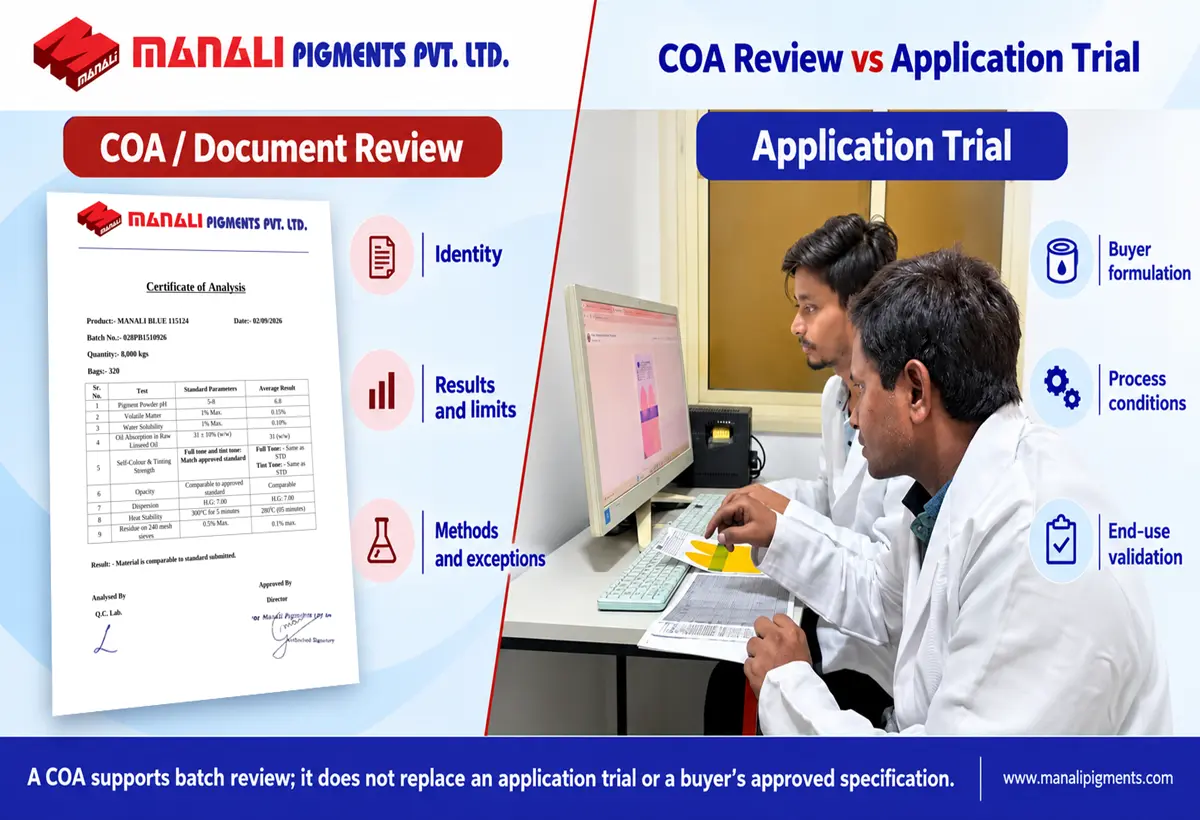
A COA supports batch review; it does not replace an application trial or a buyer’s approved specification. Document review addresses the reported evidence for a lot. It does not establish performance in every formulation or production process.
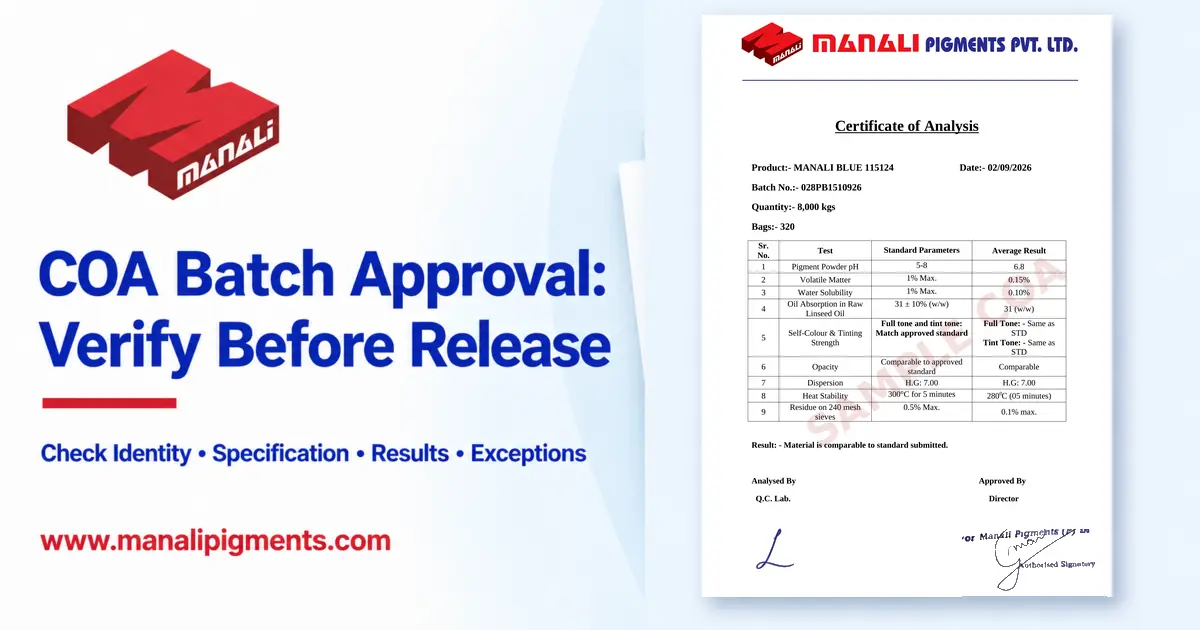
Definition and example. A certificate of analysis records results reported for a defined lot against stated tests or specifications. This guide uses MANALI BLUE 115124 from Manali Pigments Private Limited (MPPL) as a limited document-review example. Its TDS identifies the product as Pigment Blue 15:1. The certificate is used as a document-review example; no overall conformity conclusion is made.[1][2]
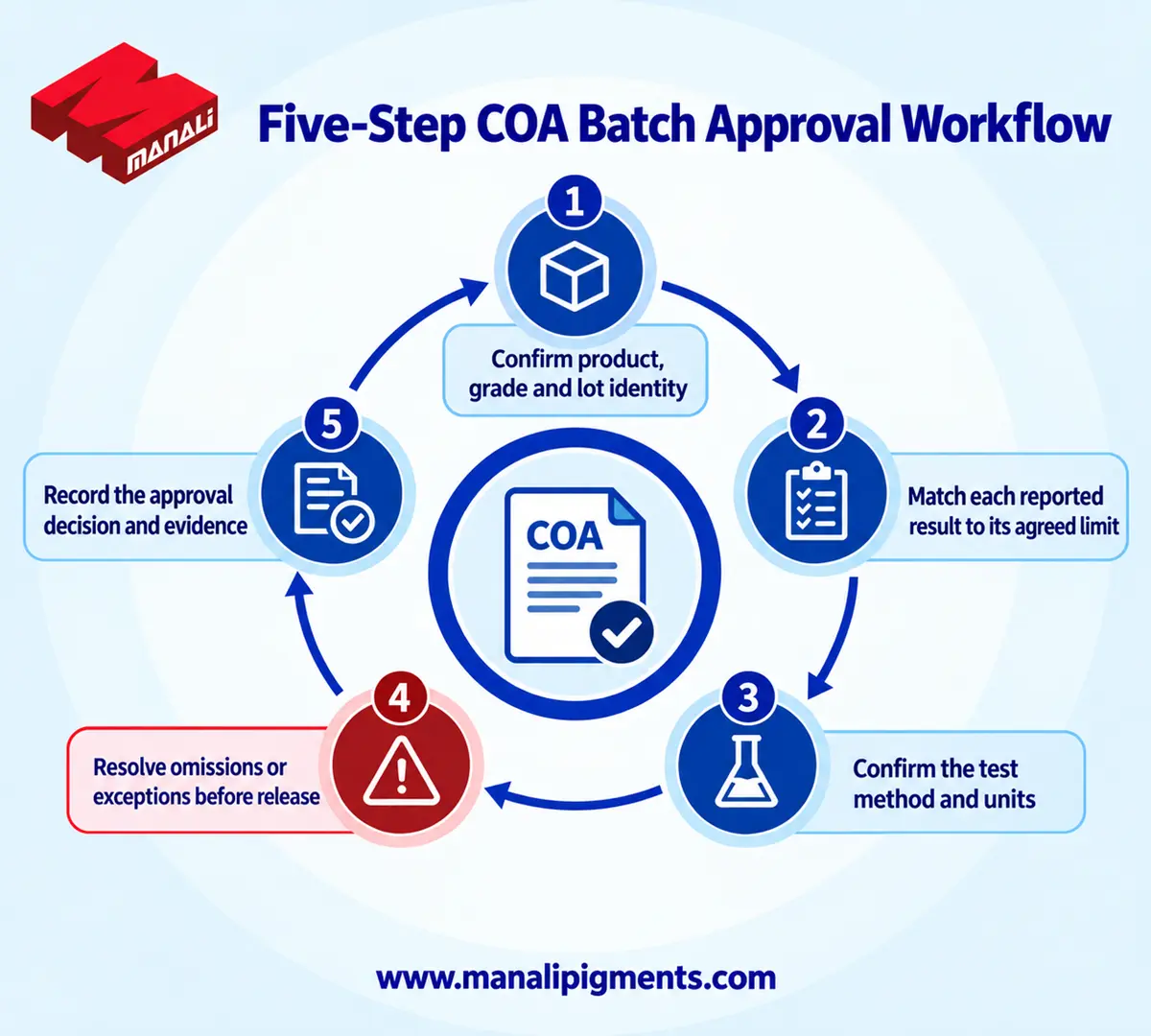
Use this five-step checklist:
- Confirm product, grade and lot identity.
- Match each reported result to its agreed limit.
- Confirm the test method and units.
- Resolve omissions or exceptions before release.
- Record the approval decision and evidence.
Start With the Approval Decision, Not the Document
Begin by identifying the question the documents must answer: is this particular lot acceptable against the requirements agreed for this purchase? A lot is the identified batch of material covered by the review. A specification states the requirements used for acceptance. A method describes how a property is tested; a result is the reported outcome. These distinctions help keep the decision attached to the material and evidence being reviewed.
Establish the applicable specification before interpreting individual entries. Ask which document governs the purchase and whether any customer-specific requirements apply. A TDS, purchase order, approved sample and COA may provide different information. Record their agreed relationship rather than assuming that one automatically overrides another.
For this example, the guide demonstrates document checks without declaring the batch acceptable. Before making an acceptance decision, identify the governing specification and its revision. Record the requirement against which each result will be evaluated, including any customer-specific condition. A stated result should not be interpreted in isolation from that documented acceptance basis.
Use the broader pigment manufacturing quality controls discussion as context, while keeping the batch decision tied to the agreed evidence. The practical output is a documented acceptance basis: the identified lot, applicable requirements, reviewed records and unresolved questions. A complete-looking certificate alone does not supply that basis.
Confirm Identity and Traceability
Confirm product and commercial grade
Match the commercial product name before comparing technical entries. The confirmed public name for this example is MANALI BLUE 115124. Its TDS lists the chemical type as Phthalocyanine and the C.I. name as Pigment Blue 15:1. Use the commercial name on the approved purchase documents consistently; do not rely on the C.I. designation alone to identify the grade being ordered.[1]
The C.I. designation identifies the pigment named in the document; it does not replace the supplier’s commercial-grade designation in a purchase review. Record both where relevant. For related product-family context, see Phthalocyanine pigments and CI Numbers and Technical Reference.
Match the batch or lot
Check whether the COA refers to the lot being received or considered for acceptance. Compare the available identifiers on the certificate with the order, labels and shipment records. If an identifier differs or is missing, ask for clarification before relying on the test entries. This is a recommended buyer check, not a description of MPPL’s internal traceability system.
The example COA contains a batch number, quantity and bag count. Review those fields against the actual consignment rather than treating their presence as proof of traceability. If the purchase is divided into several lots, keep the evidence and acceptance record for each identified lot clearly distinguishable.[2]
Check dates and document revision
Ask what each date means: manufacture, sampling, testing, issue or another event. Do not infer its meaning from placement alone. The example COA displays a date without defining the event it represents.[2]
Check the supporting TDS and COA independently. Confirm the applicable version and the record establishing its approval. A TDS approval does not, by itself, explain the date printed on a particular COA or establish that certificate’s revision history. Keep any supplementary clarification with the document to which it relates.
Read Every Pigment Manufacturer COA Result in Context
Read each entry through four connected elements: the parameter, method and conditions, unit or acceptance basis, and reported result. Then compare it with the agreed requirement. A number can be faithfully copied from a certificate while remaining insufficient for an acceptance decision.
The supplied COA has separate Average Result and Standard Parameters columns. Confirm how the reported result was obtained and whether it represents a single measurement or an average. Where sampling or averaging affects interpretation, ask for the relevant sampling basis and calculation. The column label alone does not explain how many samples or measurements contributed to the entry.[2]
For example, the COA reports pigment powder pH as 6.8 and lists 5–8 under Standard Parameters. These entries can be identified as a reported value and a stated range. This guide makes no conformity finding because comparable test conditions are not documented in the evidence used for the comparison. Being numerically inside a printed range does not complete the review.[2]
The colour entries use “Same as STD.” In the supplied example, STD refers to the approved Blue 115124 reference sample. To interpret the comparison, identify the controlled reference, preparation conditions and acceptance rule. A reference description without its identifier, version or applicable tolerance does not establish the complete comparison basis.[3]
A maximum is also different from a measured value. The sieve-residue result entry reads “0.1% max.” It is not presented here as an exact measurement, and no worked conformity comparison is made. Ask for an unambiguous result if the acceptance decision requires one.[2]
Swipe horizontally to review all columns.
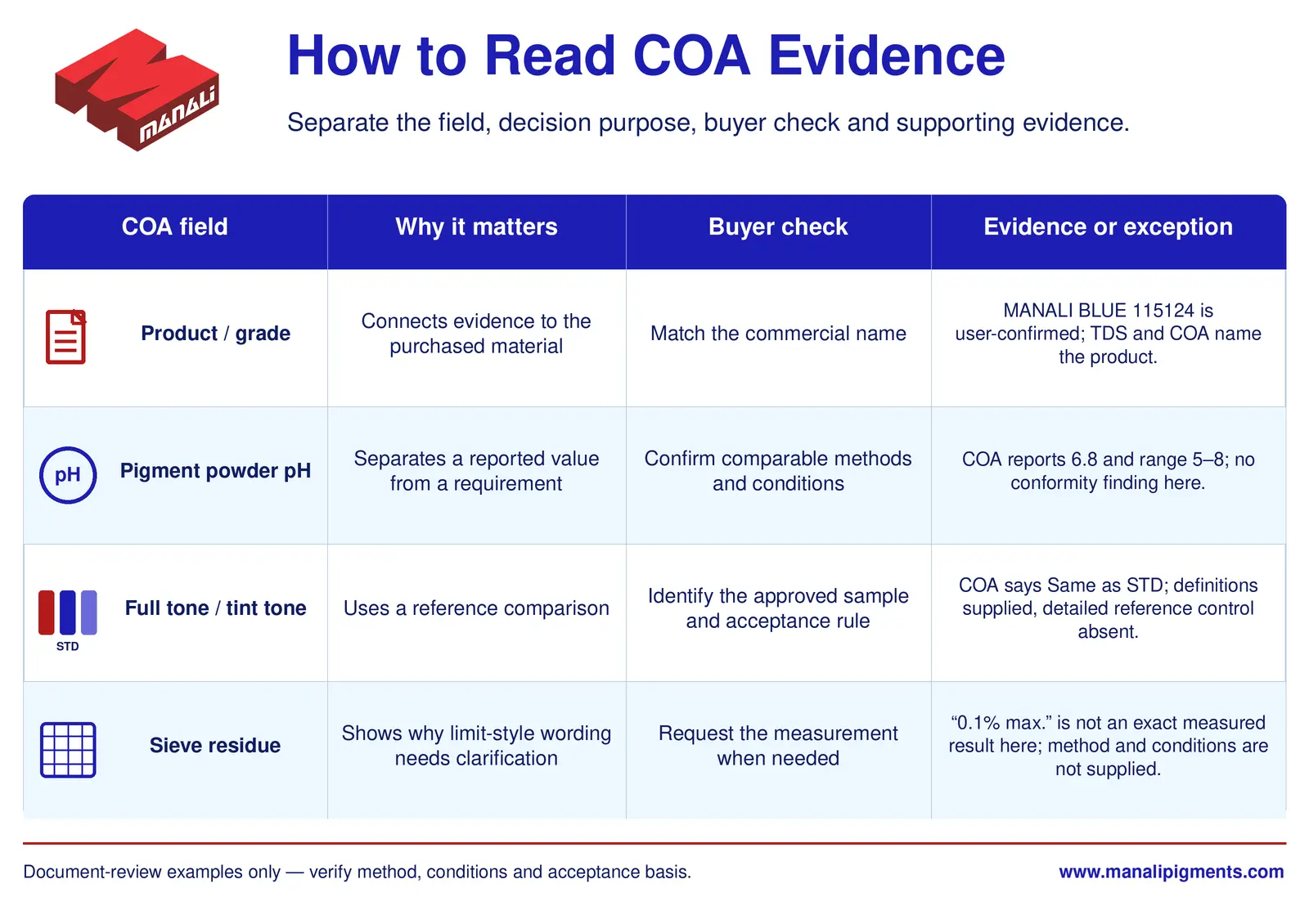
| COA field | Why it matters | Buyer check | Evidence or exception |
|---|---|---|---|
| Product/grade | Connects evidence to the purchased material | Match the commercial name | TDS and example COA identify MANALI BLUE 115124; match the name against the purchase records. |
| Pigment powder pH | Separates a reported value from a requirement | Confirm comparable methods and conditions | COA reports 6.8 and range 5–8; no conformity finding here. |
| Full tone/tint tone | Uses a reference comparison | Identify the approved sample and acceptance rule | Identify the controlled reference and acceptance rule behind “Same as STD” before interpreting the comparison. |
| Sieve residue | Shows why limit-style wording needs clarification | Request the measurement when needed | “0.1% max.” is not an exact measurement; confirm the reporting basis, method and conditions needed for review. |
Use quality and compliance documentation to organize supporting evidence. For blank or unclear fields, ask whether the test is missing, pending, not performed or considered inapplicable. Obtain the explanation needed for acceptance rather than silently assigning a status.
Use an Approve, Hold or Escalate Workflow
The following is a general buyer-side framework. It does not describe MPPL’s internal release procedure, retest policy or exception authority. Its purpose is to connect an acceptance decision with the evidence available to the buyer.
If additional testing or investigation is proposed, agree on its purpose and authorization before using the new information for acceptance. Preserve the original evidence and explain how subsequent records relate to it. This is a buyer-record recommendation, not a claim about MPPL’s investigation practices.
Where rejection is appropriate under the agreed process, document the reason and scope of the decision. Do not infer the supplier’s complete release authority from a title printed on the COA. Equally, do not assume that a supplier’s statement of comparability automatically records the buyer’s acceptance. Keep the buyer decision identifiable in its own review record.
Separate COA Review From Application Qualification
A COA provides reported test information for an identified lot. A TDS provides grade information within the scope of its stated fields and supporting controls. An application trial addresses performance under the buyer’s selected formulation and processing conditions. These records answer related questions, but they do not provide interchangeable evidence.
For MANALI BLUE 115124, this guide uses the TDS to identify the commercial product and Pigment Blue 15:1 designation. It does not convert the TDS’s application profile or performance ratings into a guarantee for a particular formulation. Any conformity conclusion requires the relevant specification, comparable methods and sufficient evidence for the particular decision.[1]
A buyer can therefore complete a document review while still needing application qualification. Define the conditions and performance criteria for that separate assessment with the appropriate technical team. Keep its conclusions attached to the material, formulation and process actually evaluated. A result obtained for one assessment should not silently become approval for every use.
Where application evidence is required for purchase acceptance, include its reference in the review record. Where qualification is a separate stage, state that boundary explicitly. This prevents a document approval from being interpreted more broadly than the evidence supports.
This guide addresses document review, not safety classification or regulatory approval. Those assessments require their own applicable evidence and qualified review; they cannot be inferred from a COA-review outcome.
Build a Repeatable Batch-Approval Record
Create a review record that another authorized person can follow without reconstructing the decision from emails. Recommended fields include the commercial product name, lot identifier, governing specification, document titles and versions, reviewed results, method references, comparison-standard details, unresolved questions, exception decisions, reviewer and decision date.
Record the source of each conclusion. Distinguish a numerical result from a qualitative comparison and identify any requirement that was not assessed. Where acceptance relies on supplementary evidence, link that record to the relevant certificate entry. Where a question remains open, identify what response or document is needed to close it.
Confirm document authenticity through an established supplier contact or agreed verification route. If a certificate is corrected or reissued, keep the relationship between the earlier and replacement records clear. Ask what changed and whether the correction affects the acceptance decision. Do not treat an unexplained replacement as proof that the underlying technical question has been resolved.
Retain the reviewed evidence according to the buyer’s applicable record process. This guide specifies no universal retention period, internal software system or supplier response time. Record who owns outstanding buyer questions so that the acceptance status remains understandable during follow-up.
A repeatable record makes the basis of approval visible: which lot was reviewed, which requirements governed it, what evidence supported acceptance and what limitations remain. It also preserves the boundary between document review and application qualification.
Discuss the documentation for your grade and application
Have the commercial grade, relevant COA and application requirements ready so that the technical question can be reviewed in context.
Questions to Resolve Before Release
A buyer should look for identifiable product and lot details, clearly described tests, reported results and the acceptance basis needed for review. Ask for supporting method, unit, condition and reference information where necessary. A certificate’s layout alone does not establish completeness; the evidence must support the decision against the agreed requirements.
No. A COA records results reported for a defined lot; a TDS provides information about a grade. Check the applicable specification and document controls before using either for acceptance. Neither document alone establishes performance in the buyer’s particular application, and grade information should not automatically be treated as a measured batch result.
Keep the affected acceptance question open and ask why the result is absent. Establish whether it is pending, not tested, inapplicable or omitted, and obtain the evidence or authorized explanation required by the agreed process. Do not replace a missing result with a TDS value or assume that silence means conformity.
They establish how a result should be interpreted and compared with the requirement. Conditions, reporting basis and comparison references may be essential to that interpretation. Confirm the relevant details before making a pass decision. A copied number, familiar abbreviation or matching-looking unit does not by itself establish comparable test evidence.
No. A COA supports batch review; it does not replace an application trial or a buyer’s approved specification. Even when document conformity is established, application conclusions need evidence relevant to the selected formulation and process. Record document acceptance and application qualification separately so that each decision retains its proper scope.
The people authorized under the agreed buyer and supplier approval arrangements should decide the proposed exception. Identify the affected requirement, justification, evidence and permitted scope before acceptance. This guide does not assign MPPL exception authority or invent a concession policy; obtain the applicable authorization rather than infer it from a certificate’s role label.