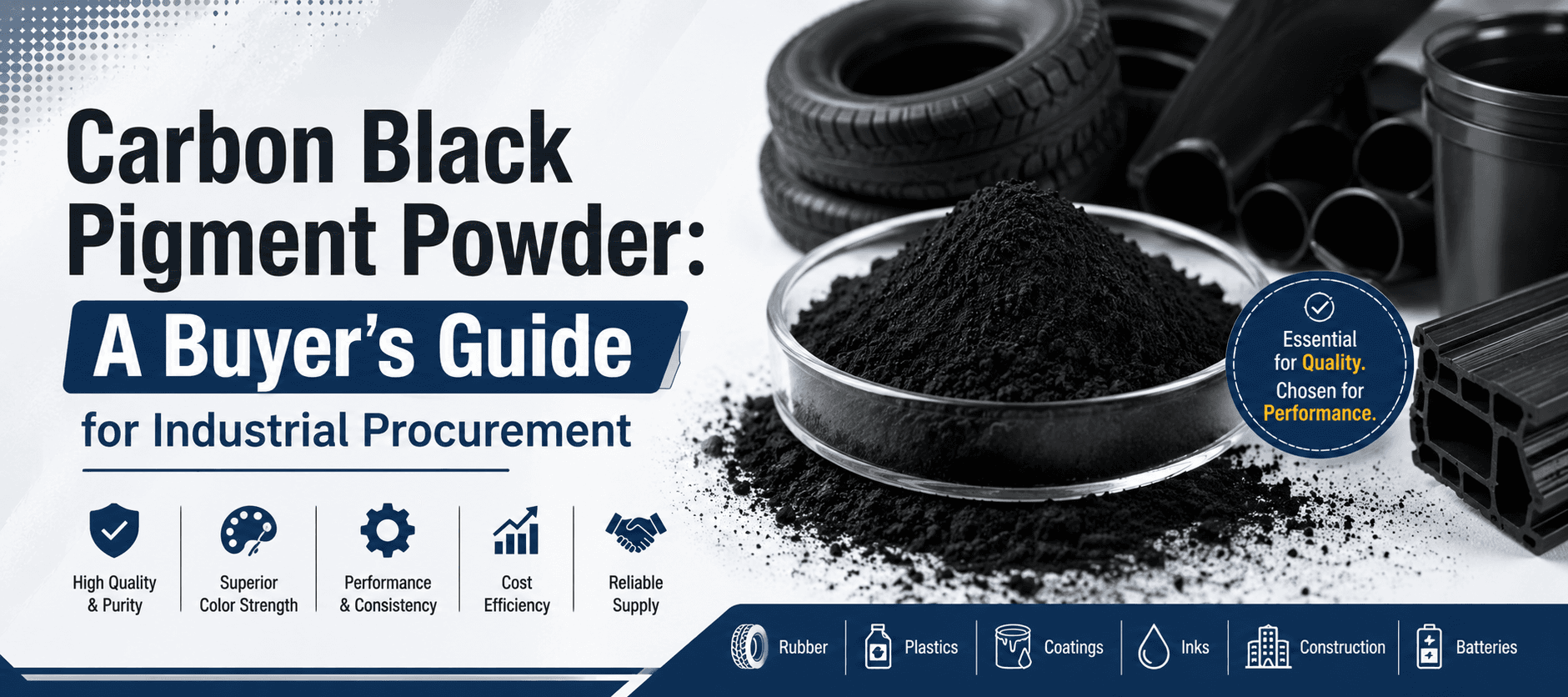
If you're sourcing carbon black pigment powder for plastics, rubber, coatings, or ink production, the real work is matching the right grade to your process and vetting a supplier who can deliver it consistently, on spec, on time. This guide covers both.
Quick Answer (TL;DR)
Carbon black pigment powder is an elemental-carbon pigment made by controlled combustion or thermal decomposition of hydrocarbons, supplied in multiple grades (including N220, N330, N550, and N660-series furnace blacks) that differ in particle size, tinting strength, and surface chemistry. For procurement, the decision isn't "carbon black or not." It's which grade, at what spec tolerance, from which supplier, since grades typically range from ultra-fine, high-tint powders for coatings and inks to coarser, reinforcing grades for rubber and tires.
What Is Carbon Black Pigment Powder?
Carbon black pigment powder is a fine black powder produced through the controlled incomplete combustion or thermal decomposition of hydrocarbons, resulting in near-pure elemental carbon particles. It's not a single product; it's a category of grades, and the grade you specify determines color strength, UV performance, conductivity, and reinforcement behavior in your finished product. Manali Pigments' carbon black range spans N220, N234, N326, N330, N339, N375, N550, N660, and N762 grades across coating, plastic, and rubber/tire applications. For a deeper breakdown of how these grades differ, see our guide on carbon black pigment grades and industrial uses.
The specs that actually differentiate grades and suppliers:
|
Spec |
What it affects |
Typical range* |
|
Particle size |
Color strength, dispersion |
~10-500 nm depending on grade |
|
Tinting strength |
Cost-per-part (dosage rate) |
Varies by grade |
|
Ash content |
Purity, high-spec applications |
Lower is generally better |
|
pH |
Dispersion behavior in your resin/binder |
~6-9 typical |
|
Iodineumber / surface area |
Reinforcement, UV performance |
Grade-depndent |
*These are general industry ranges, not a specific product spec. Always request your supplier's actual Certificate of Analysis, not published ranges. See Manali Pigments' quality and compliance standards for what to expect from an ISO 9001:2015-certified source.
Why Grade Selection Is a Procurement Decision, Not Just a Technical One?
Two suppliers quoting "carbon black pigment powder" at different prices are often quoting different grades, and the cheaper quote isn't automatically the cheaper input cost. This is where procurement and R&D need to align before an RFQ goes out:
- Cost-per-part vs. cost-per-kg. A higher-tint-strength grade often costs more per kilogram but requires a lower dosage rate. Model cost-per-finished-unit, not just unit price, before comparing quotes.
- Application fit. Coatings and inks generally need fine, high-tint grades; rubber and tire applications need coarser, reinforcing grades; conductive/antistatic applications need specialized conductive grades. Specifying the wrong grade category isn't a discount, it's a rework risk. See our head-to-head N330 vs N550 performance comparison for a concrete example of how grade choice plays out in practice.
Where Carbon Black Pigment Powder Is Used?
- Plastics: HDPE pipe, packaging, containers, automotive parts, cable sheathing, where UV resistance is often the deciding factor
- Rubber and tires: tires, belts, seals, where it also functions as a reinforcing agent, not just a colorant
- Coatings and inks: high color intensity, hiding power, weather durability, clean dispersion and gloss
- Conductive/antistatic materials: specialized conductive grades for electronic packaging and battery components
See the full product and application breakdown for grade-by-application mapping. If you know your end application, that alone should narrow your grade shortlist before you request quotes. Most wasted RFQ cycles come from requesting quotes on the wrong grade category.
How Global Pricing Get Decided?
Expect quotes to vary based on:
- Grade. Fine, high-tint grades price higher per kg than standard/coarse grades.
- Volume tier. Bulk and jumbo-bag pricing vs. standard 25 kg bag pricing.
- Packaging. 25 kg bags, jumbo bags, or bulk tanker/rail, depending on volume.
- Freight and origin. Landed cost from the manufacturing region to your US/Canada/LATAM facility, including port handling and any applicable duties.
- Regulatory documentation. Suppliers providing full compliance documentation sometimes price slightly higher than undocumented sources; that premium is usually worth it.
Ask every supplier for pricing broken out by these variables, not a single blended number. It's the only way to compare quotes apples-to-apples.
Supplier Vetting: What to Require Before You Order
- Certificate of Analysis (COA) for the specific lot: particle size, ash content, pH, tint strength, volatile content
- Sample quantity for in-house dispersion and compatibility testing before committing to a production order
- Regulatory documentation relevant to your market, e.g. TSCA (US), CEPA (Canada), or REACH-equivalent frameworks in Latin American jurisdictions. Check that your supplier is ISO 9001:2015 certified at minimum.
- MOQ and lead time, both for trial orders and standing production volumes
- Batch-to-batch consistency data, not just a single COA; ask for a spec range across recent lots
- Export track record. A Star Export House-recognized supplier with an established manufacturing infrastructure is a reasonable proxy for consistent large-volume fulfillment
- In-house testing capability. Suppliers with their own application lab and R&D team can typically troubleshoot dispersion or compatibility issues faster than a pure trading intermediary
- Backup/second-source availability for the same grade, so a single supplier issue doesn't stop your line
The same evaluation logic applies across pigment categories, not just carbon black; see our general guide on how to evaluate a pigment supplier if you're sourcing more than one pigment type.
Talk to a Pigment Expert before your next RFQ.
Buyer's Checklist (Save Before Your Next RFQ)
- Confirmed end-application and required grade category
- Requested COA and sample for internal testing
- Confirmed MOQ, lead time, and packaging options
- Requested pricing broken out by grade, volume tier, and freight
- Verified regulatory documentation for destination market
- Identified a backup/second-source supplier for the same grade
Explore Manali Pigments' full carbon black pigment range for current grades and specs, or read more about our 36+ years of manufacturing experience.
Related Buying Guides
If your procurement scope covers more than carbon black:
- Carbon Black Pigment: Grades & Industrial Uses
- Carbon Black N330 vs N550: Performance Comparison
- Phthalocyanine Pigment Guide for Industrial Buyers
- How to Evaluate a Pigment Supplier
FAQs
What is carbon black pigment powder? Carbon black pigment powder is a fine black powder made from the controlled incomplete combustion or thermal decomposition of hydrocarbons, used in plastics, rubber, coatings, inks, and masterbatches for color, UV protection, and reinforcement.
What grades of carbon black pigment powder are available? Common grade families include furnace black, channel black, thermal black, and lamp black. Manali Pigments supplies N220 through N762-series grades across coating, plastic, and rubber/tire applications; see our grades and industrial uses guide for the full breakdown.
What's a typical MOQ for carbon black pigment powder? MOQs vary by grade and supplier; bulk or jumbo-bag orders typically carry lower per-kg pricing than smaller 25 kg bag orders. Confirm both trial-order and standing-order MOQs directly with our team.
Is carbon black pigment powder electrically conductive? Standard grades are not conductive. Specialized conductive grades are available for antistatic materials, conductive plastics, and battery components; confirm grade before ordering if conductivity is required.
How does carbon black pigment powder compare to other black pigments? It offers higher UV resistance, tinting strength, and (in specialized grades) electrical conductivity compared to mineral-based alternatives like iron oxide, which trades those properties for better heat resistance and lower cost. The right choice depends on your specific application and processing conditions.
What documentation should I request before ordering internationally? At minimum, a Certificate of Analysis and regulatory compliance documentation for your destination market (e.g., TSCA for the US, CEPA for Canada). Manali Pigments' quality and compliance standards are available on request. Ask before issuing a PO, not after.
Have specs to match or need a sample for testing? Talk to a Pigment Expert.