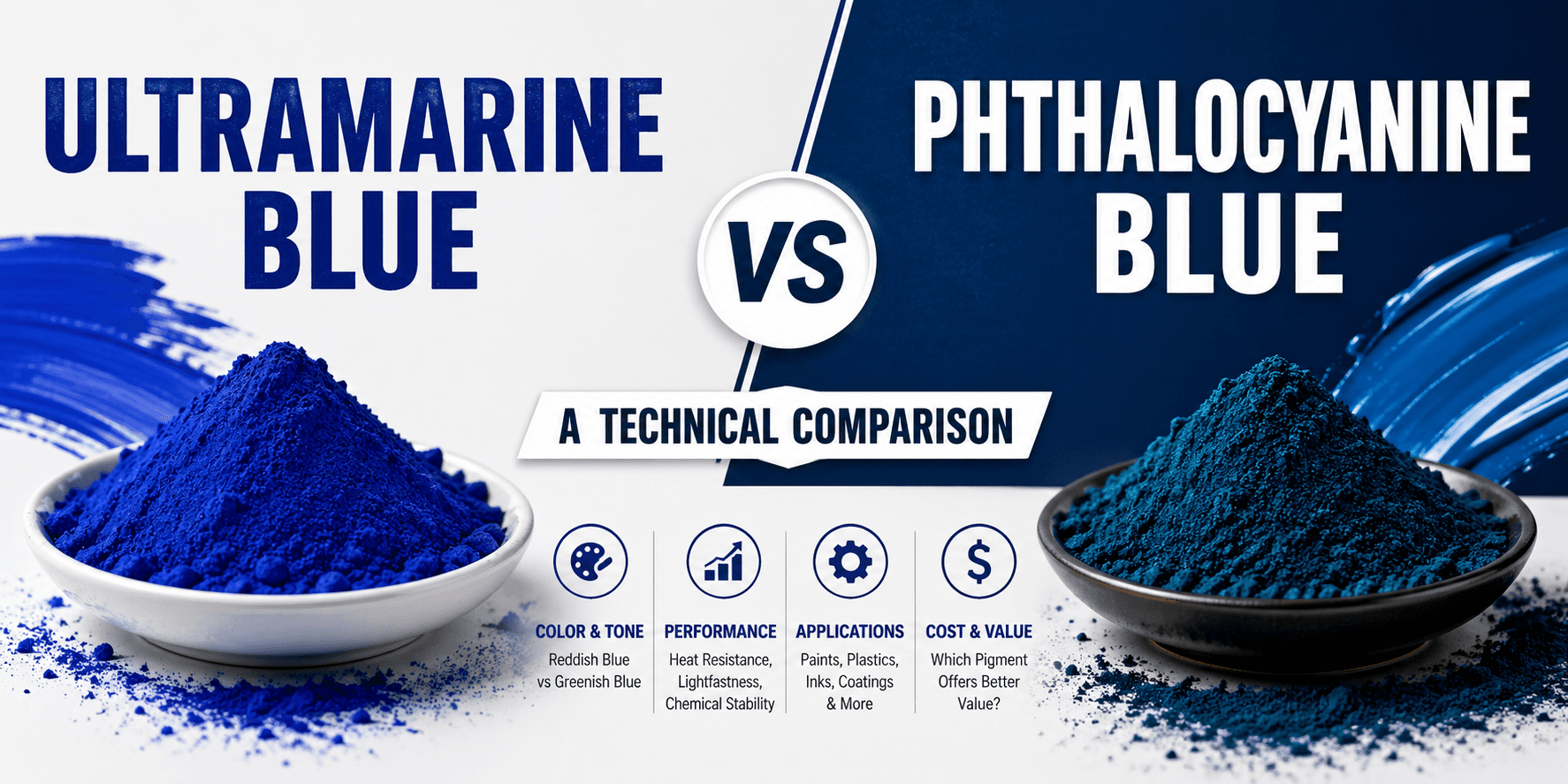
Blue pigments are essential across multiple industries, from paints and coatings to plastics, textiles, and detergents. Among the most widely used are ultramarine blue and phthalocyanine blue pigments. While both offer visually appealing blue tones, they differ significantly in composition, strength, durability, and industrial performance.
Understanding these differences is important for manufacturers, exporters, and B2B buyers who want to optimize both product quality and cost efficiency. In this blog, we provide a detailed technical comparison of ultramarine blue and phthalocyanine blue, along with their applications and benefits.
What is Ultramarine Blue?

Ultramarine blue is an inorganic pigment made from sodium aluminum silicate containing sulfur. Historically derived from lapis lazuli, today it is produced synthetically to ensure consistency and affordability.
The color ultramarine blue is known for its slightly reddish tone, making it ideal for applications where brightness and whitening effects are required.
To better understand its core properties, here are the key features:
- Bright and clean reddish-blue shade
- Excellent heat resistance, especially in plastics
- Good opacity and coverage
- Non-toxic and environmentally safe
- Cost-effective for large-scale industrial use
These characteristics make ultramarine blue paint highly suitable for industries that require stable color performance under heat and cost constraints.
Applications of Ultramarine Blue
Before exploring its industrial usage, it is important to see where this pigment performs best:
- Detergents and laundry whitening agents
- Plastic and polymer manufacturing
- Decorative paints and coatings
- Textile processing
After reviewing these applications, it becomes clear that ultramarine blue is widely used where brightness correction and affordability are key factors.
Before choosing the right pigment, it’s useful to understand how ultramarine blue performs across global industries.
What is Phthalocyanine Blue?

Phthalocyanine blue pigment, also known as blue phthalocyanine, is an organic pigment based on copper phthalocyanine. It is widely recognized for its intense color strength and superior durability.
Unlike ultramarine, this pigment produces a deeper, greenish-blue tone with very high tinting strength.
To understand its capabilities, here are the main features:
- Strong, deep blue with green undertone
- Exceptional tinting strength
- Excellent lightfastness and weather resistance
- High chemical stability
- Superior dispersion in various media
Because of these properties, phthalocyanine blue is commonly used in high-performance and premium applications.
Applications of Phthalocyanine Blue
Before moving to comparison, let’s look at its key industrial uses:
- Printing inks and packaging
- Automotive and industrial coatings
- High-performance plastics
- Textile and specialty coatings
After analyzing these uses, it is evident that phthalocyanine blue pigment is preferred where durability and color intensity are critical.
To get a clearer picture of demand and industrial growth, explore how phthalocyanine blue is shaping Argentina’s pigment market.
Ultramarine Blue vs Phthalocyanine Blue: Key Differences
Before diving into technical selection, the following table highlights the major differences between both pigments:
|
Feature |
Ultramarine Blue |
Phthalocyanine Blue |
|
Type |
Inorganic pigment |
Organic pigment |
|
Shade |
Reddish blue |
Greenish blue |
|
Tinting Strength |
Moderate |
Very high |
|
Heat Resistance |
Excellent |
Moderate |
|
Lightfastness |
Good |
Excellent |
|
Chemical Resistance |
Moderate |
High |
|
Cost |
Economical |
Premium |
|
Opacity |
Good |
Transparent to semi-transparent |
After reviewing the table, it becomes clear that both pigments serve different industrial purposes depending on performance requirements.
If you’re sourcing phthalocyanine blue pigment in bulk, understanding technical parameters and supplier standards is essential.
Technical Performance Comparison
To make a more informed decision, let’s break down their performance in real-world applications.
1. Color Strength and Appearance
Before evaluating application, understanding color behavior is essential:
- Phthalocyanine blue pigment offers very high tinting strength, meaning a small quantity produces strong color.
- Ultramarine blue provides a softer, more subtle tone, making it ideal for balancing and whitening.
After this comparison, it is clear that phthalocyanine is better for bold colors, while ultramarine is better for tone correction.
2. Heat Stability
Before selecting pigments for plastics or high-temperature processes, heat resistance is critical:
- Ultramarine blue performs exceptionally well under high temperatures.
- Blue phthalocyanine may degrade or shift in shade under extreme heat.
After evaluating heat performance, ultramarine is the preferred choice for plastic and polymer industries.
3. Chemical and Light Resistance
Before using pigments in outdoor or chemical-heavy environments, durability must be considered:
- Phthalocyanine blue offers excellent resistance to chemicals and UV exposure.
- Ultramarine blue provides moderate resistance but may not perform as well in harsh environments.
After this evaluation, phthalocyanine clearly leads in durability and long-term exposure applications.
Just like ultramarine and phthalocyanine blue, carbon black pigments vary by grade, structure, and performance. Read our complete guide on carbon black pigment grades.
Industrial Use Case Comparison
Before making a final selection, it is helpful to compare where each pigment performs best:
- Choose ultramarine blue paint for detergents, plastics, and cost-sensitive applications
- Choose phthalocyanine blue pigment for inks, coatings, and high-performance requirements
After reviewing these use cases, the selection becomes straightforward based on application needs and budget.
Why Choose Manali Pigments Private Limited?

When it comes to sourcing high-quality ultramarine blue, choosing the right pigment manufacturer is crucial.
Manali Pigments Private Limited is a leading manufacturer and exporter known for delivering consistent and high-performance pigments to global markets.
Before finalizing a supplier, consider the advantages they offer:
- Consistent color ultramarine blue quality across batches
- 36+ years of pigment manufacturing expertis
- Advanced manufacturing with strict quality control
- High brightness and excellent dispersion properties
- Competitive pricing for bulk industrial supply
- Strong export capabilities for international clients
After evaluating these benefits, it is clear that Manali Pigments provides a reliable solution for industries seeking both quality and cost efficiency.
Conclusion
Both ultramarine blue and phthalocyanine blue pigment are essential in modern industrial applications, but they serve different purposes.
Before making a decision, businesses must evaluate their specific requirements:
- Choose ultramarine blue for heat stability, affordability, and whitening applications
- Choose phthalocyanine blue for superior color strength, durability, and premium finishes
After understanding these differences, manufacturers can make informed decisions that improve product performance while optimizing costs.
FAQs
1. What is the main difference between ultramarine blue and phthalocyanine blue pigment?
The main difference lies in their composition and performance. Ultramarine blue is an inorganic pigment with good heat resistance and a reddish tone, while phthalocyanine blue pigment is an organic pigment known for its strong tinting strength, durability, and greenish-blue shade.
2. Which pigment has better color strength?
Before choosing a pigment, it is important to consider color intensity. Phthalocyanine blue has significantly higher tinting strength compared to ultramarine blue, meaning a smaller quantity gives a stronger color effect. After comparison, phthalocyanine is the better choice for vibrant and deep shades.
3. Is ultramarine blue suitable for high-temperature applications?
Before using pigments in plastics or polymers, heat resistance matters. Ultramarine blue performs very well under high temperatures and is widely used in plastic and rubber industries. After evaluation, it is considered more heat-stable than blue phthalocyanine.
4. Which pigment is better for outdoor applications?
Before selecting pigments for outdoor use, lightfastness and weather resistance are key factors. Phthalocyanine blue pigment offers excellent resistance to UV rays and chemicals. After comparison, it is the preferred choice for outdoor coatings and automotive paints.
5. What is the typical use of ultramarine blue in detergents?
Before understanding its role, note that color ultramarine blue is used to neutralize yellow tones. It enhances the whiteness of fabrics by optical correction rather than actual bleaching. After use, clothes appear brighter and cleaner.
6. Which pigment is more cost-effective?
Before making bulk purchasing decisions, cost plays an important role.
Ultramarine blue is generally more economical compared to phthalocyanine blue pigment. After analysis, it is the better option for large-scale, cost-sensitive applications.
7. Can ultramarine blue and phthalocyanine blue be used together?
Before combining pigments, compatibility should be checked. Yes, both pigments can be blended to achieve specific shades and performance characteristics. After blending, manufacturers can balance cost, color strength, and durability