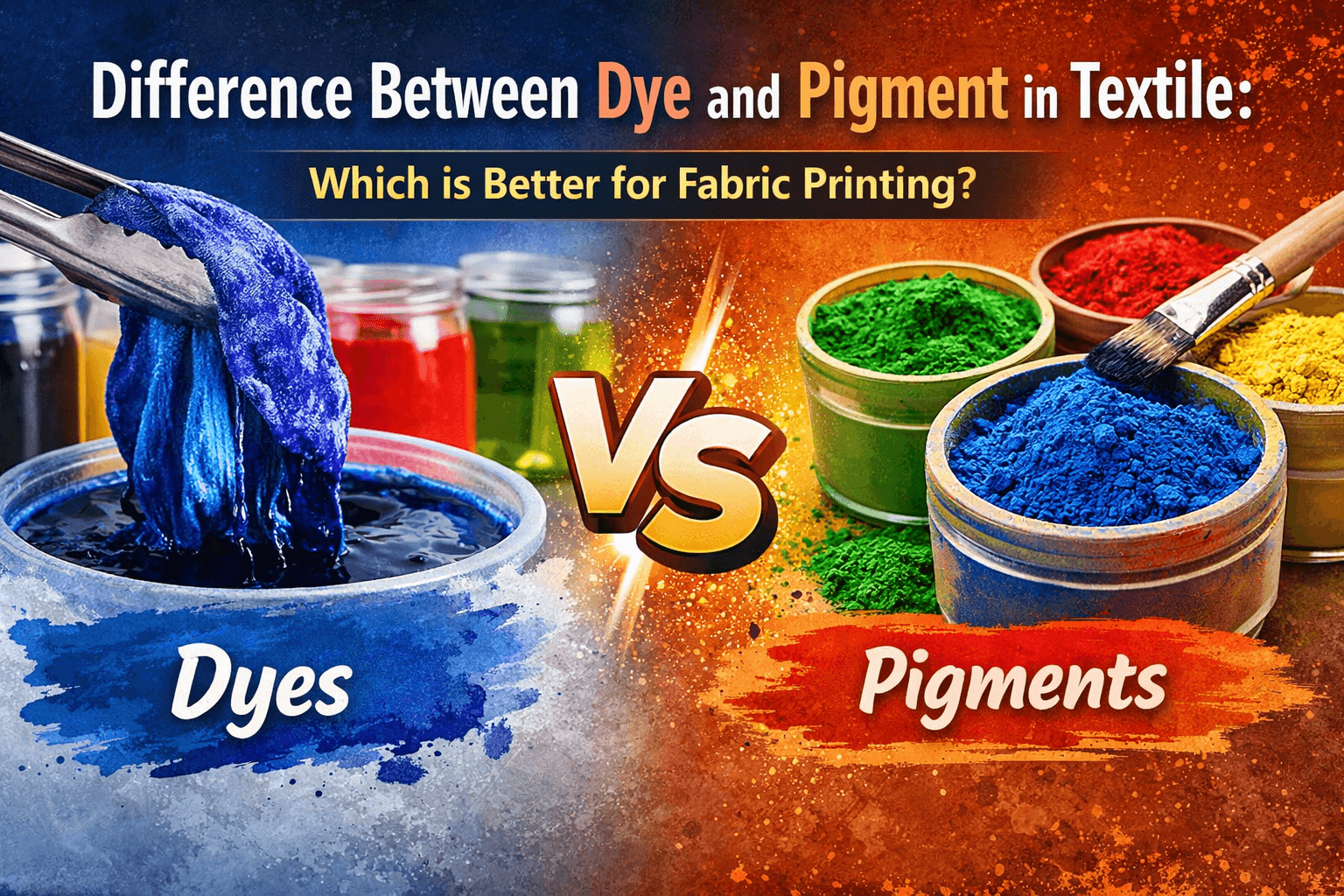
In the textile industry, choosing the right coloring method is crucial for achieving durability, vibrancy, and cost-efficiency. Two commonly used coloring agents are dyes and pigments. While they may seem similar, they function very differently in fabric applications. Understanding the difference between dye and pigment in textile helps manufacturers and buyers make better decisions, especially for fabric printing.
What Are Dyes in Textile?
Dyes are soluble colorants that chemically bond with fabric fibers. They penetrate deep into the material, resulting in long-lasting and vibrant colors.
Key Features of Dyes:
Dyes are widely preferred in textiles due to their strong fiber bonding and long-lasting color performance.
- Chemical bonding with fibers (cotton, wool, silk, etc.)
- High color fastness when processed correctly
- Soft feel since color becomes part of the fabric
- Requires water, heat, and chemicals for fixation
Common Uses:
Because of their deep penetration and vibrant results, dyes are commonly used in various textile coloring applications.
- Garment dyeing
- Tie-dye and batik
- Yarn and fiber coloring
If you're exploring global pigment trends, don’t miss this; learn why phthalocyanine green pigment demand is increasing in Argentina and what it means for manufacturers.
What Are Pigments in Textile?
Pigments are insoluble color particles that do not bond chemically with fibers. Instead, they are fixed onto the fabric surface using a binder.
Key Features of Pigments:
Pigments are valued in the textile industry for their versatility, ease of application, and compatibility with a wide range of fabrics.
- No chemical bonding with fibers
- Requires a binder to stick to the fabric
- Suitable for almost all fabric types
- Cost-effective and easy to apply
These advantages make pigments a preferred choice for modern textile printing, especially when sourcing from reliable pigment manufacturers in India known for quality and consistency.
Common Uses:
Due to their flexibility and efficiency, pigments are widely used in modern textile printing and large-scale production processes.
- Pigment printing in textile (t-shirts, home textiles)
- Printing on blended or synthetic fabrics
- Large-scale industrial printing
Curious about the growing demand for blue pigments in international markets? Learn how phthalocyanine blue is driving innovation in Argentina’s coatings and plastics sectors.
Difference Between Dye and Pigment in Textile
Understanding the difference between paint and pigment and dyes is essential in textile processing.
|
Feature |
Dyes |
Pigments |
|
Solubility |
Soluble in water |
Insoluble |
|
Bonding |
Chemically bond with fibers |
Sit on fabric surface |
|
Application |
Requires complex dyeing process |
Simple printing process |
|
Fabric Compatibility |
Fiber-specific |
Works on all fabrics |
|
Color Feel |
Soft and natural |
Slightly stiff (due to binder) |
|
Water Usage |
High |
Low |
|
Cost |
Higher |
More economical |
Want to explore how violet pigments enhance industrial applications? Discover the uses and benefits of ultramarine violet in detail in our guide on Ultramarine Violet Pigment Uses.
What is Pigment Dyeing in Textile?
What is pigment dyeing in textile? It refers to a process where pigments are applied to fabric using binders, creating a washed or vintage look. Unlike traditional dyeing, the pigment remains on the surface, giving a unique faded effect after multiple washes.
This technique is widely used in:
- Fashion garments
- Washed t-shirts
- Denim finishing
Pigment Printing in Textile: Why It’s Popular
Pigment printing in textile is one of the most widely used printing methods today.

Advantages:
Pigment printing has gained popularity in the textile industry due to its efficiency, versatility, and cost-effectiveness.
- Works on any fabric (cotton, polyester, blends)
- No need for pre-treatment
- Lower water consumption (eco-friendly option)
- Faster production cycles
- Ideal for bulk printing
Limitations:
Despite its many benefits, pigment printing also has a few limitations that manufacturers should consider.
- Slightly rough texture compared to dyes
- Lower wash durability if not properly fixed
Pigment Dyes in Textile: Are They the Same?
The term pigment dyes in textile can often create confusion among buyers and manufacturers. In reality, pigments and dyes are fundamentally different in how they interact with fabric.
Technically, pigments are not dyes. However, in the textile industry, this term is sometimes used informally to describe pigment-based coloring systems used in printing.
Key Takeaway:
Understanding this distinction is essential for choosing the right coloring method.
- Dyes = chemical bonding with fibers
- Pigments = surface coating using binders
Looking to expand into international pigment markets? Understand the opportunities and challenges in Mexico’s lead chromate industry.
Which is Better for Fabric Printing?
There is no one-size-fits-all answer, as the choice depends on your specific textile application and production requirements.

Choose Dyes When:
Dyes are ideal when quality, softness, and durability are the top priorities.
- You need deep penetration and softness
- Working with natural fibers like cotton or silk
- Long-term color durability is required
Choose Pigments When:
Pigments are preferred for efficiency, flexibility, and large-scale production.
- You want cost-effective printing
- Printing on multiple fabric types
- Fast production is important
- Eco-friendly (low water usage) processes are preferred
For most modern textile printing needs, pigments are considered a better choice due to their versatility, lower processing requirements, and overall efficiency.
Conclusion
Both dyes and pigments play a vital role in the textile industry. While dyes offer superior softness and fiber bonding, pigments dominate in printing due to their flexibility, lower cost, and sustainability benefits.
For businesses looking to optimize textile printing processes, choosing high-quality pigment solutions is essential. Manali Pigments Private Ltd. offers a wide range of premium pigment dispersions designed for textile applications. With consistent quality, excellent color strength, and reliable performance, they are a trusted partner for textile manufacturers worldwide.
FAQs
1. What is the main difference between dye and pigment in textile?
Dyes chemically bond with fabric fibers, while pigments sit on the surface and require a binder.
2. Is pigment printing better than dyeing?
For bulk printing and cost efficiency, pigment printing is better. For softness and durability, dyeing is preferred.
3. What is pigment in textile?
Pigment in textile refers to insoluble color particles used for printing or surface coloring of fabrics.
4. What is pigment dyeing in textile?
It is a surface coloring technique using pigments and binders to create a vintage or washed look.
5. Which is more eco-friendly: dye or pigment in textile?
Pigments are generally more eco-friendly than dyes because they require less water, fewer chemicals, and a simpler application process. Pigment printing reduces wastewater discharge, making it a sustainable choice for modern textile manufacturing.
6. Can pigment printing be used on all types of fabrics?
Yes, pigment printing in textile can be applied to almost all types of fabrics, including cotton, polyester, and blends. This versatility makes pigments a preferred option for large-scale and multi-fabric printing projects.
7. Does pigment printing last as long as dyeing?
Pigment printing can offer good durability when high-quality binders and proper curing methods are used. However, dyes generally provide better wash fastness since they chemically bond with the fibers.
8. What is the role of binders in pigment printing?
Binders play a crucial role in pigment printing by helping the pigment particles adhere to the fabric surface. Without binders, pigments would not stick to the textile, resulting in poor color retention