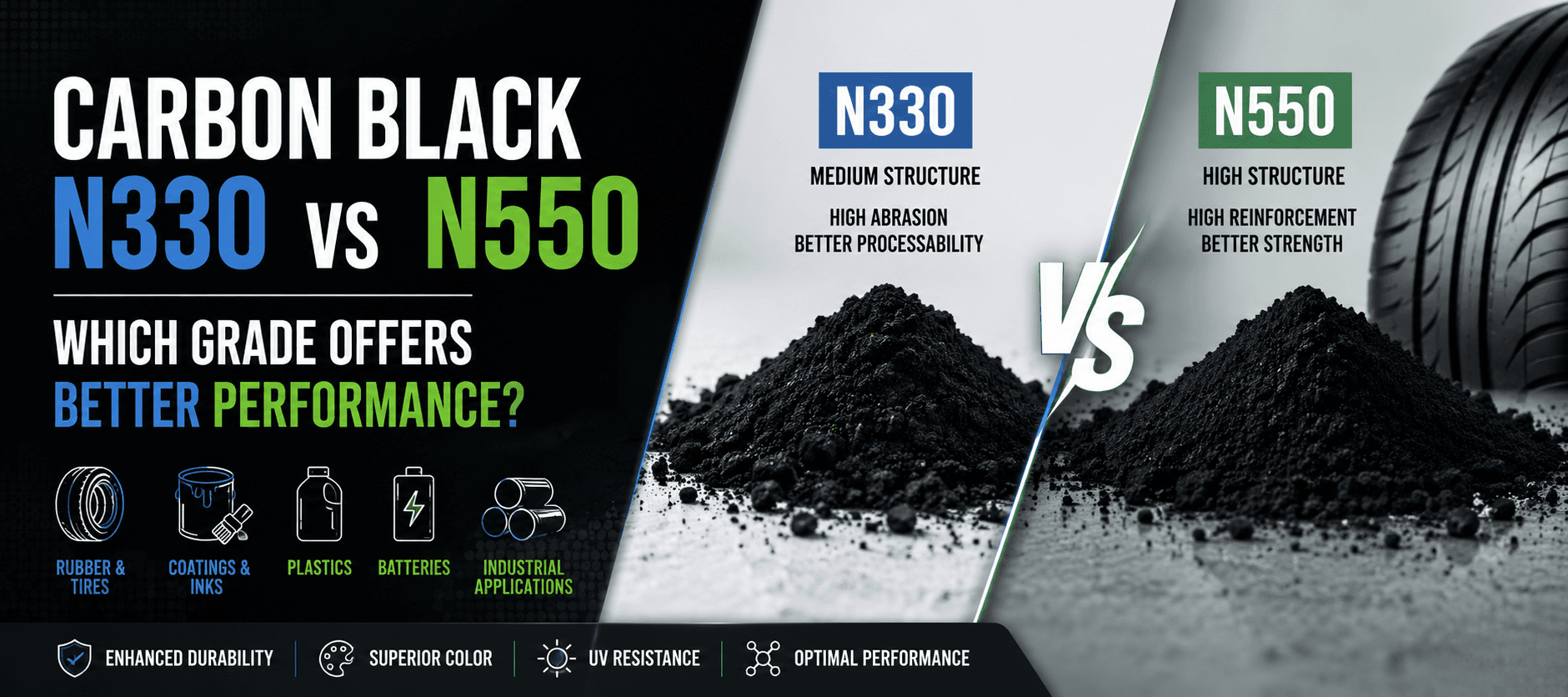
In the rubber and tire manufacturing industry, selecting the right carbon black grade can significantly impact product performance, durability, and cost efficiency. Among the most widely used grades, carbon black N330 and N550 stand out due to their versatile properties and broad industrial applications.
But which one delivers better performance?
The answer depends on your application requirements. While carbon black N330 is known for its superior reinforcement and abrasion resistance, N550 offers better processing characteristics and flexibility. Understanding the differences between these two grades helps manufacturers make informed decisions for tires, automotive parts, industrial rubber goods, and more.
In this guide, we'll compare N330 carbon black and N550 across key performance parameters, applications, and benefits.
Understanding Carbon Black Grades
Carbon black grades are classified according to ASTM standards, with each grade offering distinct particle size, structure, and reinforcing properties.
The "N" designation indicates a normal curing rate, while the accompanying numbers define specific characteristics such as:
- Surface area
- Particle size
- Structure
- Reinforcement capability
- Wear resistance
Among these grades:
- Carbon black N330 belongs to the High Abrasion Furnace (HAF) category.
- N550 belongs to the Fast Extrusion Furnace (FEF) category.
These classifications directly influence the final properties of rubber compounds.
Discover why manufacturers rely on carbon black pigments for high-quality packaging, labels, and industrial printing applications in this detailed resource.
What is Carbon Black N330?
Carbon black N330 is one of the most commonly used reinforcing carbon black grades in the rubber industry. It offers an excellent balance between tensile strength, abrasion resistance, and processing performance.
Key Characteristics of Carbon Black N330
- High reinforcement capability
- Excellent abrasion resistance
- Improved tensile strength
- Enhanced tear resistance
- Good fatigue performance
- Suitable for dynamic applications
Common Applications
- Passenger car tires
- Truck tires
- Tread compounds
- Conveyor belts
- Rubber hoses
- Industrial rubber products
Because of its strong reinforcing properties, N330 carbon black is often the preferred choice when durability and wear resistance are critical.
What is Carbon Black N550?
N550 is a medium reinforcing carbon black grade that offers lower reinforcement than N330 but provides improved processing and flexibility.
Key Characteristics of N550
- Moderate reinforcement
- Better extrusion performance
- Lower compound viscosity
- Improved flexibility
- Reduced heat build-up
- Enhanced resilience
Common Applications
- Tire carcasses
- Sidewalls
- Inner liners
- Rubber mats
- Molded rubber products
- Mechanical rubber goods
N550 is commonly selected when manufacturers prioritize processing ease and flexibility over maximum reinforcement.
Want to select the ideal carbon black pigment for plastics, coatings, inks, or electronics? Learn how each grade is engineered for specific industrial requirements.
Carbon Black N330 vs N550: Property Comparison
To better understand the performance differences between these two popular grades, the table below compares carbon black N330 and N550 across key properties that influence rubber compound performance, durability, and processing efficiency.
|
Property |
Carbon Black N330 |
N550 |
|
Reinforcement |
High |
Medium |
|
Abrasion Resistance |
Excellent |
Good |
|
Tensile Strength |
Higher |
Moderate |
|
Wear Resistance |
Superior |
Moderate |
|
Flexibility |
Moderate |
Better |
|
Heat Build-Up |
Higher |
Lower |
|
Extrusion Performance |
Good |
Excellent |
|
Processing Ease |
Good |
Very Good |
|
Dynamic Performance |
Excellent |
Good |
|
Cost Efficiency |
Performance-Oriented |
Processing-Oriented |
As the comparison shows, carbon black N330 excels in reinforcement, tensile strength, and abrasion resistance, making it the preferred choice for high-performance and wear-intensive applications. In contrast, N550 offers advantages in processing, flexibility, and heat management, making it well-suited for products where manufacturing efficiency and resilience are key priorities.
Abrasion Resistance: Which Grade Performs Better?
When abrasion resistance is a top priority, carbon black N330 clearly outperforms N550.
Its smaller particle size and higher surface area create stronger interactions with the rubber matrix, resulting in:
- Longer service life
- Improved tread wear
- Better resistance to mechanical stress
- Enhanced durability under harsh conditions
This is why N330 carbon black is extensively used in tire tread compounds where continuous friction and road contact occur.
Winner: Carbon Black N330
Tensile Strength and Reinforcement
Reinforcement is one of the most critical factors when choosing a carbon black grade.
Carbon black N330 delivers:
- Higher modulus
- Better tensile strength
- Improved tear resistance
- Superior load-bearing capability
In contrast, N550 provides moderate reinforcement suitable for products that require flexibility and comfort rather than maximum strength.
Winner: Carbon Black N330
Looking for a pigment that can withstand harsh weather while maintaining its vibrant appearance? Learn why Chrome Oxide Green has become a trusted solution for exterior coating applications across Turkey.
Processing Performance
For manufacturers focused on production efficiency, N550 offers several advantages.
Benefits of N550 Processing
- Faster extrusion rates
- Easier mixing
- Improved compound flow
- Lower energy consumption during processing
Although carbon black N330 remains relatively easy to process, N550 provides a smoother manufacturing experience, particularly in large-scale production environments.
Winner: N550
Heat Build-Up and Flexibility
Applications involving continuous flexing often require lower heat generation.
N550 typically produces:
- Lower heat build-up
- Better resilience
- Improved flex fatigue resistance
These properties make it ideal for sidewalls, vibration control components, and flexible rubber products.
Meanwhile, N330 carbon black prioritizes reinforcement over flexibility.
Winner: N550
Tire Industry Applications
Carbon Black N330 in Tires
Because of its outstanding wear resistance and reinforcement, carbon black N330 is commonly used in:
- Tire tread compounds
- Heavy-duty tires
- Performance tires
- Commercial vehicle tires
N550 in Tires
N550 is often selected for:
- Tire sidewalls
- Tire carcasses
- Inner components
- Flexible rubber sections
Many tire manufacturers use both grades within different parts of the same tire to achieve an optimal balance of durability and performance.
Known for its exceptional color strength, weather resistance, and durability, Phthalocyanine Blue is gaining traction among manufacturers in Argentina. Explore the factors driving this market growth.
Which Grade Offers Better Overall Performance?
The answer depends on your application goals.
Choose carbon black N330 when you need:
- Maximum abrasion resistance
- High tensile strength
- Superior reinforcement
- Longer product lifespan
- Enhanced wear resistance
Choose N550 when you need:
- Better processing efficiency
- Greater flexibility
- Lower heat build-up
- Improved resilience
- Cost-effective production
For demanding applications where durability and wear performance are critical, carbon black N330 generally delivers superior overall performance.
Conclusion
Both carbon black N330 and N550 are valuable grades with distinct advantages. However, when comparing overall reinforcement, abrasion resistance, tensile strength, and durability, carbon black N330 emerges as the stronger performer.
On the other hand, N550 remains an excellent choice for applications requiring flexibility, resilience, and easier processing.
By understanding the strengths of each grade, manufacturers can optimize rubber compound performance, improve product quality, and maximize long-term value.
Looking for premium-quality carbon black products? Contact Manali Pigment today to discover the right grade for your industrial application.
FAQs
1. What is the main difference between carbon black N330 and N550?
The primary difference lies in their reinforcing capabilities. Carbon black N330 offers higher reinforcement, better abrasion resistance, and improved tensile strength, while N550 provides better flexibility, lower heat build-up, and easier processing.
2. Is carbon black N330 suitable for tire tread applications?
Yes. Carbon black N330 is widely used in tire tread compounds because of its excellent wear resistance, durability, and ability to enhance tire life under demanding road conditions.
3. Which grade provides better abrasion resistance, N330 or N550?
N330 carbon black provides significantly better abrasion resistance than N550. This makes it a preferred choice for products exposed to continuous friction and mechanical wear.
4. Why do manufacturers use N550 in rubber compounds?
Manufacturers use N550 because it offers improved processing performance, better flexibility, lower compound viscosity, and reduced heat generation during operation.
5. Can N330 and N550 be used together?
Yes. Many rubber and tire manufacturers combine carbon black N330 and N550 in different compound formulations to balance reinforcement, flexibility, durability, and processing efficiency.
6. Which carbon black grade is better for industrial rubber products?
The choice depends on the application. Carbon black N330 is ideal for products requiring high strength and wear resistance, while N550 is better suited for flexible rubber goods and components that experience repeated bending or vibration.
7. Does carbon black N330 improve tensile strength?
Yes. N330 carbon black enhances tensile strength, tear resistance, and modulus, making it suitable for high-performance rubber applications.
8. Which carbon black grade is more commonly used in the tire industry?
Both grades are widely used. Carbon black N330 is commonly used in tire treads, while N550 is often used in sidewalls, carcasses, and other tire components that require flexibility and lower heat build-up